Unifying AI Agent Architectures: Amazon DynamoDB Native Vector Search Eliminates Database Fragmentation and Simplifies Infrastructure

The modern enterprise software landscape has long been plagued by architectural fragmentation, particularly for engineering teams building sophisticated artificial intelligence agents. Historically, operational data—such as user profiles, transaction logs, and structural metadata—resided within high-performance key-value data stores like Amazon DynamoDB. Concurrently, high-dimensional vector embeddings required for semantic search, similarity matching, and retrieval-augmented generation (RAG) had to be routed to purpose-built vector databases or dedicated search clusters. This multi-database approach introduced notable engineering friction: elevated infrastructure expenditures, complex synchronization pipelines, and a persistent window of data staleness during asynchronous updates.
Addressing these pervasive infrastructure challenges, Amazon Web Services (AWS) announced the general availability of native vector search capabilities within Amazon DynamoDB. Launched globally, this breakthrough feature allows development teams to store vector embeddings directly alongside operational data within the exact same DynamoDB table structure. By utilizing the newly introduced SearchVectors API operation, systems can now execute approximate nearest neighbor (ANN) searches and standard key-value lookups concurrently. For organizations leveraging conversational AI, this means that orchestrators like Amazon Bedrock can execute both structured CRUD (create, read, update, and delete) operations and natural language semantic retrieval from a singular, unified data source.
Background Context and Technological Evolution
To understand the magnitude of this architectural shift, one must examine the rapid evolution of generative AI applications over the preceding years. As foundational models and large language models (LLMs) transitioned from experimental prototypes to mission-critical production systems, the demand for low-latency, highly scalable memory architectures skyrocketed. AI agents require rapid access to vast repositories of internal documentation, runbooks, and enterprise knowledge bases to deliver accurate, contextual responses.
Previously, meeting this requirement meant deploying and managing complex hybrid architectures. A typical technical knowledge management platform relied on DynamoDB for document IDs and administrative metadata, while simultaneously maintaining a separate vector index via Amazon OpenSearch Service or external vector engines. Keeping these two distinct storage layers synchronized necessitated complex event-driven pipelines, typically powered by Amazon DynamoDB Streams linked to intermediate worker functions. Any network latency, processing bottleneck, or service degradation in the synchronization pipeline resulted in stale retrieval results, directly degrading the performance of the downstream AI agent.
The introduction of native vector search fundamentally alters this paradigm. By collapsing dual-storage architectures into a single-table design, AWS has effectively removed an entire tier of operational overhead. Engineers no longer need to provision, scale, and monitor separate vector clusters or write custom reconciliation scripts to ensure data consistency between operational tables and vector indices.
Technical Implementation and Solution Architecture
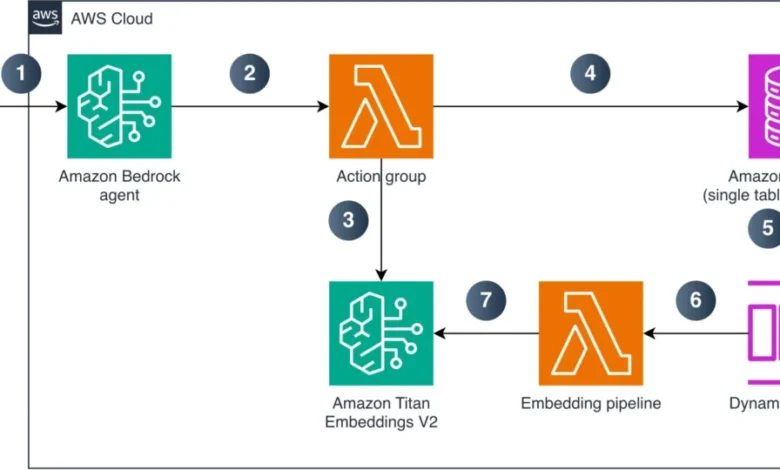
Implementing a unified AI agent architecture using DynamoDB vector search relies on a cohesive integration of several core AWS cloud services. At the center of the solution is a single-table DynamoDB schema utilizing a composite primary key—comprising an entity identifier as the partition key and a sort key for item versioning. Embeddings are stored natively as lists of floating-point numbers within the item attributes.
The workflow begins when an end-user submits a natural language query to an Amazon Bedrock agent. The agent acts as the primary orchestrator, evaluating the user’s intent and routing the request to designated AWS Lambda action groups. Depending on the user’s prompt, the Lambda function either executes a standard structured lookup via DynamoDB’s CRUD APIs or initiates a semantic search by invoking the SearchVectors API.
For semantic queries, the system must first transform the natural language text into a high-dimensional vector. This is accomplished by calling foundation models such as Amazon Titan Text Embeddings V2, which generates normalized, 1024-dimensional vectors. The resulting vector is passed directly into the DynamoDB SearchVectors operation, which evaluates the embeddings against the table’s vector index using cosine distance metrics. Lower distance scores indicate higher semantic similarity, allowing the system to return the most relevant enterprise documents instantaneously.
Automating Index Synchronization via DynamoDB Streams
Maintaining real-time synchronization between operational record updates and the underlying vector index is critical for maintaining agent accuracy. The architecture resolves this challenge through an automated event-driven pipeline powered by Amazon DynamoDB Streams.
Whenever an item within the DynamoDB table undergoes an INSERT or MODIFY operation, a DynamoDB Streams trigger invokes an embedding pipeline Lambda function. This function intercepts the data change, evaluates the text content, and utilizes Amazon Titan Text Embeddings V2 to generate a fresh vector representation. The updated vector is then written directly back to the respective item.
Crucially, production implementations of this pipeline must incorporate safeguards against infinite recursion loops. Because the embedding generation function writes an update back to the same table item, it risks triggering a continuous cycle of stream events. Engineers mitigate this by embedding logical guards that compare the content field of the old and new table images. If only the embedding attribute has changed while the core textual content remains identical, the function gracefully terminates execution. Furthermore, configuring event source mappings with batch item failure reporting and dead-letter queues ensures high fault tolerance and reliable error handling during high-throughput ingestion phases.
Strategic Use Cases and Industry Implications
The financial and operational implications of native vector search in DynamoDB are substantial for enterprises scaling generative AI initiatives. By eliminating the necessity to license, manage, and scale external vector databases, organizations can achieve significant cost reductions. Infrastructure footprints shrink, network hops between disparate database endpoints are eliminated, and overall system latency drops.
Industry analysts and cloud architects note that this pattern is particularly advantageous for knowledge management systems, customer support automation, enterprise search engines, and multi-tenant software-as-a-service (SaaS) platforms. For instance, in a technical documentation repository where support engineers query internal runbooks using natural language, the unified architecture delivers rapid, reliable document retrieval while minimizing operational complexity.
However, architects must carefully evaluate data access patterns and cardinality before deployment. Selecting an appropriate partition key for the vector index—such as a category identifier or a tenant ID in multi-tenant workloads—is essential for maintaining balanced throughput scaling. Excessively low-cardinality keys can concentrate data into a narrow subset of partitions, while overly fragmented keys prevent effective neighbor comparisons.
Security, Compliance, and Governance
Deploying AI agents that interact with enterprise data stores mandates rigorous security postures. Within this unified DynamoDB architecture, security is enforced through granular AWS Identity and Access Management (IAM) policies, resource-based permissions, and encryption at rest using AWS Key Management Service (KMS).
Action group Lambda functions operate under strict least-privilege principles, possessing only the permissions required to execute specific CRUD operations and invoke the SearchVectors API. Furthermore, all data transmissions between Amazon Bedrock, Lambda, and DynamoDB remain encrypted within the secure AWS backbone network. Compliance teams benefit from the simplification of audit trails; because operational data and vector embeddings reside within the same managed table, governance policies, backup schedules, and data residency compliance frameworks can be applied uniformly across the entire dataset.
Future Outlook and Ecosystem Adoption
As organizations increasingly demand agile, cost-effective infrastructure to support advanced artificial intelligence workloads, the convergence of operational and vector data storage represents a major milestone in cloud database design. The general availability of native vector search in Amazon DynamoDB bridges a long-standing architectural divide, empowering developers to construct robust, high-performance AI agents with unprecedented simplicity.
Engineering teams looking to adopt this pattern can access complete, deployment-ready implementations via open-source repositories such as the AWS sample-dynamodb-vector-search-architecture project on GitHub. By adapting table schemas, embedding dimensions, and agent instructions to specific domain requirements, enterprises can accelerate their AI adoption roadmaps while maintaining lean, efficient cloud architectures.
Related posts: