Truckload Market Remains Resilient as Tender Rejections Hold Near 13.5% Heading Into Q4

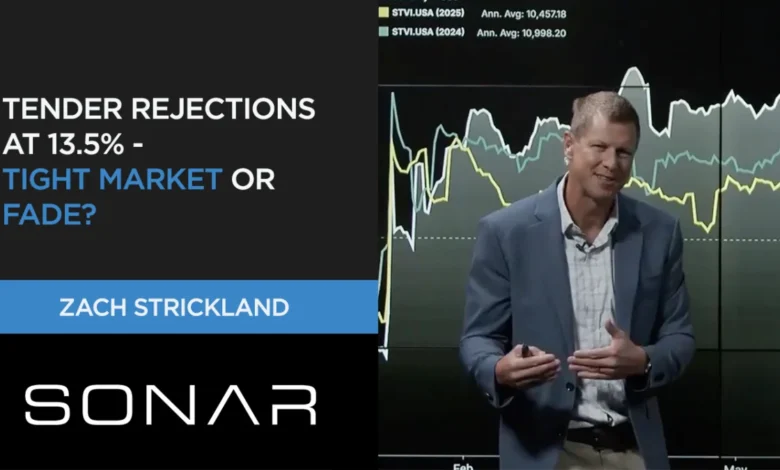
The North American truckload market is exhibiting notable resilience as the industry transitions into the final quarter of the year. According to market data analyzed by Zach Strickland and highlighted in recent SONAR updates, the Outbound Tender Rejection Index (OTRI) hovered at 13.45% as of mid-September. This figure remains significantly elevated compared to historical averages from prior years, signaling a persistently tight operating environment for carriers, brokers, and shippers alike. While spot rates have experienced a minor cooling off following a robust Labor Day surge, the structural tightness of the market continues to defy typical seasonal softening.
Industry stakeholders are closely monitoring these metrics to gauge the trajectory of freight movement for the remainder of the year. As the market digests the post-holiday adjustments, the key question is no longer whether capacity will tighten—that outcome is largely assumed—but rather the rate of change and how external pressures, such as rising diesel costs and lean inventories, will intersect with consumer demand as the peak holiday shipping season approaches.
Analyzing the Post-Labor Day Freight Landscape
The Labor Day holiday traditionally serves as a critical inflection point for the U.S. freight economy, often triggering a temporary spike in tender rejections as shippers scramble to move loads ahead of factory and distribution center closures. However, the magnitude of the post-Labor Day bump observed this year was markedly more pronounced than in any of the previous three years. This sharp upward movement in rejection rates underscores a fundamental baseline shift in how carriers are managing their capacity and pricing network commitments.
Despite the initial holiday-driven surge pulling back slightly, the OTRI’s refusal to drop significantly below the mid-13% threshold indicates that underlying capacity remains constrained. Carriers are exercising increased discipline, rejecting contracted loads that fail to meet margin expectations or moving trucks toward more lucrative spot market lanes.
“It’s still going to be tight, I think, for the rest of the year. That’s not in question. It’s just the rate of change that I think we’re really interested in at this point,” Strickland noted during his market update, emphasizing that the velocity of market shifts will dictate operational strategies for the coming months.
Demand Dynamics and Modal Shifts
On the demand side of the equation, the SONAR Tender Volume Index (OTVI)—which tracks a seven-day moving average of all accepted and rejected tender volumes—has displayed a softer trajectory since mid-July. This moderation in over-the-road volume is not necessarily a sign of a collapsing consumer economy, but rather the result of strategic supply chain adjustments made by shippers.
A primary driver behind this softness has been modal conversion. Faced with persistent macroeconomic pressures and a desire to optimize transportation spend, many enterprise shippers have actively shifted long-haul freight moves away from traditional dry van trucking and toward intermodal rail networks. This trend has been particularly visible along East Coast corridors, where expanded rail intermodal capacity has successfully absorbed a substantial share of long-haul volume that would have otherwise strained over-the-road carrier networks.
Nevertheless, baseline demand remains remarkably resilient. Even with the shift toward intermodal transport, current volume troughs are sitting comfortably above the comparable periods recorded last year, pointing to a steady, if controlled, flow of goods moving through domestic supply chains.
Inventory Risks and Q4 Urgency
Perhaps the most critical variable for the upcoming fourth quarter is the current state of commercial inventories. Throughout much of the year, supply chain managers have maintained lean inventory strategies to mitigate carrying costs and hedge against uncertain consumer demand patterns. While this approach has successfully reduced warehousing overhead, it introduces substantial operational risk as the industry enters the holiday shopping season.
If retail demand experiences even a modest uptick during the golden quarter of holiday shopping, lean inventories could force shippers to resort to expedited trucking solutions to replenish stock rapidly. This scenario becomes even more acute as winter weather disrupts intermodal networks and rail options become less fungible with over-the-road trucking options.
The sharp post-Labor Day spike in tender volumes served as an early warning indicator that shipper urgency has returned to the market. Supply chain professionals are now racing to secure capacity before seasonal demand peaks, increasing the likelihood of localized capacity crunches and sudden rate volatility as October and November unfold.
Fuel Pressures and Cost Realities for Carriers
Compounding the supply-and-demand dynamics are mounting cost pressures, particularly regarding fuel. National spot rates, heavily influenced by surging fuel surcharges, continue to reflect the heavy financial burden placed on motor carriers. The National Truckload Index (NTI) for dry van spot rates has hovered around $3.43 per mile, a figure that incorporates steep fuel surcharges driven by rising retail diesel prices.
Retail diesel prices have been steadily climbing, pushing uncomfortably close to the $6-per-gallon threshold in many regions of the country. For asset-based carriers and owner-operators alike, fuel represents one of the most volatile and unavoidable operating expenses. Strickland highlighted that these rising diesel costs translate into an immediate financial impact for shippers, with fuel surcharge bills projected to trend upward over subsequent weekly billing cycles.
Sector-specific indices further illustrate this uneven cost and demand environment. While the Reefer Tender Index continues to experience consistent seasonal pressure driven by agricultural harvests and temperature-controlled shipping requirements, the Flatbed Tender Index has largely flatlined. This flatlining is entirely consistent with historical Q4 seasonality, during which construction and heavy-industrial shipping activity typically tapers off ahead of winter weather conditions.
Import Volumes and Regional Capacity Disparities
Supporting the thesis of lean supply chains are import volume trends tracked by the inbound container indices (IOTI). Import numbers remain elevated both relative to earlier periods this year and compared to historical seasonal norms. The steady influx of containerized freight arriving at major U.S. ports indicates that goods continue to flow into the domestic ecosystem, ensuring that distribution centers and warehouses will require sustained outbound transportation services to clear the influx.
However, a geographic examination of dry van spot rate maps reveals significant regional dispersion. Many individual shipping lanes continue to operate in negative territory, reflecting localized imbalances where outbound capacity outstrips available freight. Market analysts view these regional disparities as a temporary lagging indicator, suggesting that capacity has not yet fully normalized following the holiday disruptions, but anticipating a broader market rebalancing in the weeks ahead.
Broader Industry Implications and Future Outlook
As the freight transportation sector prepares for the culmination of the year, the convergence of high tender rejections, elevated diesel costs, lean inventories, and steady import volumes creates a complex matrix of operational challenges.
Shippers are advised to maintain close collaboration with core carrier partners, secure guaranteed capacity agreements early, and model various holiday demand scenarios to avoid costly spot market exposure. Meanwhile, motor carriers and freight brokers must carefully balance rate realization against volume commitments, ensuring their networks remain agile enough to capitalize on localized rate spikes without overextending equipment.
With industry leaders and technology innovators set to gather at upcoming events such as the Future of Freight Festival (F3) in Chattanooga, Tennessee, discussions surrounding brokerage compliance, fraud mitigation, and freight technology adoption will take center stage. As regulatory landscapes shift and market conditions evolve, the ability to leverage real-time data intelligence—such as the metrics provided by SONAR—will remain a critical differentiator for organizations navigating the complexities of the modern freight economy.