Critical Security Flaw in Zimbra Collaboration Suite Exploited by Threat Actors to Facilitate Large-Scale Data Exfiltration

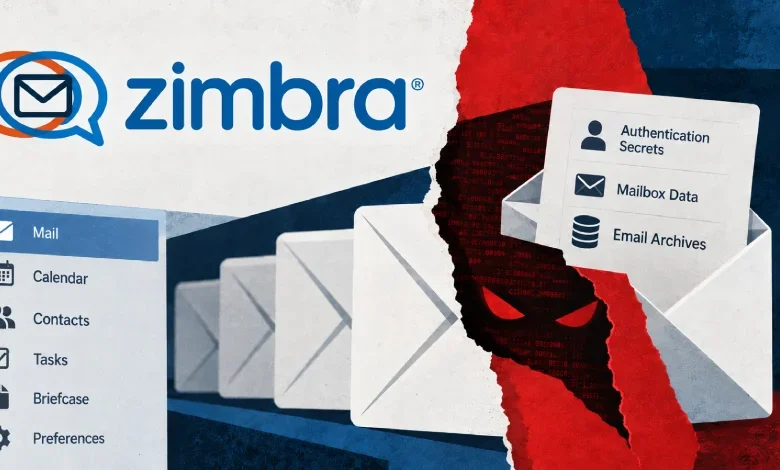
The global cybersecurity landscape faces renewed scrutiny following the discovery of a sophisticated exploitation campaign targeting the Zimbra Collaboration Suite (ZCS), a widely utilized email and collaboration platform. Microsoft’s Security Research team has confirmed that threat actors have been actively weaponizing a critical, now-patched operating system command injection vulnerability, identified as CVE-2026-73570, to gain unauthorized access to enterprise-grade mailbox infrastructure. With a CVSS severity score of 8.9, this vulnerability represents a significant risk to organizations that rely on Zimbra for mission-critical communications, as it allows for unauthenticated remote code execution (RCE) under specific, yet common, configuration parameters.
Anatomy of the Vulnerability: CVE-2026-73570
The vulnerability stems from an insecure handling of Simple Network Management Protocol (SNMP) notifications within the Zimbra architecture. Specifically, the flaw exists when the optional zimbra-snmp package is installed and SNMP notifications are enabled. An attacker can trigger the injection by transmitting a specially crafted SMTP request to an internet-facing Zimbra server. Because the exploit does not require authentication or user interaction, it provides a low-barrier, high-impact entry point for malicious actors.
Once the command injection is successful, the attackers execute payloads with the privileges of the "zimbra" service account. This level of access grants the intruder broad visibility into the internal workings of the mail server, enabling the deployment of JSP (JavaServer Pages) web shells, the establishment of persistent reverse shells, and the ability to pivot deeper into the host network.

A Chronology of the Exploitation Campaign
The timeline surrounding this incident underscores the rapid transition from discovery to widespread exploitation. While Zimbra released a patch in the form of version 10.1.20 in July 2026, the window between the patch release and the public disclosure of the vulnerability became a prime hunting ground for threat actors.
- July 20, 2026: Zimbra officially releases version 10.1.20, addressing the command injection flaw.
- July 28 – August 7, 2026: Microsoft telemetry data indicates that two distinct, out-of-band scanning tools were actively probing internet-facing Zimbra servers to validate the injection path. These probes were diagnostic in nature, designed to confirm reachability without triggering an immediate follow-on payload.
- August 13, 2026: Public disclosure of the vulnerability occurs, providing a roadmap for opportunistic attackers.
- Late August 2026: The Polish Computer Emergency Response Team (CERT Polska) issues an urgent warning, detailing signs of compromise such as suspicious service restarts and unauthorized file modifications in web application directories.
- August 24, 2026: The U.S. Cybersecurity and Infrastructure Security Agency (CISA) adds CVE-2026-73570 to its Known Exploited Vulnerabilities (KEV) catalog, mandating that all U.S. federal agencies remediate the flaw by this deadline.
Sophistication and Persistence: The Attacker’s Playbook
Microsoft researchers have categorized the observed attack activity as highly methodical. The actors do not simply rely on a single point of entry; they prioritize redundancy and stealth. Following the initial injection, attackers have been observed deploying multiple JSP web shells across various Jetty and mailboxd application paths. This ensures that even if one shell is identified and removed by security teams, the attacker retains a back door to the server.
The post-exploitation phase involves a complex array of tools designed to maintain long-term control. In several campaigns, attackers utilized a "Zimdown2" Go-based binary, which serves as a dropper for the "Zimclient2" remote-access agent. Zimclient2 is a robust, multi-functional tool that supports WebSocket, TLS, and raw TCP transports, facilitating bidirectional file operations and SOCKS5 proxying. This allows attackers to tunnel traffic through the compromised Zimbra server, effectively masking their presence and creating a bridge for network lateral movement.
To ensure persistence, the attackers employed diverse techniques, including the creation of systemd services, the modification of cron jobs, the injection of shell startup files, and the addition of rogue SSH authorized keys. In some instances, they performed "permission scrubbing"—temporarily granting write access to public directories to deploy payloads and then reverting permissions to their original state to evade basic security audits.

Data Exfiltration and Operational Impact
The ultimate objective of the threat actors appears to be the systematic harvesting of sensitive data. By extracting service-account credentials from the "/opt/zimbra/conf/localconfig.xml" file, attackers gain the ability to authenticate against the Zimbra MySQL and LDAP instances. This access allows them to export entire databases, including user configuration, mail-rule artifacts, and, most critically, the contents of individual mailboxes.
Microsoft documented at least one instance where an attacker attempted to leverage the "AzCopy" utility to exfiltrate archived mailbox data to an external Azure Blob storage container. While the evidence does not definitively prove the success of every exfiltration attempt, the intent is clear: the attackers are treating these servers as centralized repositories of high-value intelligence. The involvement of automated tools to compress and stage these files suggests that the campaign is aimed at large-scale, automated theft rather than isolated incidents.
Broader Implications for Enterprise Security
The exploitation of CVE-2026-73570 highlights several critical weaknesses in modern enterprise network defense. First, it demonstrates the danger of "time-to-patch" delays. Organizations that did not apply the July 2026 update within the first few weeks were left vulnerable to automated scanning tools that acted as a precursor to more severe intrusions.
Second, the use of memory-resident payloads—such as the abuse of memfd_create—shows that attackers are increasingly aware of forensic tools that look for disk-based artifacts. By executing code directly in memory, attackers can bypass traditional endpoint detection and response (EDR) solutions that primarily scan the filesystem.

Finally, the incident reinforces the risks associated with peripheral services. The Zimbra SNMP package, while useful for administrative monitoring, provided the necessary attack vector for this entire campaign. This serves as a reminder of the "principle of least functionality": if a component, service, or feature is not strictly required for business operations, it should be disabled or uninstalled to reduce the overall attack surface.
Mitigation and Remediation Strategies
Security professionals are urged to move beyond simple patching if they suspect their environment may have been compromised during the active exploitation window. The following steps are recommended:
- Immediate Patching: Ensure all Zimbra instances are updated to the latest version. Patching is the only way to permanently close the command injection vector.
- Audit for Web Shells: Conduct a thorough sweep of the
/opt/zimbra/directory, specifically focusing on Jetty and mailboxd web application paths, for unrecognized JSP or executable files. - Review Service Logs: Examine
/var/log/zimbra.logfor anomalous activity, specifically looking for unexpected service restarts or unauthorized command executions tied to thezimbraservice account. - Credential Rotation: If a compromise is suspected, assume all service account credentials, LDAP secrets, and administrator passwords have been harvested. A full rotation of these secrets is essential.
- Configuration Hardening: If immediate patching is not possible, disable the
zimbra-snmppackage and restrict network-level access to SNMP and SMTP ports to known, trusted management IPs only. - Network Monitoring: Implement stricter egress filtering to block connections to unknown or unauthorized cloud storage endpoints, such as those used in the AzCopy exfiltration attempt.
As of this writing, the identity of the threat actor remains unknown. The lack of clear attribution, combined with the professional-grade tooling and the cross-industry nature of the targets, suggests a well-resourced group capable of adapting to various security environments. Organizations must treat these findings as a catalyst for a broader security review, ensuring that their mail infrastructure—the backbone of corporate communication—is shielded from both known vulnerabilities and emerging, persistent threats.
Related posts: