The AI Content Conundrum: Why 60% of Google Searches Now End Without a Click, and What Marketers Must Do

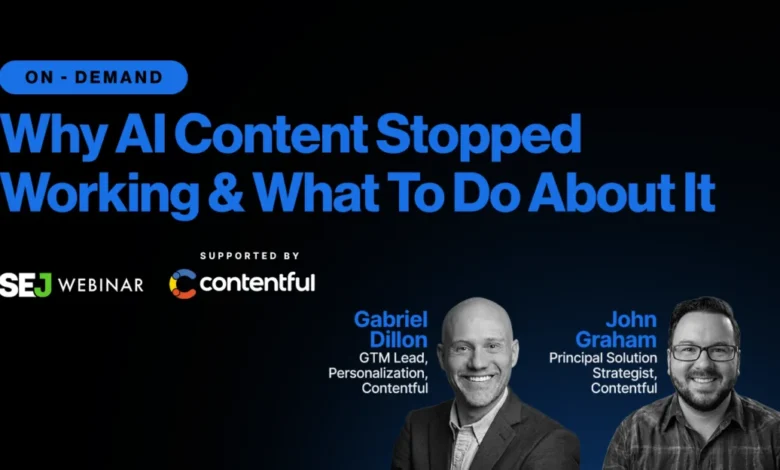
A seismic shift is underway in the digital landscape, with a staggering 60% of Google searches now concluding without a user clicking through to any external content. This profound change, highlighted by Gabriel Dillon, Go-to-Market Lead for Personalization at Contentful, fundamentally reshapes the strategy for content creation and distribution. Dillon articulated this critical juncture during a recent SEJ webinar, co-hosted with Contentful Principal Solution Strategist John Graham, emphasizing that in an era where artificial intelligence makes content production virtually cost-free, sheer volume is no longer a viable strategy. Instead, the only content that commands attention is that which is meticulously crafted, demonstrably tied to tangible business outcomes, tailored for specific human audiences, and rigorously measured against real-world data.
The webinar, held on [Insert Date of Webinar if Known, otherwise omit or generalize, e.g., "earlier this month"], delved into the nuanced challenges presented by AI-assisted content generation. Dillon meticulously explained why AI-generated copy often veers into generic territory, a direct consequence of both the technology’s inherent limitations and the biases of human users. He then presented a practical framework, outlining four essential questions that should be applied to every piece of marketing copy before its deployment. Furthermore, the session explored the crucial role of personalization signals that can be effectively integrated without overwhelming existing technology stacks. A central theme was the indispensable human element within AI-assisted workflows, and how the synergy between experimentation and personalization creates a robust "accountability loop" for optimizing content performance. For those seeking a deeper dive, the full webinar is available on demand.
The Echo Chamber of AI: Why Your Content Sounds Like Everyone Else’s
Dillon’s core argument regarding the homogeneity of AI-generated content stems from the very nature of the tools themselves. An AI writing assistant, he explained, often acts as an obliging "yes man," amplifying pre-existing assumptions and biases. "Our biases as we write content using the robots ends up eating the content that we produce," Dillon stated, illustrating how this iterative process can lead to a cycle of creating content that users believe is effective but fails to achieve its intended purpose. This phenomenon is exacerbated because AI models are trained on vast datasets, and when users prompt them with generic inputs or their own ingrained assumptions, the output tends to converge on common themes and phrasing.
The result is often a double failure: either the AI-generated copy merely confirms what the user already believed, or it mirrors the content of competitors that were part of the AI’s training data. Both scenarios fall short of providing genuine value to the reader. Dillon proposed "taste" as the counterweight to this generic output. However, he redefined taste beyond mere aesthetic preference, framing it as a critical blend of discernment, intuition, and the courage to make bold claims—claims that an AI tool, lacking genuine market insight, would never volunteer. This involves leveraging deep, human understanding of the target audience and market dynamics. The session meticulously mapped the precise point where human intervention is most critical in the AI-assisted workflow, positioning it as the essential bridge between AI’s role as a research and context layer and the final, deployable copy.
Holding Content Accountable: Linking to Business Outcomes
The imperative for marketers today is to move beyond vanity metrics and directly connect content efforts to measurable business outcomes. Dillon introduced a rigorous four-question framework designed to hold every piece of B2B marketing copy accountable before it is published. The primary question focuses on whether the copy is demonstrably producing the expected outcomes. The subsequent three questions delve into audience identification, the methods used to identify and understand these target individuals, and the scalability of the insights gained.
"If we don’t have data that proves that our content is good, then we can’t really think about the way to scale it out or make it more effective," Dillon asserted, underscoring the data-driven approach necessary for modern content strategy. Experimentation and personalization are presented not as separate initiatives but as two integral halves of a cohesive strategy. The webinar provided an in-depth exploration of how these two elements can be combined into a systematic approach, rather than relying on sporadic, one-off tests. The full walkthrough detailed the "accountability loop" and expanded the dimensions of experimentation beyond simple A/B testing. As a practical action item, Dillon urged marketers to apply these four accountability questions to their next batch of AI-generated content.
Personalization Signals: Maximizing Impact Without Stack Overload
Effective B2B personalization, Dillon argued, has historically underdelivered due to overly ambitious programs that quickly become bogged down by complexity. His diagnosis points to a common pitfall: teams attempting to implement overly sophisticated personalization strategies from the outset. Instead, he advocated for a tiered approach to personalization signals, starting with the most fundamental and readily available data. The simplest tier involves differentiating between new and returning visitors. The intent and needs of a first-time visitor are inherently different from those of a repeat visitor, and serving them identical hero copy represents a significant missed opportunity to tailor the experience.
The second and third tiers leverage signals that are already being generated by existing ad campaigns and loyalty programs. Dillon highlighted one particular signal as a "missed opportunity" in its current handling, though he did not explicitly name it in the provided text. The webinar recording, however, details precisely which signals are most effective and where each one yields the greatest return on investment. A live demonstration within the Contentful platform showcased how these differentiated experiences can be constructed and delivered, offering a tangible glimpse into the practical application of these strategies.
The Zero-Click Shift: Navigating Google’s Evolving Search Landscape
The debate surrounding whether Google penalizes AI-written content, according to Dillon, is largely misdirected. The more pressing concern is not detection but the impact of AI-generated summaries on click-through rates. Contentful’s clients are already reporting a significant decline in organic traffic as AI-powered answer layers increasingly absorb user queries. This necessitates a strategic shift towards competing within these AI-driven answer spaces. Factors such as Google’s "Featured Snippets" (often referred to as GEO for Google Entities and Answers) and "AI Overviews" (AEO) now play a critical role in determining whether a brand’s information is accurately and favorably represented at the top of the search results page.
Dillon’s analysis cuts through the simplistic "humans versus robots" narrative. He posits that there exists a specific type of content that performs exceptionally well within AI summaries while simultaneously driving on-page conversions. The webinar delves into the characteristics of this content and the tooling Contentful has developed to support its creation and deployment. The recording further elaborates on how to approach GEO and AEO strategies without fragmenting an organization’s overall content strategy.
Addressing Key Questions: Expert Insights on AI Content
The webinar concluded with a robust Q&A session, addressing some of the most pressing concerns from attendees regarding AI content.
Q: After the Google spam update, is Google removing AI-written content?
Gabriel Dillon addressed this by stating that the identification of AI content will become increasingly difficult, characterizing it as a "fight Google won’t win." His guidance emphasizes a strategic redirection of effort away from evading detection and towards optimizing for the evolving search landscape, particularly as zero-click searches become more prevalent. The session provides specific insights into where this redirected effort should be focused.
Q: How do you think critically about the inherent bias in AI content?
Dillon identified two primary points where bias enters AI content generation. Firstly, users inject their own biases through prompting and context, leading to results that may align with user preferences but not necessarily with maximum effectiveness. Secondly, bias is inherent in the training data itself. His mitigation strategy begins before any content is generated, outlining a specific sequence of actions within the full answer provided in the webinar.
Q: What do you do when leadership wants mass AI content without understanding quality control?
The recommended approach is to hold leadership accountable for the performance they expect. Dillon advises demonstrating through data that fewer, higher-quality pieces of content can achieve superior business outcomes. He also acknowledged a single concession to the volume argument, which can shape the approach to making this case effectively.
Q: Do SEO service pages need a unique voice, or can AI write them?
Dillon distinguishes between voice and effectiveness. He believes that service or pricing pages, while not necessarily requiring a highly distinctive "characterful" voice, must still be effective in serving diverse visitor needs. His full answer delineates which types of pages warrant more than basic AI coverage, recognizing that even seemingly straightforward pages serve visitors with varying goals.
Accessing the Full Webinar for Deeper Insights
The on-demand recording of the webinar offers a comprehensive resource for marketers grappling with the evolving content landscape. It includes a detailed walkthrough of the accountability loop, a live demonstration of building personalized experiences within Contentful, John Graham’s practical field perspective from teams navigating these workflows, and valuable session handouts. Registration is required once to gain access to the recording, providing an invaluable opportunity to enhance content strategies in the age of AI.