Stitch Fix Restructures Private-Label Strategy to Drive Revenue Growth and Deepen Customer Loyalty

Personalized online styling pioneer Stitch Fix is undergoing a strategic operational evolution, pivoting toward a narrower yet deeper portfolio of in-house private-label brands. By streamlining its collection and leveraging advanced artificial intelligence alongside direct client feedback, the company aims to capture a larger share of wallet among inflation-weary consumers. This calculated maneuver comes at a critical juncture for the online retail sector, where e-commerce platforms and traditional brick-and-mortar establishments alike are leaning heavily on proprietary lines to boost margins, enhance product differentiation, and secure long-term brand loyalty.
The Evolution of the Portfolio: Narrowing Down to Scale Up
For much of its corporate history, Stitch Fix maintained a sprawling catalog of in-house brands designed to address various apparel niches. However, according to Amy Sullivan, Vice President of Buying and Private Brands, company leadership recognized a fundamental disconnect between traditional retail segmentation and modern consumer behavior. Rather than compartmentalizing clothes into rigid categories like strictly workwear or casual weekend attire, contemporary shoppers demand versatile pieces that adapt fluidly to multifaceted, dynamic lifestyles.
Consequently, Stitch Fix initiated a strategic consolidation. During fiscal year 2025, the company managed a portfolio of 16 private-label brands. By fiscal year 2026, that number was trimmed down to 10 core brands. Yet, while the total number of brands decreased, the operational scope within each surviving brand expanded significantly. Instead of merely offering shirts and trousers, Stitch Fix widened its product architectures to encompass comprehensive lifestyle categories, including footwear, jewelry, handbags, belts, and specialized cold-weather accessories.
This "narrow and deep" methodology allows the merchandising teams to focus design resources on high-converting essentials. Brands such as 41 Hawthorn, Market & Spruce, Montgomery Post, We Wander, and 01.Algo are no longer bound by single-category limitations. By integrating accessories and non-apparel items into these established lines, Stitch Fix is positioning itself as a comprehensive, one-stop shopping destination for its 2.277 million active clients.
A Chronological Look at Private Labels at Stitch Fix
The current emphasis on proprietary brands represents the maturation of an operational strategy that began shortly after the company’s inception. Understanding the trajectory of Stitch Fix’s private-label program highlights how deeply embedded these lines have become in the company’s financial architecture.
- 2011: Stitch Fix is founded by Katrina Lake, pioneering the personalized styling subscription model that merges human curation with data science.
- 2013: The company introduces its inaugural women’s private-label brands, establishing an initial framework for proprietary margins and exclusive trend capture.
- 2016: Building upon the success of the women’s segment, Stitch Fix expands its private-label portfolio to include men’s collections, such as the activewear-leaning brand 01.Algo.
- 2018: The company further broadens its demographic reach by launching kids’ private labels, eventually making proprietary lines dominant across multiple age brackets.
- 2025–2026: Facing a shifting macroeconomic landscape, Stitch Fix slashes its brand count from 16 down to 10 while aggressively expanding into non-apparel categories like bags, footwear, belts, and seasonal accessories.
Today, this chronology of expansion has yielded profound results. Within the women’s and kids’ divisions, the top three best-selling brands are entirely proprietary. In the men’s division, private labels claim three spots among the top five best-performing brands, demonstrating that clients are actively seeking out these exclusive labels by name.
Data-Driven Design and the Integration of Artificial Intelligence
What separates Stitch Fix’s private-label development from traditional apparel manufacturing is its symbiotic relationship with client data and cutting-edge artificial intelligence. With millions of active users generating continuous feedback loops through professional stylists, the company possesses an exceptionally clear view of inventory gaps in the market.
Stitch Fix employs AI tools to aggregate and summarize macro-level fashion trends from global fashion capitals, including New York, Paris, and London, based on visual data captured by company scouts. Merchandising experts then run targeted AI prompts to accelerate the initial design phase
—requesting specific fabric attributes, such as stretch-friendly, non-itchy yarns, or functional design layouts.
Once initial concepts are generated, the platform utilizes proprietary engagement tools like "Style Shuffle." Through this feature, clients submitted more than 14 million ratings on nearly 2,800 distinct design images throughout the year, providing vital quantitative validation before a single garment enters full-scale production.
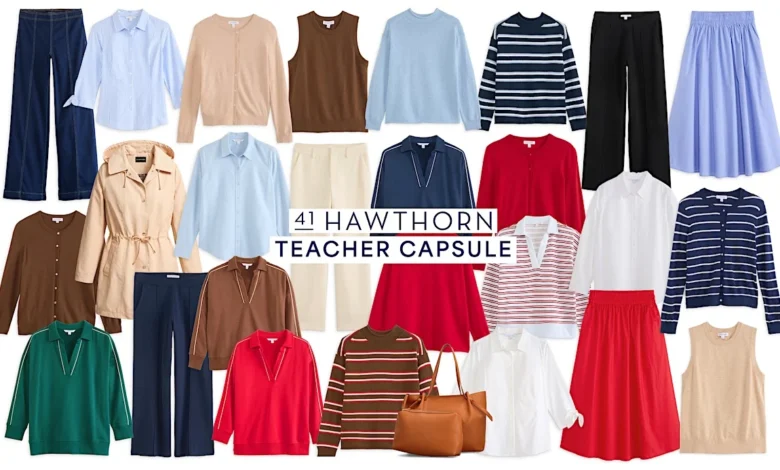
This responsive design mechanism was vividly demonstrated in August prior to the back-to-school shopping season. After analyzing feedback notes from over 5,000 clients working as teachers, Stitch Fix discovered that 57% of these professionals prioritized practical clothing attributes such as stretch, mobility, appropriate coverage, and functional pocket storage. Furthermore, 35% requested mix-and-match capsule options.
In response, the merchandising team swiftly engineered the 41 Hawthorn teacher-focused capsule collection. Items included 3/4-sleeve button-down shirts designed so educators would not need to physically roll up their sleeves when grading papers, alongside the "Lessons to Lounge Trouser" and the "Cozy Cash Cardigan." Machine-washable and highly practical, these items not only became top performers among educators but also resonated strongly with the broader customer base seeking versatile, durable work-casual attire.
Macroeconomic Tailwinds and the Rise of Retail Private Labels
Stitch Fix’s aggressive pivot toward private-label merchandise aligns with a broader structural shift across the entire retail ecosystem. As persistent inflation and macroeconomic uncertainty weigh on consumer spending, budget-conscious shoppers are increasingly willing to trade down from expensive national brands to high-quality store labels.
Market research underscores this behavioral evolution. A comprehensive 2025 survey conducted by Gartner revealed that 77% of respondents believe store and private-label brands match or even exceed the quality of name-brand equivalents. Across the retail landscape, legacy players are aggressively updating their proprietary portfolios. Walmart rolled out a sweeping modern redesign of its flagship Great Value brand, Aldi revamped its private-label packaging to appeal to design-conscious shoppers, and department store chain JCPenney reported that private labels account for over 50% of its total business, with its top-selling brand entirely in-house.
For Stitch Fix, private brands offer an essential advantage in maximizing the "cost-per-wear" metric for its users. By rigorously evaluating whether a garment can be worn multiple times a month without sacrificing durability or style, the company ensures high perceived value. This dynamic has contributed to strong year-over-year revenue growth in private labels, even as the broader retail environment remains volatile.
Financial Performance and Future Outlook
Stitch Fix reported solid fiscal metrics for the full year 2026, registering a 6.4% year-over-year revenue increase. For the fourth quarter ending in August, the company posted a net revenue per active client of $592, representing a 7.8% increase compared to the previous year.
However, executive leadership remains pragmatic about the horizon. Citing an increasingly challenging consumer environment, the company has cautioned that revenue growth may moderate in the coming fiscal year. Despite these headwinds, the private-label division remains a vital bulwark against margin compression.
As Stitch Fix heads into future holiday marketing campaigns and prepares to scale its collections into 2027, the primary metric of success will remain brand equity. When customers explicitly request private-label items by name through their styling notes, it serves as the ultimate validation of the company’s "narrow and deep" strategy. By maintaining a disciplined portfolio of versatile, high-intent brands backed by responsive AI and rich client data, Stitch Fix has engineered a resilient model designed to weather macroeconomic pressures while cementing long-term customer relationships.
Related posts: