OpenKruise Agents v0.6.0 Advances Kubernetes Sandbox Orchestration with Enhanced Security and Automated Lifecycle Management

OpenKruise Agents, a prominent sub-project within the Cloud Native Computing Foundation (CNCF) ecosystem, has officially released version 0.6.0. This milestone marks a significant shift in how infrastructure and platform teams manage high-scale sandbox environments on Kubernetes. By transitioning from a basic workload layer to a sophisticated architecture equipped with a dedicated data plane, the project addresses critical enterprise needs for network governance, security identity integration, and automated cost optimization.
Evolution of the OpenKruise Agents Framework
The OpenKruise Agents project originated as an extension of the broader OpenKruise initiative, which focuses on advanced application automation and workload orchestration. Since its inception, the project has aimed to bridge the gap between complex Kubernetes infrastructure and the specific requirements of AI algorithm engineers and platform architects.
The project’s development timeline reflects an aggressive pace of innovation. Version 0.3.0, released in May 2026, established the foundational capability for sandbox lifecycle management, addressing basic concerns such as resizing and accounting. However, it left open critical questions regarding network security and credential management. The v0.6.0 release serves as a direct response to these gaps, incorporating 283 merged pull requests from 27 new contributors. This surge in community participation underscores the growing demand for standardized, secure, and performant sandbox environments in the era of generative AI and automated agents.
Architectural Transformation: Introducing the Data Plane
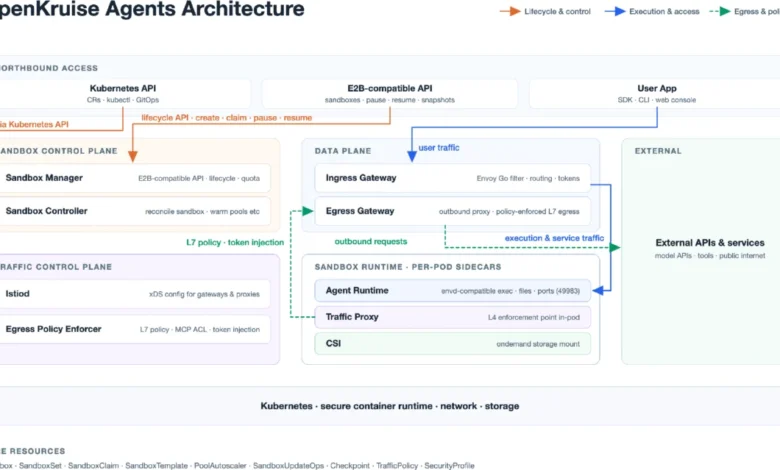
The most profound change in v0.6.0 is the evolution of the project’s architecture. The system has expanded from four core components to six, introducing the traffic-control-plane and the traffic-proxy.
In previous iterations, egress traffic management was often an afterthought or handled by external, decoupled add-ons. Version 0.6.0 integrates traffic inspection, policy distribution, and identity management as first-class citizens. The new architecture comprises:
- sandbox-manager: A stateless backend that governs the northbound API, managing lifecycle and route orchestration.
- sandbox-controller: Responsible for reconciling Sandbox, SandboxSet, and SandboxClaim objects, while managing admission webhooks.
- sandbox-gateway: An Envoy-based data plane that handles ingress routing and policy-driven egress enforcement.
- traffic-control-plane: Leverages Istio-derived xDS configurations to distribute policies and enforce L7 egress rules.
- agent-runtime: A sidecar that provides E2B-compatible environment operations.
- traffic-proxy: An in-pod L4 enforcement point that captures egress traffic before it reaches the broader network.
This architectural shift allows for granular control over egress traffic, moving the decision-making process away from the individual pod and into a centralized, policy-aware gateway.
Network Access Control and the Zero-Trust Mandate
The implementation of robust network access control represents the most complex technical hurdle cleared in this release. By adopting a two-stage traffic takeover strategy—node-side L4 filtering combined with centralized L7 inspection—OpenKruise Agents ensures that security is both performant and comprehensive.
L4 filtering occurs at the node level, providing low-latency blocking of unauthorized destinations. Meanwhile, L7 inspection happens at the gateway level, where the system can perform deep packet inspection, apply MCP (Model Context Protocol) tool-level access control lists, and inject credentials dynamically.
A notable feature is the secure credential injection mechanism. In typical cloud environments, API keys are often exposed within environment variables or configuration files, creating a significant security risk. In v0.6.0, sensitive credentials are held in Kubernetes Secrets and are injected by the egress proxy on a per-request basis. Consequently, the actual API keys never enter the sandbox environment, significantly reducing the blast radius of a potential compromise or prompt-injection attack.

Operational Efficiency: Upgrades, Autoscaling, and Lifecycle Automation
The release also introduces sophisticated operational machinery designed to reduce the overhead of managing thousands of transient sandbox instances.
CheckpointRestore and Upgrades:
Previously, upgrading a sandbox required a "Recreate" operation, which destroyed the existing pod and resulted in the loss of memory, network state, and root filesystem data. The new CheckpointRestore mode allows for the preservation of the rootfs during upgrades. Furthermore, the stateFilter mechanism allows administrators to perform batch upgrades on paused instances, ensuring that fleets remain up-to-date without necessitating a full, resource-intensive restart.
PoolAutoscaler:
Managing warm pools—pre-provisioned instances ready for immediate use—is a costly endeavor. The new PoolAutoscaler provides a declarative mechanism to manage pool capacity. By employing asymmetric stabilization windows (fast scale-up, slow scale-down) and integrating cron-based overrides, organizations can ensure that capacity is available during peak business hours while aggressively trimming costs during off-peak periods.
Automatic Pause/Resume:
To optimize compute costs, v0.6.0 introduces an idle-detection mechanism. By utilizing probes that monitor sandbox activity (such as active sessions or scheduled tasks), the system can automatically transition idle sandboxes into a "Paused" state. When a request arrives or a task is scheduled, the system initiates an automated wake-on-traffic procedure. This ensures that resources are not being billed for dormant workloads while maintaining a near-instantaneous experience for the end-user.
Industry Implications and Future Roadmap
The implications of these advancements are significant for organizations operating at the intersection of Kubernetes and AI. As businesses increasingly deploy LLM-based agents that require external tool access and secure data retrieval, the lack of standardized "sandbox guardrails" has become a bottleneck.
OpenKruise Agents v0.6.0 provides the necessary infrastructure to treat sandboxes as manageable, secure, and cost-efficient components of the broader application stack. By aligning with Kubernetes-native patterns—such as custom resource definitions (CRDs) for security profiles and traffic policies—the project lowers the barrier to entry for platform teams.
Looking ahead, the project maintainers have outlined a roadmap that emphasizes community collaboration. Future efforts will likely focus on:
- Integration with eBPF: Leveraging kernel-level observability to further reduce latency and increase the reliability of traffic interception.
- Expanded Protocol Support: Extending L7 inspection capabilities to cover a wider array of AI-specific protocols and gRPC-based tool interactions.
- Enhanced Multi-tenancy: Refining the isolation mechanisms to support even more complex, high-density multi-tenant environments where security posture must be strictly enforced across heterogeneous teams.
The transition of OpenKruise Agents into a more mature, data-plane-centric architecture signals a broader trend in the Kubernetes ecosystem: the movement toward "intelligent infrastructure" that understands the nature of the workloads it manages. By providing deep, policy-driven control over sandbox environments, the project enables organizations to scale their AI capabilities without sacrificing security or operational efficiency.
As the CNCF landscape continues to evolve, OpenKruise Agents stands as a critical tool for those seeking to operationalize AI sandboxes within a standard Kubernetes deployment. With version 0.6.0, the project has moved beyond simple orchestration, providing a comprehensive framework that addresses the most pressing challenges of the modern cloud-native era. Organizations looking to implement these capabilities are encouraged to engage with the community, contribute to the ongoing refinement of the API, and leverage the new policy-driven architecture to harden their sandbox infrastructure against the risks of tomorrow.
Related posts: