Mux Video Introduces Automated AI Round Trips for Enhanced Thumbnails and Smart Chapters


The modern digital media landscape demands unprecedented levels of efficiency, discoverability, and user engagement. Video hosting and infrastructure providers are continually challenged to bridge the gap between heavy backend processing tasks—often driven by complex artificial intelligence models—and the front-end user experience. Historically, automated tools like video analyzers, scene detectors, and speech-to-text engines would perform extensive computations, only to deposit their findings into isolated job output files. Developers were then forced to write custom integration scripts to parse these outputs and apply them back to the video assets.
Addressing this workflow friction head-on, video technology provider Mux has announced a major upgrade to its video processing pipeline. The company is rolling out fully automated "round trip" capabilities for Mux Robots, its suite of AI-powered video processing tools. Under the updated architecture, advanced AI workflows can now write their analytical findings—such as high-performing thumbnail timestamps and structured video chapters—directly back to the core Mux Video asset. This integration enables these elements to propagate seamlessly to modern video players, such as Video.js v10, without requiring developers to write a single line of custom middleware code.
The Evolution of Video Ingestion and Metadata Management

To understand the significance of this development, it is helpful to examine the historical evolution of video asset management. In the early days of online video, content creators manually selected poster frames, often guessing which second of a multi-hour recording would best encapsulate the entire video. Similarly, adding chapter markers required manual transcription, timecode calculation, and the generation of specialized sidecar files—such as WebVTT or custom JSON structures—which then had to be hosted, maintained, and explicitly referenced within the player configuration.
As media libraries expanded into the terabytes and petabytes, manual curation became economically unfeasible. Platforms began deploying automated scripts and machine learning models to inspect video files upon upload. However, a persistent bottleneck remained: the "last mile" problem of delivery. While an AI model might successfully identify the five most engaging scenes in a documentary, getting those timestamps to serve as native chapter markers inside an HTML5 video player required dedicated software engineering hours.
Mux’s new system eliminates this friction. By establishing a direct feedback loop between the Mux Robots processing engine and the Mux Video asset database, automated insights are transformed instantly into native metadata. Captions established this pattern previously, and the company has now expanded the paradigm to include visual thumbnail selection and structural chapter generation.
Optimizing Viewer Discovery with AI-Driven Thumbnails
The visual thumbnail serves as the primary storefront for digital video content. In a crowded digital ecosystem, a compelling thumbnail can dictate whether a user clicks to watch or scrolls past. Previously, Mux Video relied on a rudimentary heuristic: capturing a frame precisely at the midpoint of the video asset. While functional, the midpoint of a video is often arbitrary—frequently landing on a blank transition screen, a dark frame, or an uninformative static shot.
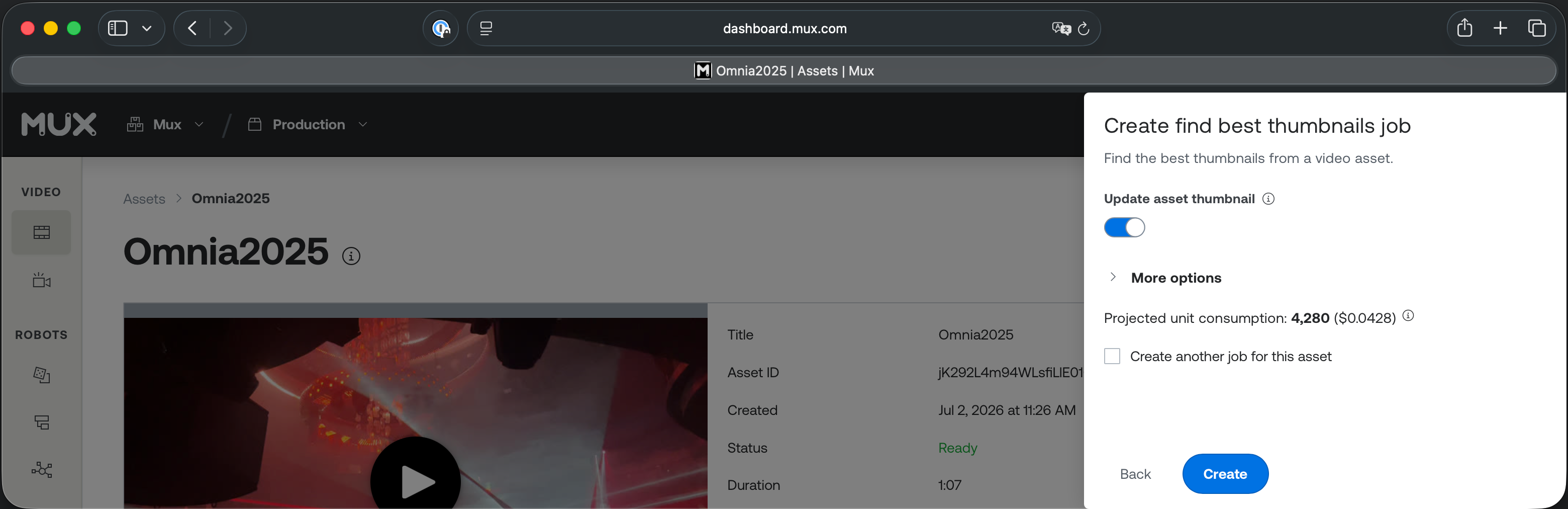
To solve this, Mux Robots features a specialized "Find best thumbnails" workflow. Powered by advanced computer vision models, the system samples frames across the entire duration of the video. It evaluates potential frames using a multi-variable scoring matrix that weighs composition, color vibrancy, contrast, facial detection, action density, and focal clarity. Creators retain control over the parameters, allowing them to steer the model toward specific aesthetic or thematic goals.
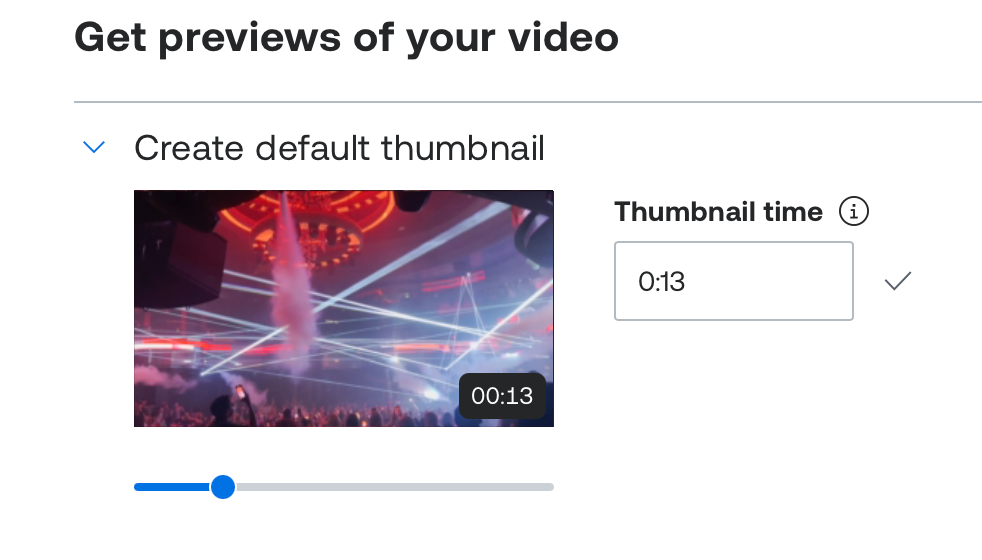
With the latest update, setting the update_asset_thumbnail parameter to true via the Mux Robots API or dashboard instructs the system to automatically assign the highest-scoring frame as the asset’s default thumbnail_time. This eliminates the need for manual frame hunting. Alternatively, administrators can bypass the AI workflow entirely and set precise thumbnail timestamps directly through the Mux Video API using a simple PATCH request, or interactively via a timeline slider in the Mux dashboard.
Navigating Long-Form Content Through Automated Chapters
While thumbnails attract viewers, chapter markers retain them. Long-form video content—such as conference presentations, educational courses, and live-stream archives—suffers from high abandonment rates if viewers cannot easily locate specific topics of interest. Chapters divide a continuous timeline into discrete, labeled segments, empowering users to jump directly to the information they need while providing a clear macroscopic view of the video’s structure.
Mux Video now supports the direct association of chapter metadata with video assets, storing the information in the industry-standard HLS (HTTP Live Streaming) JSON format mandated by modern streaming specifications.
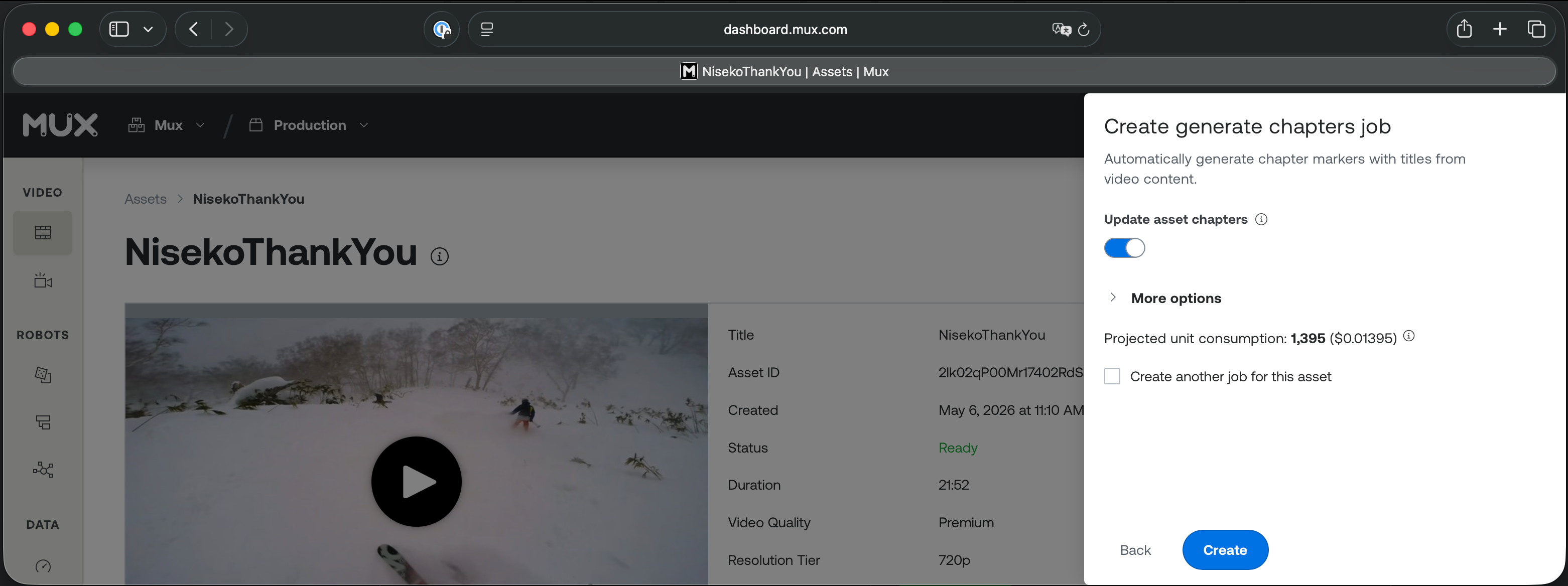
The Mux Robots "Generate chapters" and "Analyze structure" workflows automate this process entirely. By analyzing audio transcripts, visual scene transitions, and narrative shifts, the AI identifies logical breaks in the content. When the update_asset_chapters parameter is enabled, the system compiles these sections into a standardized JSON track and attaches it to the asset.
For developers preferring programmatic control, chapters can also be added directly by uploading an HLS-compliant JSON file via the Mux Tracks API. Once associated, players that support standard HLS metadata specifications—most notably Video.js v10—automatically render the chapters on the player timeline. When users hover over the playback bar, they are greeted with segmented timeline divisions, chapter titles overlaid on storyboard preview images, and precise timestamps, all achieved without custom player plugins.
Automating Workflows at Scale with Directives
For enterprise media organizations processing thousands of video assets daily, manual workflow configuration is impractical. To address this scale, Mux has integrated these round-trip capabilities with Mux Robots Directives.
Directives function as automated blueprints that execute upon video ingest. By defining a directive—such as bundling "Find best thumbnails" and "Generate chapters" into a single automated pipeline—creators ensure that every newly uploaded asset is instantly analyzed, processed, and enriched. Resource dependencies, such as caption tracks required for accurate chapter generation or shot lists for optimal thumbnail selection, are managed automatically by the platform.
Industry Implications and Technical Analysis

Industry analysts point out that the move toward closed-loop AI media processing reflects a broader software trend: the shift from infrastructure-as-a-service (IaaS) to intelligent-platform-as-a-service (iPaaS). By absorbing the complex orchestration layers that traditionally fell to internal engineering teams, video infrastructure providers are lowering the barrier to entry for high-end video features.
Smaller streaming services, educational platforms, and niche publishers who previously lacked the engineering bandwidth to implement computer-vision-based thumbnail selection or automated HLS chapter generation can now deploy these capabilities out of the box. Furthermore, by standardizing on open formats like HLS JSON, Mux ensures that content remains portable and compatible with a wide array of downstream video players.
As media consumption habits continue to shift toward on-demand, highly digestible formats, tools that automate the tedious aspects of content organization will become indispensable. Mux’s integration of AI analysis with native asset management signals a maturation of video cloud infrastructure—one where the pipeline not only processes the media bytes, but actively understands, organizes, and optimizes them for human consumption.
Related posts: