Amazon Subsidiary Bee Introduces Zero Operator Access Architecture to Secure Personal Artificial Intelligence Data

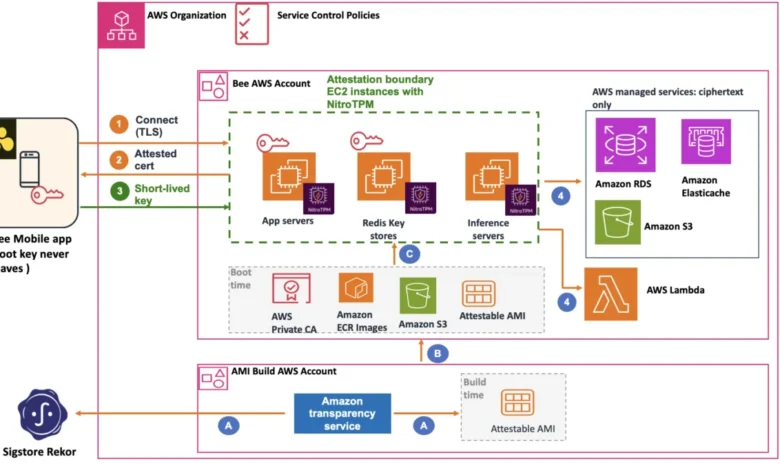
The landscape of personal artificial intelligence is undergoing a profound paradigm shift concerning user privacy, data governance, and cryptographic trust. Bee, an Amazon company specializing in wearable personal artificial intelligence devices designed to capture, synthesize, and recall daily commitments, conversations, and ideas, has officially unveiled its Zero Operator Access architecture. By processing profoundly intimate details regarding personal health, financial transactions, and family dynamics, Bee has established a rigorous, hardware-enforced security framework that technically precludes any human operator—including internal software engineers, corporate leadership, and cloud infrastructure administrators—from accessing cleartext customer data.
The initiative arrives at a critical juncture for the consumer technology sector. As wearable artificial intelligence hardware proliferates, consumers increasingly demand absolute assurances that ambient listening devices and cloud-backed assistants cannot be compromised by internal actors, subpoenaed data requests, or systemic infrastructure vulnerabilities. By combining advanced cryptographic attestation techniques with institutional separation of duties, Bee and Amazon Web Services (AWS) are setting a new benchmark for privacy-preserving intelligence.
Background and Context of Privacy-Preserving AI
For decades, cloud computing has operated under the conventional shared responsibility model, wherein cloud providers manage the security of the underlying infrastructure, while clients retain responsibility for security within the cloud. However, traditional architectures frequently grant cloud operators, system administrators, and application engineers administrative privileges, service roles, or backdoor mechanisms to troubleshoot failures, patch systems, and perform routine maintenance. While these administrative privileges are essential for operational continuity, they simultaneously introduce significant risk surfaces. In the event of a sophisticated cyberattack, insider threat, or sweeping governmental data demand, privileged operators can theoretically bypass application-layer controls to view underlying data stores.
Recognizing these vulnerabilities, Bee set out to design a system where administrative trust is entirely eliminated through mathematical and cryptographic proof. The core philosophy driving the Zero Operator Access model is simple: even if an administrator gains full root access to an underlying virtual machine or storage cluster, the data must remain entirely indecipherable without explicit, user-controlled cryptographic keys.
To achieve this ambitious objective, Bee leveraged the advanced hardware capabilities of the AWS Nitro System. Originally engineered to isolate virtualization resources, the Nitro architecture features dedicated security chips that handle hardware virtualization, storage, and networking without hypervisor intervention. Building upon this foundation, Bee integrated EC2 instance attestation, container-level measured boot tools, independent transparency logs, and strict network segmentation to construct an impenetrable fortress around user data.
The Mechanics of Zero Operator Access: Build-Time and Runtime Controls
Bee’s security architecture operates across two distinct temporal phases: build-time verification and runtime enforcement.
During the build-time phase, Bee constructs its base virtual machine images using a hardened, internal pipeline that yields attestable Amazon Machine Images for Amazon Elastic Compute Cloud. Rather than relying on traditional post-boot verification, the pipeline computes offline reference measurements from the Unified Kernel Image and the Secure Boot configuration. These cryptographic signatures correspond to specific Platform Configuration Registers, specifically PCR4, PCR7, and PCR12, which record measurement states during the boot sequence. Crucially, these attestable AMIs are engineered with zero interactive access pathways—meaning Secure Shell, AWS Systems Manager, and interactive shells are entirely absent from the production environment. The root filesystem is permanently configured as read-only, local instance storage is encrypted with ephemeral keys held exclusively in memory, and instances are systematically destroyed and replaced rather than rebooted, ensuring that operational data never outlives the active instance lifecycle.
Transitioning to the runtime environment, Bee addresses a common vulnerability in containerized architectures: the risk that application container images or machine learning model weights could be modified independently of the operating system image. If an unauthorized actor were to swap a container image or alter a model file, standard operating system attestation might still report a clean boot. To neutralize this vector, Bee deployed a custom measured boot tool that executes prior to the initialization of any application container.
This tool maps each Docker container image to its immutable Amazon Elastic Container Registry digest and retrieves the SHA-256 checksums of all Amazon Simple Storage Service artifacts. A deterministic cryptographic hash is then computed across the entire manifest, container digests, and artifact checksums, subsequently extending NitroTPM PCR14. Consequently, any micro-modification to a container image, model weight, or operational manifest alters PCR14, generating a completely unique attestation document.
Prior to production deployment, an independent transparency service executes a parallel signing process, recomputing the expected PCR14 values and committing the complete PCR map to Sigstore/Rekor, an immutable, publicly auditable transparency log. The resulting cryptographic proof bundle is replicated across regional S3 buckets, allowing the cloud instances to perform offline verification at boot time without depending on external network infrastructure.
Network Isolation, Client-Side Key Management, and Organizational Safeguards
Beyond hardware attestation and cryptographic verification, Bee’s architecture enforces strict boundaries regarding network reachability and key management. All attested EC2 instances operate within isolated subnets inside an Amazon Virtual Private Cloud completely devoid of direct internet egress. Outbound communication is strictly channeled through VPC endpoints connected to Amazon Relational Database Service, Amazon ElastiCache, and tightly scoped AWS Lambda functions. These Lambda functions, which handle peripheral integrations such as email routing and push notifications, process exclusively data that has already been encrypted with client-side keys; plaintext data never traverses these functions.
A cornerstone of the Zero Operator Access model is the absolute separation of encryption keys from cloud storage infrastructure. Cryptographic keys originate exclusively on the user’s personal device. Following the successful cryptographic attestation of a server instance, the user’s device releases a short-lived, highly scoped encryption key directly to the instance. This key resides solely in volatile memory within the application instance and in Redis key stores running inside attested instances with disk persistence disabled. Furthermore, the key automatically expires after seven days of user inactivity. Because AWS and Bee operators never possess or handle this key, underlying storage tiers, database backups, IAM policies, and KMS grants cannot be weaponized to decrypt user information. Sensitive information is encrypted directly within the attested compute boundary before reaching Amazon RDS, ElastiCache, or S3, ensuring that persistent storage media retain nothing more than unreadable ciphertext.
To eliminate unilateral internal access, Bee implemented rigorous organizational controls and Service Control Policies across its AWS infrastructure accounts. Management of the private certificate authority and deployment pipelines is cordoned off from the team overseeing the public transparency service. Deploying software updates that diverge from the publicly logged transparency records would necessitate coordinated collusion across entirely independent corporate teams, backed by multi-party authorization requirements enforced directly at the infrastructure level via AWS SCPs.
Industry Implications and Future Roadmap
Independent security assessments underscore the robustness of Bee’s architectural design. Notably, cybersecurity firm Trail of Bits conducted a comprehensive security review of the Bee Private Compute whitepaper and associated cryptographic protocols, validating the integrity of the client-side cryptography and attestation mechanisms.
The broader implications of Bee’s Zero Operator Access architecture extend far beyond wearable consumer gadgets. As enterprises across heavily regulated sectors—including healthcare, finance, and legal services—accelerate their adoption of generative artificial intelligence and cloud-based machine learning models, the demand for verifiable compute guarantees is reaching unprecedented levels. By demonstrating that complex, stateful artificial intelligence workloads can operate entirely shielded from administrative oversight, Bee and AWS have established a scalable blueprint for confidential cloud computing.
Looking forward, Bee is actively expanding its technical infrastructure by migrating its machine learning inference workloads to Amazon Bedrock Mantle, a managed capability designed to deliver native zero operator access. While this migration streamlines operational overhead, the foundational pillars of the architecture—user-held cryptographic keys and hardware-attested application servers—will remain firmly intact, ensuring that user privacy remains uncompromised as the platform scales. For organizations seeking to replicate this security posture, AWS offers advanced tools such as Nitro Sandboxes, enabling every containerized workload, Kubernetes pod, and virtual machine to inherit hardware-isolated virtualization with built-in attestation and zero operator access controls.