Mastering AEO Benchmarking: A Strategic Framework for Navigating AI Search Visibility

The rise of generative AI has fundamentally altered the digital discovery landscape, shifting the paradigm from traditional link-based search engine optimization (SEO) to answer engine optimization (AEO). As platforms like ChatGPT, Gemini, and Perplexity become primary interfaces for information retrieval, brands face a critical challenge: distinguishing between market-wide shifts in search behavior and localized declines in their own content performance. AEO benchmarking has emerged as the essential methodology for brands to navigate this complexity, providing a structured approach to measuring visibility against competitors and market trends.
The core necessity for AEO benchmarking arises from the "accountability gap" created by AI-driven search. When organic traffic fluctuates, marketing teams often lack the diagnostic tools to determine if the drop is an algorithmic adjustment by the AI provider or a failure in their own content strategy. Without a benchmark, every dip in visibility is unfairly attributed to internal execution, while every spike is erroneously claimed as a tactical win. By utilizing a two-tier model—comparing brand-level performance against industry-wide market benchmarks—organizations can effectively isolate variables and make data-driven decisions.
The Mechanics of the Two-Tier Measurement Model
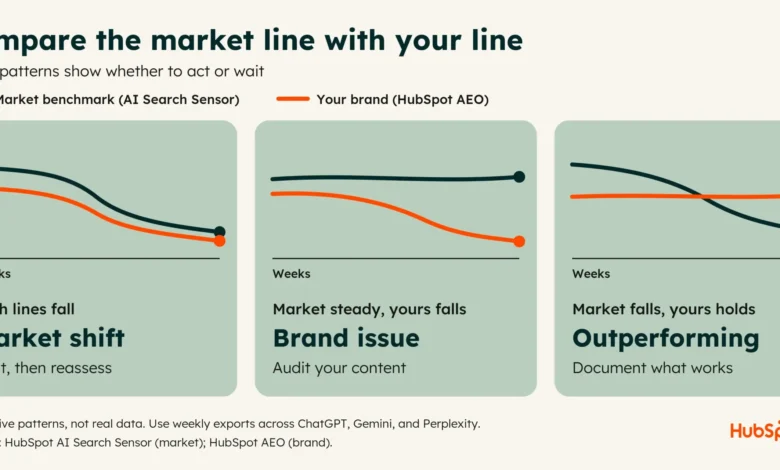
The two-tier model functions by pairing external market-wide benchmarks with internal, brand-specific key performance indicators (KPIs). The external tier provides context; for instance, if the entire financial services sector experiences a shift in how AI engines cite sources, a single brand’s decline is likely a reflection of that market shift rather than a deficit in content quality. Conversely, if a brand’s visibility falls while the industry trend remains stable, the issue is clearly internal, signaling a need for a targeted content audit or a shift in technical SEO strategy.
Tools such as the AI Search Sensor have been developed to provide this external visibility, allowing teams to track how often their brand is mentioned, cited, and positioned relative to competitors across major AI platforms. When integrated with internal metrics—such as those found in HubSpot’s AEO suite—this allows marketers to move beyond reactive troubleshooting. The goal is to avoid the "expensive AEO mistake": attempting to fix problems that are actually systemic industry changes.
Chronology and Evolution of AI Search Measurement
The transition toward AEO began in earnest during the 2024-2025 period, as major search providers shifted from blue-link results to synthesized, AI-generated answers. By mid-2026, the industry reached a tipping point where traditional SEO metrics, such as keyword ranking positions, were no longer sufficient to gauge true digital influence.

In September 2026, industry analysts at Stackmatix released a landmark measurement guide, establishing the foundational formulas for citation rates and visibility scoring. This guide underscored that AI answers are inherently dynamic, with citation rankings often subject to high levels of volatility. A subsequent study by researcher Ronald Sielinski in March 2026 further highlighted the necessity of reporting uncertainty estimates, noting that one-off samples of AI output are statistically unreliable due to the "noise floor" of LLM-based search results. Consequently, the industry has shifted toward 30-to-60-day trend windows to ensure that decisions are based on statistically significant data rather than ephemeral snapshots.
Key Performance Indicators in the Age of AI
To effectively benchmark AI performance, organizations must move beyond vanity metrics and focus on four critical areas: citation rate, share of voice, sentiment, and source attribution.
Citation rate measures how frequently a brand’s domain is cited as an authority by an AI engine. This is arguably the most critical metric for brand credibility. Share of voice, meanwhile, quantifies a brand’s prominence relative to its direct competitors. If a sector has 100 total brand mentions across a cohort of AI responses, a brand with 25 mentions holds a 25% share of voice. This metric is a strong predictor of which brands are being recommended in purchase-intent conversations.
Sentiment analysis provides a qualitative layer to the quantitative data. It is possible for a brand to have high visibility but negative sentiment, which indicates a brand health crisis rather than a discovery issue. Finally, source attribution—often tracked through domain analysis—reveals the ecosystem that influences AI answers. In many sectors, such as finance or healthcare, third-party aggregators often out-cite primary brands. Understanding this reliance allows companies to adjust their off-site PR and content distribution strategies to better align with the sources that AI engines trust.
Methodological Best Practices: The Prompt Cohort
A reliable AEO benchmark depends heavily on the design of the "prompt cohort." An ad-hoc approach—querying the AI with random questions—fails to produce actionable trends. Instead, industry experts recommend a fixed, consistent set of 50 to 100 prompts organized by topic cluster and intent. These should cover three specific categories: category-level queries (broad industry questions), brand-adjacent queries (problems the brand solves), and direct brand queries.
By running this fixed cohort on a weekly cadence, brands can ensure that their results are comparable over time. Any changes in the methodology, such as altering the prompt phrasing or shifting the engine settings, must be documented to prevent these changes from being misinterpreted as market volatility. This disciplined approach ensures that the data remains "clean" and suitable for high-level strategic reporting.

The Impact on Corporate Strategy and Reporting
For marketing leaders, the challenge lies in reporting these findings to stakeholders without over-attributing causes. The recommended protocol involves leading with the two-tier comparison: demonstrating what the market did, what the brand did, and the gap between the two. When an organization can explicitly state, "Our visibility dropped 5%, but the overall sector experienced a 10% decline due to an update in the AI’s citation algorithm," it fosters a culture of trust and objective analysis.
Furthermore, these benchmarks must be translated into actionable content roadmaps. If the data shows that Reddit or specific news outlets are the primary sources for a certain topic, the brand can pivot its content strategy to ensure its own assets are being cited by those third-party domains. If the benchmark indicates a competitor is dominating a specific intent-based query, it provides a clear mandate for a content gap analysis and a subsequent production surge.
Broad Implications for the Digital Landscape
The shift to AEO represents a fundamental change in the internet’s architecture. In the past, companies could optimize for a relatively static set of search algorithms. Today, they must optimize for dynamic, non-linear reasoning engines that prioritize synthesized information. As AI platforms continue to evolve, the distinction between "organic traffic" and "AI-referred traffic" will become increasingly blurred.
This transition necessitates a new breed of digital marketer—one who is as comfortable with statistical significance and probability as they are with content creation. Organizations that fail to adopt rigorous AEO benchmarking risk operating in the dark, reacting to fluctuations in traffic without understanding the underlying mechanics of the platforms that drive them.
Looking toward the future, the integration of AI Search Sensor data with internal performance suites will likely become the standard for digital teams. As the "State of AEO" continues to develop, the brands that win will be those that view AI engines not as black boxes to be gamed, but as ecosystems to be analyzed and influenced through consistent, evidence-based strategy. The era of guessing is over; in the new search landscape, the brands that measure the market with precision are the ones that will dictate the conversation.