Mapfre Insurance Revolutionizes Fraud Detection with Graph-Based AI on AWS, Delivering Over $5 Million in Savings

Insurance fraud represents a pervasive and costly challenge for the global insurance industry, manifesting in increased loss costs, erosion of customer trust, and a significant drain on investigative resources that could otherwise be dedicated to legitimate claims. Historically, fraud detection mechanisms have predominantly relied on rudimentary rules-based controls, manual triggers for investigation, analysis of historical claim patterns, and scrutiny of structured data alone. While these conventional methods offer some utility in identifying established fraud schemes, their inherent limitations become glaringly apparent when confronted with sophisticated, evolving fraud rings or the intricate, often concealed, relationships spanning multiple claimants, policies, vehicles, service providers, addresses, and prior suspicious activities. The static nature of these systems struggles to adapt to the dynamic tactics of fraudsters, leaving significant vulnerabilities within the system.
Mapfre Insurance, a prominent entity in the U.S. insurance landscape, holding the leading position as the number one auto and home insurer in Massachusetts and extending its services across 11 states nationwide, embarked on a strategic initiative to fortify its fraud prevention capabilities. As a vital component of the larger Mapfre Group, a global insurance leader serving over 31.1 million customers in more than 100 countries with a dedicated workforce of 31,000 employees, the company recognized the imperative to transcend traditional approaches. In a pioneering collaboration with Amazon Web Services (AWS) and Neo4j, Mapfre Insurance successfully modernized its fraud prevention infrastructure by integrating advanced graph-based features with sophisticated machine learning (ML) models, all deployed on the robust AWS cloud platform. This transformative project, initially concentrated on Massachusetts Auto insurance and subsequently expanded to include Home (HO) insurance, has yielded substantial business impact, generating a Net Present Value (NPV) exceeding $5 million, with realized savings already surpassing initial projections. This endeavor not only marks a significant technological leap for Mapfre but also sets a new benchmark for the insurance industry in combating complex fraud. This report will delve into the design and implementation of this innovative solution, highlight the underlying technical architecture on AWS’s Atenea Data Platform, and extract critical lessons learned that possess broad applicability across other sectors grappling with intricate fraud challenges.
The Escalating Challenge of Insurance Fraud
The scale of insurance fraud is staggering, posing an annual threat of tens of billions of dollars to insurers and ultimately impacting honest policyholders through higher premiums. According to the Coalition Against Insurance Fraud, the total cost of insurance fraud in the U.S. is estimated to be over $300 billion annually across all lines of insurance. Auto insurance fraud alone accounts for a significant portion of this figure, with fraudulent claims ranging from inflated repair estimates and staged accidents to phantom passengers and organized fraud rings exploiting vulnerabilities in the claims process. These illicit activities are not merely isolated incidents but often represent the tip of a larger iceberg, involving complex, interconnected networks of individuals and entities.
Traditional detection methods, reliant on isolated data points and pre-defined rules, are inherently ill-equipped to uncover these hidden connections. A rule-based system might flag an individual with multiple claims, but it would likely miss a network of seemingly unrelated claimants who share a common address, a specific repair shop, or a particular legal firm, all operating in concert to defraud the insurer. The static nature of these rules means they are easily circumvented by adaptive fraudsters, leading to a constant cat-and-mouse game where insurers are always playing catch-up. This inefficiency not only allows more fraud to slip through but also burdens legitimate claims with unnecessary scrutiny, prolonging processing times and diminishing customer satisfaction. Mapfre’s objective was clear: to move beyond reactive, siloed detection to a proactive, holistic approach capable of identifying these hidden relationships and anticipating emerging fraud patterns.
A Phased Approach to Modernization: Project Timeline
Mapfre’s journey to a modernized fraud detection system unfolded through a meticulously planned, phased approach, demonstrating a strategic commitment to innovation and measurable outcomes. The initiative effectively began with an internal recognition of the limitations inherent in their existing, largely rules-based fraud detection infrastructure. This foundational assessment highlighted the urgent need for a more dynamic and intelligent system capable of tackling the increasing sophistication of fraudulent activities.
- Early 2022: Initial Assessment and Strategy Formulation: Mapfre’s Advanced Analytics and Data Engineering teams, alongside business stakeholders from Claims, initiated a comprehensive review of current fraud detection efficacy. This phase involved identifying key pain points, analyzing historical fraud data, and exploring emerging technologies like machine learning and graph databases as potential solutions.
- Mid-2022: Technology Partner Selection and Proof-of-Concept: Following extensive research and vendor evaluations, Mapfre partnered with AWS for its scalable cloud infrastructure and comprehensive suite of data and machine learning services, and Neo4j for its unparalleled capabilities in graph database management. A proof-of-concept (POC) was launched, focusing on a specific, high-impact area within Massachusetts Auto insurance to demonstrate the viability and potential return on investment (ROI) of the integrated solution.
- Late 2022 – Early 2023: Pilot Phase – Massachusetts Auto Insurance: The solution moved into a pilot phase, where the graph-based ML models were developed and trained using historical and near real-time auto insurance claims data from Massachusetts. This phase focused on fine-tuning the models, establishing the AWS Atenea Data Platform, and integrating the initial fraud alerts into the Guidewire claims system. Early results from this pilot significantly exceeded initial projections, validating the project’s potential.
- Mid-2023: Expansion to Home (HO) Insurance and Broader Rollout: Building on the success of the auto insurance pilot, the fraud detection capabilities were expanded to include Home (HO) insurance. This phase involved adapting the models for different data structures and fraud patterns inherent in home insurance, further refining the architecture for scalability and efficiency. The solution began its broader rollout within Mapfre’s operational workflows.
- Late 2023 – Present: Production Deployment, Optimization, and Future Planning: The system was fully deployed into production, continuously monitoring claims and providing real-time fraud alerts. Ongoing optimization efforts focused on model retraining, data quality improvements, and enhancing investigator feedback loops. The documented success, including the $5 million+ NPV, firmly established the business case, leading to plans for expanding the platform’s capabilities into new use cases like underwriting anomaly detection and customer entity resolution.
The Atenea Data Platform: A Technical Blueprint for Fraud Detection
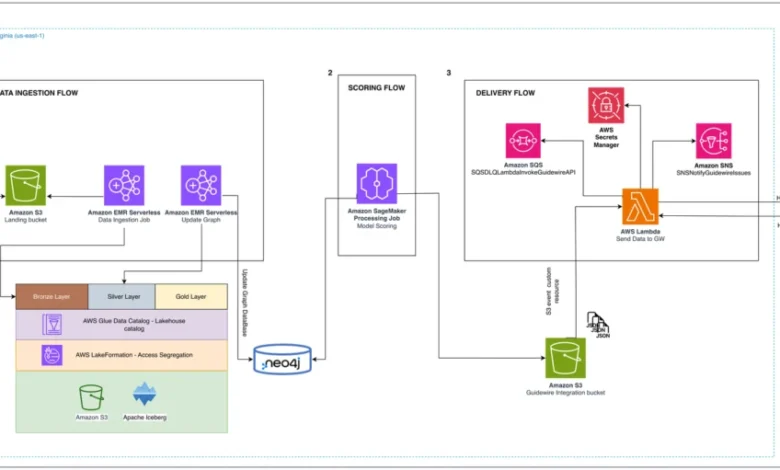
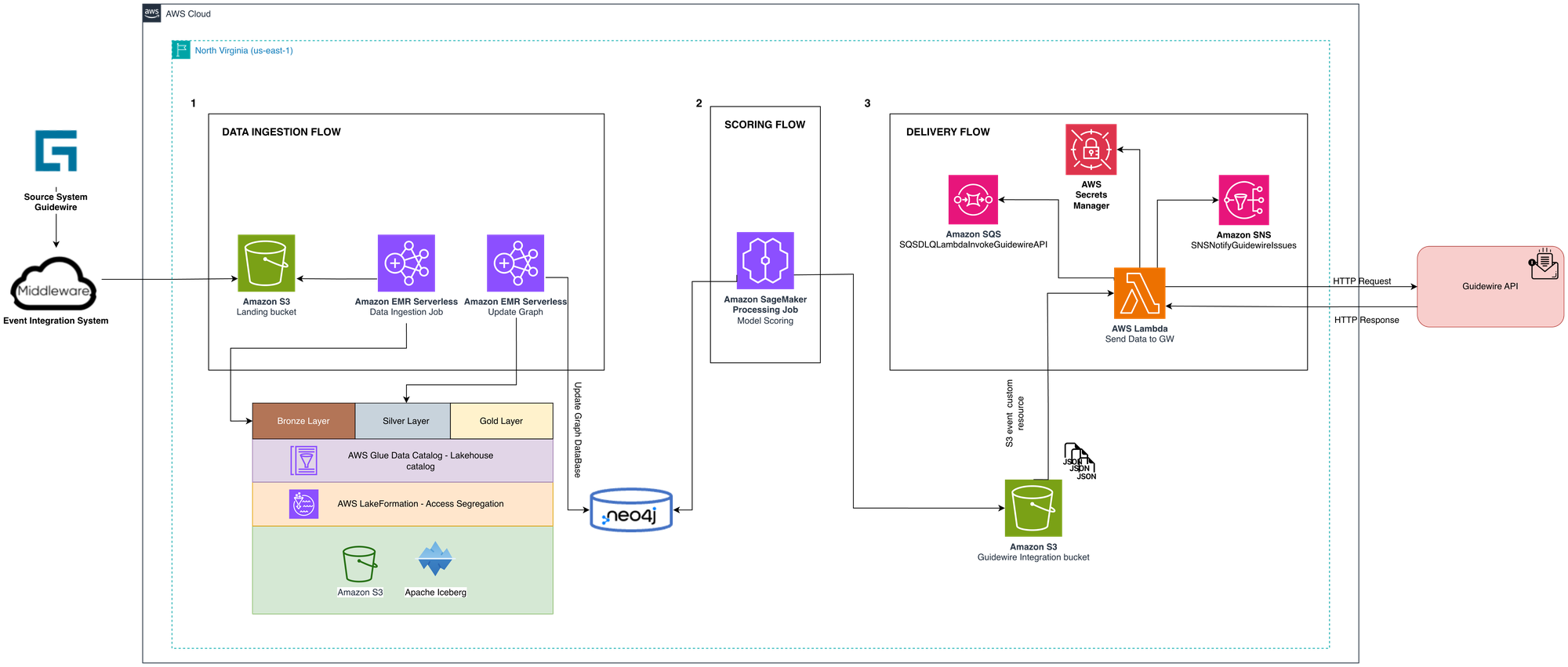
At the heart of Mapfre’s modernized fraud detection system lies the Atenea Data Platform, a robust, scalable, and secure architecture built entirely on AWS. This platform is meticulously engineered to handle the vast volumes of structured and unstructured data required for sophisticated fraud analytics, while ensuring long-term governance and cost efficiency. The design principles of the Atenea platform revolve around elasticity, data integrity, and seamless integration with existing business processes.
The foundational layer of the solution leverages Apache Iceberg tables, a high-performance format for large analytic tables, stored efficiently on Amazon Simple Storage Service (Amazon S3). This combination provides a highly scalable and cost-effective data lake solution, offering critical features like schema evolution, hidden partitioning, and time travel capabilities, which are essential for auditing and reprocessing historical data in a fraud detection context. Metadata for these Iceberg tables is centrally managed through the AWS Glue Data Catalog, providing a unified catalog for all data assets across the platform. This ensures data discoverability and consistent schema enforcement. Access to this sensitive data is rigorously governed through AWS Lake Formation, implementing fine-grained security controls down to the column and row level, thereby upholding the strict regulatory and privacy requirements inherent in the insurance industry.

A critical component of the Atenea platform is its custom-built feature store, implemented through feature-store-managed Iceberg tables. This centralized repository stores all model features, predictions, and the Guidewire activities generated by the system. This approach ensures feature consistency across different models, promotes reusability, and streamlines the machine learning lifecycle from experimentation to production deployment. The platform’s logical structure is organized into distinct layers: a raw data layer for initial ingestion, a curated layer for cleaned and transformed data, and an analytics layer where features are engineered and models are executed.
Processing pipelines, responsible for data ingestion, feature engineering, and model scoring, are executed on Amazon EMR Serverless. This revolutionary service provides elastic, cost-efficient compute for big data workloads without the need to provision, manage, or scale clusters. This "pay-as-you-go" model is particularly advantageous for intermittent or variable workloads typical of fraud detection, allowing Mapfre to scale compute resources up or down precisely as needed, optimizing operational costs. Orchestration of these complex pipelines is managed by Apache Airflow operators running on Amazon Managed Workflows for Apache Airflow (Amazon MWAA). MWAA provides a fully managed service for Airflow, simplifying the deployment and operation of workflows while ensuring centralized control, monitoring, and robust recovery mechanisms for batch processing and fast-time scoring.
For the crucial graph enrichment capabilities, the Atenea platform seamlessly connects to Neo4j using a dedicated driver. This integration enables the extraction and computation of advanced network-based features that are impossible to derive from traditional relational databases. These graph features include:
- Suspicious Claim Linkages: Identifying claims that, while appearing unrelated on the surface, are connected through shared policyholders, vehicles, addresses, phone numbers, or even subtle temporal patterns.
- Provider Fraud Ratios: Calculating the propensity of specific service providers (e.g., repair shops, medical clinics, legal firms) to be associated with fraudulent claims, based on their network position and historical interactions.
- Centrality Metrics: Identifying "hub" entities (individuals, providers, vehicles) that are disproportionately connected to suspicious activities, indicating their potential role as orchestrators or key nodes within a fraud ring.
- Community Detection: Grouping entities into suspected fraud rings based on the density and strength of their interconnections.
This comprehensive architecture supports efficient, reliable, and transparent production execution through repeatable Airflow orchestration, environment-based continuous integration and delivery (CI/CD) promotion, centralized monitoring, proactive failure notifications, robust retry mechanisms, and dead-letter queue handling for Guidewire integration. Furthermore, controlled secret management ensures the security of credentials and sensitive configuration data. The layered lakehouse design maintains the platform’s flexibility, allowing it to evolve with new business requirements and adapt to emerging fraud detection use cases, ensuring its long-term strategic value.
Guidewire Integration: Closing the Loop with MLOps
One of the most critical aspects of Mapfre’s solution, and a testament to its practical utility, was the successful integration of machine learning predictions directly into the Guidewire Claims system. This "closing the loop" between advanced analytics and the core claims handling workflow is paramount for realizing the full business impact of fraud savings. Without this seamless integration, even the most accurate fraud models would remain academic exercises, failing to translate into actionable intelligence for claims adjusters. The integration required a resilient, real-time mechanism between the Atenea data platform on AWS and Guidewire Claims.
The integration flow operates as follows:
- Model Scoring: The ML models on the Atenea platform process incoming claims data and generate fraud predictions.
- Prediction Output: These predictions, along with the top three model drivers explaining the fraud flag, are stored in the feature store.
- Asynchronous Messaging: An AWS Lambda function is triggered, publishing a message to an Amazon Simple Queue Service (SQS) queue containing the necessary details for Guidewire integration.
- Guidewire API Invocation: Another AWS Lambda function, acting as a secure intermediary, consumes messages from the SQS queue and invokes the Guidewire Claims API. It constructs a JSON payload, securely retrieving API credentials from AWS Secrets Manager, to create a new "predictive activity" within Guidewire.
- Error Handling and Retries: For robustness, the system incorporates retry mechanisms for failed Guidewire API calls. If repeated attempts fail, messages are moved to an SQS dead-letter queue for manual investigation and resolution, ensuring no critical alerts are lost.
- Investigator Action: Within Guidewire, the new activity immediately alerts claims investigators to potential fraud, providing them with the model’s rationale (top drivers) to facilitate rapid and informed decision-making.
A typical JSON payload sent to Guidewire might look like this:
  "method": "createPredictiveActivity",
  "params": [

      "claimNumber": "AUXXXXXXX",
      "exposureNumber": 1,
      "subject": "Fraud alert from ML model",
      "description": "Claim flagged as potential fraud based on graph + ML features",
      "shortSubject": "ML_Fraud_Flag",
      "priority": "high",
      "availableForClosedClaim": true,
      "autoCloseOnExposureClosure": false,
      "targetDays": 4,
      "escalationDays": 6

  ]
The key benefits derived from this meticulously engineered integration are manifold: real-time alerts ensure that potential fraud is identified and flagged early in the claims lifecycle, significantly reducing the window of opportunity for fraudsters. The transparency provided by displaying the top model drivers directly within Guidewire fosters trust among claims adjusters, enhancing their adoption and confidence in the system. By automating the alert generation and integrating it into existing workflows, manual effort is drastically reduced, allowing investigators to focus on high-value analysis rather than administrative tasks. Furthermore, the robust audit trail created by these activities provides comprehensive documentation for compliance and continuous improvement. This integration underscores the principle that fraud models do not exist in isolation; their true power is unleashed when they actively augment daily claim workflows, directly connecting Atenea’s MLOps pipelines on AWS with core business decision-making systems.
Data Quality, Resilience, and Investigator Empowerment
The effectiveness of any advanced analytics solution hinges critically on the quality and integrity of its underlying data. Recognizing this, Mapfre implemented rigorous data quality checks at various stages of its fraud detection pipelines, particularly during data ingestion and graph feature computation. Automated validation mechanisms are designed to detect anomalies and inconsistencies early, preventing corrupted data from propagating through the system and compromising model accuracy.
Beyond data quality, the platform is built for resilience. Comprehensive monitoring dashboards track key performance indicators (KPIs) for both the data pipelines and the ML models, providing real-time visibility into system health and model performance. This proactive monitoring allows for early detection of potential issues, enabling rapid intervention. Standardized recovery and promotion processes are in place across different environments (development, testing, production), ensuring consistency and minimizing risks during deployments and updates.
A crucial aspect of empowering investigators is the visual exploration of complex relationships. Mapfre leverages Neo4j Bloom, a graph visualization tool, to support its Special Investigative Unit (SIU) workflows. Bloom allows investigators to visually explore entity relationships, such as a specific provider linked across multiple suspicious claims, or a network of individuals connected through shared addresses and vehicles. This intuitive visual interface accelerates the identification of fraud rings and complex schemes that would be arduous, if not impossible, to uncover through tabular data analysis alone. The ability to see these connections graphically significantly reduces investigation time and improves the accuracy of fraud identification.
Conclusion and Future Outlook
The implementation of the graph-based machine learning fraud detection model in auto and home claims has demonstrably enhanced Mapfre Insurance’s ability to identify and mitigate fraudulent activity. This initiative has driven significant financial savings and substantially improved overall claims efficiency. During the initial pilot phase, the realized savings not only met but exceeded all projections, a clear indicator of the project’s profound impact. In full production, the initiative has delivered a Net Present Value (NPV) exceeding $5 million, unequivocally confirming the robust business case and underscoring the formidable strength of combining structured data analysis with advanced graph-based features. This hybrid approach is particularly effective at uncovering hidden fraud networks that traditional, rule-based methodologies consistently miss.
The compelling results can be summarized as follows: a significant reduction in false positives, leading to more efficient allocation of investigative resources; faster claim processing times due to quicker identification and resolution of suspicious claims; and substantially enhanced investigator efficiency, allowing SIU teams to focus on complex cases with higher certainty of fraud.
Beyond the quantifiable financial outcomes, several invaluable lessons have emerged from this transformative project. Firstly, the critical importance of cross-functional collaboration cannot be overstated. The seamless cooperation between diverse groups such as Claims, Data Engineering, Advanced Analytics, and external technology partners like AWS and Neo4j was absolutely foundational to the project’s success. Secondly, the emphasis on model explainability proved to be essential for adoption. By presenting adjusters with the top model drivers and the rationale behind each fraud flag directly within the Guidewire system, trust and confidence in the automated system increased substantially, fostering greater utilization and effectiveness. Finally, the deliberate embedding of resilience into the architectural design—through comprehensive monitoring, automated retries, and rigorous data quality processes—was crucial for ensuring the models operate reliably and consistently in a demanding production environment.
Looking ahead, the Atenea Data Platform is strategically positioned to expand its capabilities far beyond its initial scope of fraud detection. New and impactful use cases, such as underwriting anomaly detection to identify unusual patterns in new policy applications and customer entity resolution to create a unified view of customers across disparate data sources, are already firmly on the roadmap. With a robust and scalable architecture built on the cutting-edge services of AWS, including Amazon EMR Serverless for elastic compute, Apache Iceberg on Amazon S3 supported by AWS Glue Data Catalog and Lake Formation for a resilient data lake, a custom-built Feature Store for streamlined ML operations, and the powerful graph analytics capabilities of Neo4j, Mapfre Insurance now possesses a truly scalable and innovative foundation. This technological bedrock will continue to drive significant innovation and deliver tangible business impact, solidifying Mapfre’s position as a leader in leveraging advanced analytics for operational excellence and enhanced customer value.
Related posts: