Federal Reserve Reverses Course, Hikes Interest Rates by 25 Basis Points to Combat Persistent Inflation and Tighten Economic Levers

On September 16, the Federal Open Market Committee (FOMC) formally shifted its monetary stance by raising the federal funds target range by 25 basis points to a new bracket of 3.75% to 4.00%. This definitive policy adjustment breaks a prolonged sequence of interest rate cuts that defined the central bank’s actions over previous quarters. Announcing the decision, Federal Reserve Chair Kevin Warsh characterized the move as a necessary intervention against price pressures that have remained stubbornly elevated, stating plainly that inflation is "too high and has been for too long."
The policy shift is immediately consequential for the broader financial architecture. Effective September 17, the central bank adjusted its entire framework of administered rates in lockstep with the primary benchmark change. For capital markets, commercial institutions, and industrial sectors—most notably freight, logistics, and supply chain enterprises that operate heavily on credit, floating debt, and rolling inventory—this rate hike reverberates through every layer of operational financing.
Understanding the Mechanics: The FOMC and the Dual Mandate
To comprehend why the central bank adjusted its stance, one must look to the statutory obligations governing its actions. The Federal Reserve operates under a dual mandate bestowed by Congress: the pursuit of maximum sustainable employment and price stability. The FOMC, which directs monetary policy, convenes approximately eight times a year. Comprising 12 voting members—specifically the seven permanent governors and a rotating selection of five presidents from the 12 regional Federal Reserve Banks—the committee votes on the target range for the federal funds rate. This benchmark represents the interest rate commercial institutions charge one another for unsecured overnight loans of reserve balances.
When key inflation barometers, such as the Personal Consumption Expenditures (PCE) Price Index—the Fed’s preferred gauge—run persistently above the central bank’s targeted 2% threshold, the dual mandate inevitably shifts its weight. Even in the face of a resilient and stable labor market, the FOMC determined that checking inflationary momentum must take precedence, accepting the friction of higher borrowing costs to safeguard the purchasing power of the currency over the long term.
How the Fed Translates a Target Range into Real-World Borrowing Costs
The FOMC does not dictate specific market borrowing costs directly. Instead, it establishes a target range for the federal funds rate and manages it using a sophisticated suite of four administered rates designed to bridge commercial banks and non-bank financial institutions.
At the base of this architecture are the primary floors. The Interest on Reserve Balances (IORB) rate serves as the foundational floor for depository institutions. Because commercial banks are guaranteed a risk-free return of 3.90%—raised from 3.65% following the September announcement—directly from the Fed on their reserve balances, they have no economic incentive to lend funds to third parties overnight at a lower yield.
Simultaneously, the Overnight Reverse Repo (ON RRP) rate acts as a parallel floor for non-bank financial entities that lack direct access to reserve accounts at the central bank. This group includes government-sponsored enterprises (GSEs) such as Fannie Mae and the Federal Home Loan Banks (FHLBs), prominent money market funds like Vanguard’s Treasury Money Market Fund and BlackRock’s Government Money Market Fund, and primary dealers including Goldman Sachs & Co. and J.P. Morgan Securities. By lifting the ON RRP rate from 3.50% to 3.75%, the Fed ensures that massive pools of non-bank liquidity do not leak into the broader financial system at artificially low yields.
On the upper boundary, the central bank maintains strict ceilings to prevent liquidity crunches. The primary credit discount rate was moved to 4.00%, offering depository institutions an emergency borrowing option rather than forcing them to source capital elsewhere at exorbitant spot rates. Similarly, the Standing Repo Facility (SRF) rate was adjusted to 4.00%. The SRF functions as a vital institutional backstop, permitting both depository institutions and primary dealers to secure overnight liquidity by pledging Treasury securities and agency debt as collateral. This mechanism is specifically engineered to preempt systemic liquidity squeezes and avert historical banking panics.
The Effective Federal Funds Rate and Daily Market Realities
While the official target range captures headlines, the operational metric that dictates daily funding conditions is the Effective Federal Funds Rate (EFFR). Published daily by the Federal Reserve Bank of New York, the EFFR represents the volume-weighted median rate at which banks actually execute overnight federal funds transactions.
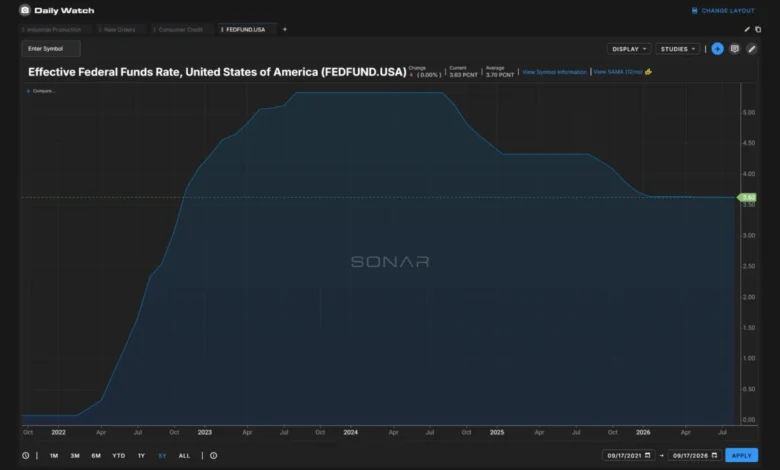
The EFFR typically hovers just beneath the IORB rate. This dynamic exists because certain major market lenders—most notably the Federal Home Loan Banks—are active participants in the federal funds market but are ineligible to earn IORB directly. Consequently, these entities are compelled to lend slightly below the IORB rate to secure any return on surplus cash rather than holding idle capital. On the final full trading day preceding the September rate hike, the EFFR printed at 3.63%, cleanly aligned beneath an IORB of 3.65% and within the then-prevailing target range of 3.50% to 3.75%. Following the FOMC’s latest adjustment, market analysts project the EFFR to settle just underneath the newly established 3.90% IORB rate while maintaining a comfortable buffer above the 3.75% ON RRP floor.
Economic Theory: The Price of Time and Loanable Funds
Underlying these complex administrative levers is a fundamental economic principle: interest as the explicit price of time. Interest represents both the compensation demanded by savers who defer immediate consumption to supply capital, and the cost incurred by borrowers for the early deployment of those funds.
In a theoretical free market, this price is determined by the intersection of supply and demand within the market for loanable funds. As interest rates rise, the economic incentive to save increases—expanding the supply of loanable funds—while the cost of capital discourages marginal borrowing, contracting the quantity demanded.
The Federal Reserve does not abolish this foundational market equilibrium; rather, it distorts and anchors the short-term end of the yield curve by injecting risk-free liquidity options via the IORB and ON RRP mechanisms. Because the entire broader term structure of credit—ranging from benchmark U.S. Treasury yields and residential mortgages to commercial paper and corporate revolving credit lines—prices directly off these short-term risk-free rates, any adjustment by the FOMC sends immediate ripples across every sector of the domestic economy.
The Transmission Mechanism: Cooling Inflation Through Capital Restraint
The economic transmission mechanism connecting higher policy rates to lower inflation is direct and historically proven. When the central bank elevates the federal funds target, commercial banks experience an immediate escalation in their cost of funds. Financial institutions inevitably pass these increased expenses along to corporate and retail borrowers through higher interest rates on commercial loans, lines of credit, and consumer financing products.
Higher borrowing costs establish a stricter hurdle rate for both capital investment by businesses and discretionary consumption by households, causing economic velocity to moderate. As credit growth slows against a near-term supply of goods and services that remains relatively fixed, the upward trajectory of price inflation loses momentum.
Furthermore, higher domestic interest rates generate international capital flows. Global investors seeking risk-free, dollar-denominated yields convert foreign capital into U.S. assets, driving up the valuation of the U.S. dollar. A stronger dollar effectively reduces the purchase price of imported goods and dampens dollar-denominated commodity prices—a crucial transmission channel during inflationary cycles driven largely by global energy shocks.
Macroeconomic Implications for Logistics and Freight Markets
While monetary policy is formulated in Washington based on macroeconomic indicators, its ultimate impact is felt acutely on the nation’s supply chains and logistics networks. Every adjustment in the cost of capital eventually manifests as physical friction in the movement of freight.
Inventory Financing and Shipper Behavior
Higher interest rates dramatically increase the carrying cost of holding commercial inventory. When money was cheap, businesses frequently maintained large buffer stocks to guard against supply chain disruptions. As financing expenses climb due to elevated benchmark rates, corporate treasurers prioritize inventory minimization, shifting toward leaner, highly frequent replenishment schedules.
Initially, this behavioral pivot creates a headwind for freight volumes as supply chains flush out excess stock. Over the medium term, however, leaner buffer stocks increase vulnerability to sudden demand shocks, setting the stage for sharper, more volatile spot-rate freight spikes when disruptions inevitably occur.
Sector-Specific Vulnerabilities: Housing and Durable Goods
Rate-sensitive sectors of the economy—principally residential housing, real estate development, and heavy durable goods manufacturing—are historically the first to contract under tighter monetary policy. A cooling housing market immediately depresses demand for flatbed trucking capacity, building materials, lumber, and appliance-linked freight. Logistics providers specializing in heavy industrial and construction inputs typically experience volume contractions well before consumer packaged goods face similar declines.
Carrier Fleet Renewal and Capital Constraints
On the supply side of transportation, motor carriers, rail operators, and warehouse owners face severe capital cost inflation. Financing commercial tractors, refrigerated trailers, and warehouse automation systems becomes noticeably more expensive. Consequently, fleets frequently delay scheduled equipment replacement cycles and curtail capacity expansion plans.
This lagged tightening effect restricts the natural growth of transport capacity, eventually creating upward pressure on spot rates as older equipment retires faster than new units can be financed and integrated.
Small Carriers and Market Attrition
Small-to-medium motor carriers, which form the backbone of the domestic over-the-road trucking network, are particularly vulnerable to sudden monetary tightening. Operating on tight margins, many small fleets rely heavily on revolving credit lines and fuel cards to manage daily cash flow, fuel float, and payroll. When interest rates rise, debt service obligations expand rapidly. This financial pressure accelerates capacity exits and business failures among thinly capitalized operators—a structural phenomenon frequently observed during extended freight market downturns.
The Dual Impact of Currency Fluctuations
The concurrent strengthening of the U.S. dollar yields mixed results for international and intermodal logistics providers. On one hand, a robust dollar lowers the landed cost of foreign containerized imports for domestic retailers, providing baseline support for major import-heavy gateway ports and intermodal rail networks. Conversely, higher dollar valuations make American agricultural and industrial exports more expensive for overseas buyers, dampening outbound international freight volumes.
Conclusion and Forward Outlook
The FOMC’s decision to increase the federal funds target range by 25 basis points to 3.75%–4.00% represents a decisive effort to anchor inflation expectations at the expense of short-term economic acceleration. By systematically lifting its administered rates—including the IORB, ON RRP, discount rate, and SRF—the central bank has signaled that price stability remains its paramount institutional priority.
For the logistics and transportation sector, this monetary pivot underscores a timeless reality: financial cycles and physical freight cycles operate on divergent timelines. Shippers, carriers, and 3PL providers must account for the lagged effects of higher capital costs when formulating capacity strategies, inventory management policies, and financial projections for the quarters ahead.