Covenant Logistics Reports Strong Third-Quarter 2026 Revenue Growth Fueled by Managed Freight and Improved Pricing

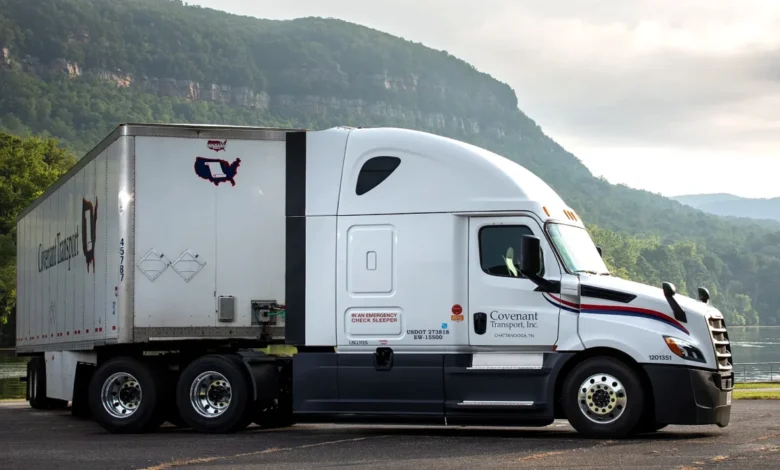
Chattanooga-based carrier Covenant Logistics Group Inc. posted a robust financial performance for the third quarter of 2026, registering a 19.2% year-over-year increase in total revenue. Driven largely by exceptional growth in its managed freight segment and disciplined fleet optimization strategies, the transportation and logistics provider announced total revenue of $353.9 million for the quarter ended September 30, up significantly from $296.9 million during the same period in 2025.
The earnings report, made public on Thursday, underscores a broader strategic pivot within the carrier industry. Fleet operators across North America are increasingly leaning into asset-light business models, shifting capacity toward long-term committed contracts, and optimizing yield management to navigate a persistent environment of elevated operational costs and tightening driver pools. For Covenant, trading under the ticker symbol CVLG on the New York Stock Exchange, these tactical adjustments have begun yielding tangible bottom-line improvements.
Freight revenue excluding fuel surcharges—a critical metric monitored closely by transportation analysts to gauge core carrier productivity—rose 17.2% to $315.1 million, compared with $268.8 million in the third quarter of the previous year. Net income for the quarter advanced to $10.7 million, or 40 cents per diluted share, improving upon the $9.1 million, or 35 cents per share, recorded in the third quarter of 2025. On an adjusted basis, the company earned 50 cents per diluted share, representing a 13.6% increase over the 44 cents reported a year earlier.
Chairman and Chief Executive Officer David R. Parker noted that the latest financial results mark a crucial inflection point for the enterprise. According to Parker, this quarter represents the first time since the second quarter of 2022 that Covenant has managed to achieve sequential and year-over-year growth in adjusted earnings per share simultaneously.
Chronology and Operational Shifts: Tracing Covenant’s Strategic Evolution
To fully understand Covenant’s third-quarter performance, industry observers must look at the structural changes the carrier has implemented over the past several quarters. Throughout late 2025 and into 2026, the company actively executed a multi-faceted operational strategy aimed at reducing fleet volatility, expanding its logistics footprint, and insulating itself from the spot market’s historical volatility.
A cornerstone of this strategy was the acquisition and subsequent integration of new brokerage operations during the final quarter of 2025. This integration paid immediate dividends in 2026, culminating in a record-setting third quarter for the managed freight division. Simultaneously, Covenant has systematically pruned its asset-based truckload and expedited tractor fleets. By shedding underperforming units and redeploying equipment into higher-margin, multi-year capacity agreements, executive leadership sought to extract higher revenue per mile even as total truck counts declined.
By the close of September 2026, approximately 80% of Covenant’s entire asset-based fleet was operating under long-term committed contracts. This represents a dramatic structural shift from previous years, moving the carrier further away from spot-market exposure and establishing a predictable revenue baseline that leadership hopes will cushion the enterprise against macroeconomic headwinds.
Managed Freight Segment Emerges as the Primary Growth Engine
The standout performer within Covenant’s operational portfolio during the third quarter was undoubtedly the Managed Freight segment. The division generated $121.6 million in revenue, marking a staggering 68.4% increase compared to the $72.2 million reported in the third quarter of 2025.
Profitability within the segment expanded at an even faster pace. Adjusted segment operating income more than doubled, surging 133.3% to $7.1 million from $3.04 million a year earlier. Furthermore, the segment’s adjusted operating ratio improved by 160 basis points, dropping to 94.2% from 95.8%.
Company executives attributed these remarkable gains to the successful amalgamation of the brokerage operations acquired in late 2025, combined with strategic customer rate adjustments and favorable decreases in purchased transportation costs. Parker highlighted that the acquired brokerage units delivered their strongest performance since joining the Covenant portfolio. Additionally, the company’s legacy brokerage operations played a vital role by successfully sourcing external carrier capacity to handle overflow freight from Covenant’s expedited network.
However, management offered caveats regarding the sustainability of these rapid margin expansions. Sourcing qualified, reliable carrier pricing below contractual freight rates remains an ongoing challenge as baseline trucking capacity continues to exit the market. Furthermore, rising insurance premiums and claims expenses present continuous downward pressure on profitability across the third-party logistics sector.
Truckload and Expedited Operations Shrink Fleet Size While Boosting Yields
Covenant’s combined Truckload operations produced $204.6 million in total revenue, reflecting a modest 2.5% increase from $199.7 million in the prior-year period. However, looking strictly at freight revenue excluding fuel surcharges, the segment experienced a 3.4% decline down to $166 million from $171.8 million.
This top-line contraction in core truckload revenue was directly tied to an 8.9% reduction in the company’s average tractor count, which decreased to 2,186 tractors compared to 2,400 a year ago. Despite deploying fewer physical assets, Covenant successfully engineered higher pricing yields and improved revenue productivity across the board.
Key performance indicators for the truckload division highlighted the benefits of this disciplined capacity management:
- Average freight revenue per total mile climbed 19.8% to $3.03, up from $2.53 in Q3 2025.
- Average freight revenue per tractor per week increased 6.1% to $5,778, compared with $5,445 previously.
- Average miles per tractor declined 11.4% to 25,081, down from 28,306, reflecting the targeted shift toward shorter-haul dedicated routes and reduced empty deadheading.
President Paul Bunn noted that while higher freight rates and an optimized freight mix successfully cushioned the top-line impact of operating a smaller fleet, persistent inflationary pressures hampered bottom-line conversion. Costs associated with repositioning equipment and drivers, alongside broader inflationary trends, pushed truckload operating expenses up by approximately 20.8% year over year on an adjusted basis. Consequently, truckload adjusted operating income dipped to $7.9 million from $10 million, and the segment’s adjusted operating ratio deteriorated slightly from 94.2% to 95.3%.
Within the Expedited sector, the trend of fleet reduction continued more aggressively. Expedited freight revenue excluding fuel dropped 12% to $70.6 million, accompanied by a 21.4% reduction in the average tractor fleet down to 677 units. Adjusted operating income for the expedited division fell 19% to $4.2 million. Nevertheless, efficiency gains were visible: average freight revenue per tractor per week in the expedited division jumped 12% to $7,934. By the end of the quarter, roughly 58% of expedited tractors operated under committed capacity agreements, up sharply from approximately 40% at the close of the second quarter.
Meanwhile, Dedicated freight revenue grew 4.2% to $95.4 million, supported by expansion in agricultural protein transport contracts and the strategic pruning of lower-margin agreements. Dedicated revenue per tractor per week rose 6.2% to $4,810.
Macroeconomic Realities: Rising Costs Counteract Freight Rate Momentum
While overall freight demand remained steady across most domestic sectors and showed distinct pockets of strength tied to resilient consumer and industrial activity, executive leadership remained vocal about the structural cost pressures facing the carrier community.
"Driver capacity is tight, and the cost of recruiting, retaining, and compensating drivers is increasing significantly," Parker stated. He explained that escalating expenses tied to driver wages, employee benefits, equipment ownership, maintenance, and fleet technology have largely offset the revenue gains achieved through higher contract freight rates.
The warehousing segment also encountered operational hurdles during the period. Although warehousing revenue grew 7.8% to $26.7 million, adjusted operating income fell precipitously to $888,000 from approximately $2 million a year earlier. Covenant blamed these headwinds on operational inefficiencies at newly onboarded customer facilities and localized labor inflation.
Financial Health, Capital Allocation, and Fourth-Quarter Outlook
Covenant’s balance sheet reflected disciplined capital management as the company entered the final stretch of fiscal 2026. As of September 30, net indebtedness stood at approximately $283.9 million, representing a reduction of $12.4 million from the close of 2025. The carrier also maintained robust liquidity, boasting $75.2 million in immediately available borrowing capacity under its asset-based lending facility.
Additionally, the company’s 49% equity stake in Transport Enterprise Leasing continued to prove lucrative, contributing $5.7 million in pretax income during the third quarter, compared to $3.6 million in the prior-year period—though management cautioned that this contribution is expected to moderate slightly in the fourth quarter. Net capital equipment expenditures for the full year are projected to land between $35 million and $40 million.
Looking ahead, Covenant leadership issued a cautiously optimistic outlook. The company anticipates a sequential increase in earnings per share for the fourth quarter of 2026, driven by ongoing transitions of asset equipment into higher-margin committed contracts and a reduction in operational repositioning costs.
Broader Industry Implications
Covenant Logistics Group’s third-quarter financial report serves as a bellwether for the modern U.S. trucking industry. As carriers grapple with a protracted freight market recovery, the traditional playbook of maintaining massive asset-heavy fleets to chase volatile spot-market volumes has largely given way to strategic restraint.
By aggressively shrinking tractor counts, prioritizing multi-year dedicated contracts, and scaling high-margin asset-light brokerage operations, Covenant has demonstrated that profitability can be successfully extracted even in an inflationary environment defined by expensive labor, rising equipment maintenance costs, and tight driver availability. As the broader freight market prepares for potential structural improvements heading into future operating cycles, Covenant’s disciplined execution provides a blueprint for asset-right transformation across the logistics landscape.