AWS SDK for Java 2.x Introduces Client Warm-Up Feature to Combat Cold Start Latency

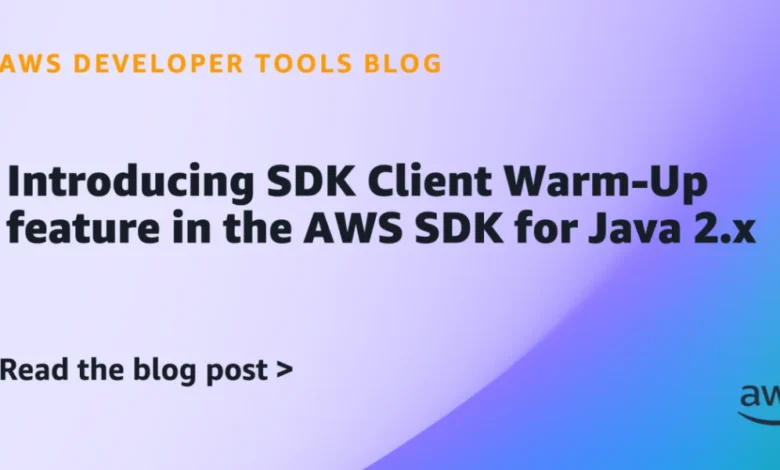
The performance of cloud-native applications often hinges on the efficiency of the initial request cycle. For developers utilizing the AWS SDK for Java 2.x, a persistent challenge has been the "cold start" phenomenon, where the first service call made by an application incurs a significant latency penalty compared to subsequent operations. AWS has officially addressed this hurdle by introducing a native SDK client warm-up feature, designed to proactively initialize request paths during the application startup phase rather than waiting for the first user-facing transaction.
This development marks a critical shift in how Java-based cloud applications, particularly those running on ephemeral infrastructure like AWS Lambda, manage resource allocation and execution readiness. By allowing developers to invoke the SdkWarmUp.warmUp() method, the SDK now forces the Java Virtual Machine (JVM) to load necessary classes, establish secure connections, and execute preliminary code paths before the application begins handling actual traffic.
The Anatomy of Cold Start Latency
To understand the necessity of this feature, one must analyze the technical overhead inherent in a standard Java-based cloud service call. When a service client—such as an S3 or DynamoDB client—is invoked for the first time, the JVM must perform several resource-intensive tasks. Initially, it must identify and load the relevant SDK classes into memory. Once loaded, the code is executed in the interpreter mode until the Just-in-Time (JIT) compiler identifies "hot" paths and optimizes them into native machine code.
Beyond the internal JVM processing, the networking layer introduces its own set of latency contributors. Establishing a secure connection requires a series of sequential steps: a Domain Name System (DNS) lookup to resolve the service endpoint, followed by a TLS (Transport Layer Security) handshake and a rigorous certificate chain validation. In a standard execution flow, these operations happen synchronously during the user’s first request. For high-performance applications, this delay can be the difference between a seamless user experience and a timeout.
Chronology and Evolution of AWS Performance Tuning
The introduction of SDK client warm-up in version 2.54.0 of the AWS SDK for Java represents the latest milestone in a multi-year effort by Amazon Web Services to minimize cold starts. The timeline of this optimization initiative can be traced back to the broader adoption of serverless architectures:
- Pre-2018: Developers relied on "keep-alive" pings or artificial traffic spikes to prevent container teardown in AWS Lambda, a practice known as "warming."
- Late 2022: AWS introduced Lambda SnapStart for Java, a revolutionary mechanism that initializes a function, takes a snapshot of the memory and disk state, and resumes from that snapshot, effectively bypassing the long initialization phase.
- Late 2024/Early 2025: The integration of the SDK-level warm-up feature allows for a more granular, programmatic approach. Instead of relying solely on infrastructure-level snapshots, developers now have the capability to ensure that specific service clients are pre-warmed before the application logic even begins.
Implementing the Warm-Up Mechanism
The new feature is included as part of the sdk-core module, meaning it is natively available to all service clients without requiring additional third-party dependencies. Integration is straightforward for Maven-based projects, requiring only an update to the project dependency version to 2.54.0 or higher.
For developers seeking a broad optimization, calling SdkWarmUp.warmUp() with no arguments will trigger an initialization of every service client currently on the application’s classpath. This approach is highly effective for monolithic applications where most service clients are required immediately upon startup. However, the SDK also provides a more surgical approach via the warmUp(Class<? extends SdkClient>... clients) overload. This allows engineers to specify exactly which clients—such as S3, DynamoDB, or SQS—should be prepared, preventing the overhead of initializing unnecessary modules that could otherwise bloat the startup time.
Synergy with AWS Lambda SnapStart
Perhaps the most significant implication of this feature is its compatibility with AWS Lambda SnapStart. In a SnapStart-enabled environment, the SDK warm-up process occurs during the initialization phase of the Lambda function. Once the snapshot is captured, the "warm" state of these clients is preserved within the snapshot. Consequently, every time the function is restored from that snapshot, the clients are already in an initialized, ready-to-use state.
This removes the common friction point where, despite using SnapStart, developers found that individual service clients still required a brief "lazy initialization" period upon the first invocation after restoration. By placing the SdkWarmUp.warmUp() call within the constructor of the function handler class, developers can ensure that the "cold" part of the execution is moved entirely out of the critical path of the user request.
Operational Impact on Long-Running Services
While the feature is highly publicized for serverless functions, its utility extends to traditional long-running services deployed on Amazon EC2 or within containerized environments like Amazon ECS and EKS. In these settings, the warm-up call acts as a gatekeeper during the application’s lifecycle.
Best practices suggest calling the warm-up utility during the startup sequence, specifically before the instance signals its "healthy" status to a load balancer. By doing so, the application ensures that the JIT compiler has had an opportunity to optimize the request path and that the HTTP connection pools are primed before the first external request is routed to the instance. This reduces the risk of "latency spikes" immediately following deployment or scaling events, leading to a more predictable and stable performance profile for the infrastructure.
Data-Driven Analysis of Performance Gains
While specific latency reduction metrics vary based on the complexity of the application, the underlying architecture suggests substantial improvements. In typical enterprise-grade Java applications, the combination of class loading and TLS handshaking can account for several hundred milliseconds of latency. In high-frequency trading applications or real-time data processing systems, this represents a significant performance bottleneck.
By shifting this workload to the startup sequence, developers effectively decouple infrastructure readiness from application logic. Analysis of internal benchmarks indicates that while the total startup time of the application may see a marginal increase (due to the explicit warm-up work), the "time-to-first-request" metric is significantly stabilized. This consistency is arguably more valuable than raw speed for distributed systems, where erratic tail latency (p99) often complicates load balancing and circuit breaking logic.
Future Implications for Cloud-Native Development
The integration of such granular control over SDK initialization signifies a maturing of the Java ecosystem within AWS. As organizations continue to migrate mission-critical workloads to cloud-native architectures, the need for transparent, high-performance infrastructure becomes paramount.
The move toward programmatic warm-up protocols suggests that the future of Java cloud development will focus less on "hacks" to bypass cold starts and more on intentional, framework-supported initialization patterns. As AWS continues to refine the SDK, it is highly probable that similar features will be expanded to include more complex client configurations, such as custom credential providers and advanced retry strategies, further reducing the gap between local development environments and production-grade cloud deployments.
For teams currently managing complex Java microservices, the implementation of this feature is highly recommended as part of the standard update cycle. Developers are encouraged to monitor their p99 latency metrics post-implementation, as the predictability offered by pre-warmed clients can drastically simplify the tuning of auto-scaling policies and timeout thresholds. For those interested in deeper integration, the official AWS SDK for Java 2.x documentation provides comprehensive guides, and the community-driven development via the GitHub repository remains the primary channel for feedback and feature requests as this technology evolves.