Amazon Unveils Bedrock AgentCore Architecture to Revolutionize Clinical Trial Enrollment and Mitigate Industry-Wide Screening Bottlenecks

In an effort to address a pervasive crisis that plagues modern pharmaceutical research, Amazon Web Services (AWS) has introduced a transformative technical framework leveraging Amazon Bedrock AgentCore and AWS HealthLake. Designed specifically for clinical trial operations, the new architecture integrates advanced multi-step artificial intelligence reasoning with strict human-in-the-loop (HIL) oversight. The solution aims to dismantle the administrative and logistical barriers that routinely compromise medical research timelines, offering a scalable method to parse fragmented patient data, accelerate enrollment decisions, and maintain rigorous regulatory compliance.
The stakes for the pharmaceutical industry are exceptionally high. According to benchmark metrics established by the Tufts Center for the Study of Drug Development, approximately 80 percent of all clinical trials fail to meet their targeted enrollment schedules. These delays carry a staggering financial penalty, with industry analysts estimating that each day a trial is stalled costs sponsors and research institutions an average of $500,000 in lost patent-protected market exclusivity and operational burn. Furthermore, complex modern protocols—particularly in precision oncology and biomarker-driven therapies—frequently result in high screen failure rates, with fewer than five percent of eligible cancer patients successfully navigating traditional recruitment procedures.
Background Context and Information Fragmentation
The root cause of these delays has rarely been a shortage of eligible patients; rather, it stems from the extreme fragmentation of healthcare data. Historically, clinical trial screening relies on exhaustive, manual chart reviews conducted by overburdened study coordinators and investigators. Critical eligibility and safety signals are typically scattered across disparate source systems, including Electronic Health Records (EHR) clinical notes, external laboratory portals, diagnostic imaging reports, and historical medication logs.
To determine whether a single candidate qualifies for a trial, study teams must spend hours manually reconstructing complete medical histories and cross-referencing them against intricate inclusion and exclusion criteria. As therapeutic protocols grow increasingly intricate, this manual paradigm has proven structurally unscalable. High screen failure rates persist, target enrollment windows slip, and billions of dollars in development capital are lost to administrative friction.
To resolve this information bottleneck, the AWS-backed architecture introduces a sophisticated knowledge graph foundation. Rather than repeatedly querying and joining disconnected databases for every candidate, the system stores clinical entities—such as patients, molecules, endpoints, and medical conditions—as nodes, with clinical relationships stored as edges. When an eligibility or safety question arises, automated AI agents traverse these edges directly, efficiently mapping a diagnosis to its associated laboratory values or tracing a medication to potential adverse drug interactions without manual data gathering.
Technical Architecture and Operational Workflow
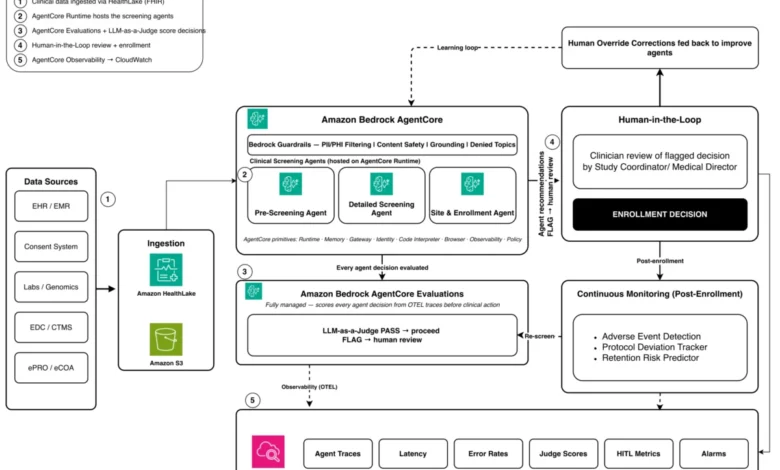
The newly detailed AWS reference architecture orchestrates a multi-layered screening pipeline through a synchronized deployment of specialized cloud services. AWS HealthLake serves as the foundational data layer, ingesting and normalizing multi-source patient records into standardized Fast Healthcare Interoperability Resources (FHIR R4) formats, rendering disparate health data instantly queryable.
At the core of the reasoning engine is Amazon Bedrock AgentCore operating within the Amazon Bedrock AgentCore Runtime. This runtime connects to specialized tools via the Model Context Protocol (MCP) Gateway, maintaining conversational session memory so that agents can reference earlier findings without re-querying datasets. Identity-based access control enforces least-privilege principles, while built-in code interpreters dynamically compute complex clinical metrics such as estimated Glomerular Filtration Rate (eGFR) and Body Mass Index (BMI).
The operational pipeline is divided into three distinct agent phases:
-
Pre-screening Agent: Acting as the initial operational gate, this component rapidly resolves three baseline parameters: validating informed consent, checking high-level demographic alignment (such as age, diagnostic category, and geography), and verifying whether the candidate has completed any mandated washout periods. Candidates passing these initial thresholds advance automatically, while non-qualifying profiles generate immediate, fully documented rejections citing the specific failing parameter.
-
Detailed Screening Agent: Serving as the primary clinical reasoning engine, this agent systematically evaluates all protocol inclusion and exclusion criteria. By retrieving relevant FHIR resources—including observations, conditions, and medication statements—the agent assesses organ function, evaluates adverse drug reactions, screens for contraindicated substances, and analyzes broader comorbidity risks. The output is a comprehensive, structured determination consisting of an evidence matrix, confidence scores, and reasoning summaries complete with direct source citations.
-
Site and Enrollment Agent: Once a candidate clears clinical screening, this operational component matches the patient to the most optimal trial site based on geographical proximity, institutional capabilities, investigator availability, and open enrollment capacity. Should a primary site reach capacity, the agent identifies alternative locations and alerts the study coordinator.
All agent operations are securely bound by Amazon Bedrock Guardrails, which enforce strict behavioral limits, block harmful content, and prevent demographic bias from influencing screening outcomes.
Evaluation Layers and Human-in-the-Loop Safeguards
To ensure uncompromised clinical integrity, the architecture implements a dual-layered governance model combining automated algorithmic evaluation with human oversight.
Step 3 of the pipeline utilizes Amazon Bedrock AgentCore Evaluations to continuously score every screening decision through an LLM-as-a-judge paradigm. Evaluators assess performance across three core pillars: clinical accuracy (correctness, faithfulness, coherence, and context relevance), operational effectiveness (helpfulness, conciseness, instruction following, and tool selection accuracy), and safety compliance (harmfulness detection, bias prevention, and uncertainty acknowledgment).
When an agent’s confidence score falls beneath a predefined threshold or when the evaluation layer flags potential ambiguities, the case is automatically routed to a tiered Human-in-the-Loop (HIL) review dashboard. Clinicians retain absolute authority at every stage of the process, possessing the capability to override, approve, or reject any recommendation generated by the system. Furthermore, every clinician correction is captured by the platform, feeding back into the system’s evaluation datasets to refine prompt engineering and retrieval tuning over time. This establishes a continuous learning loop where human expertise directly elevates machine performance.
Security, Compliance, and Auditability
Given the deeply sensitive nature of clinical trial records, the architecture is engineered to meet the stringent regulatory requirements governing modern healthcare technology. AWS HealthLake and Amazon Bedrock are fully HIPAA-eligible, SOC 2 attested, and certified under ISO and CSA STAR Level 2 frameworks. Data is encrypted both in transit and at rest, while AWS PrivateLink ensures that internal traffic remains isolated from the public internet.
To satisfy regulatory mandates such as FDA 21 CFR Part 11 concerning electronic records and digital signatures, the system generates immutable audit logs stored within Amazon DynamoDB. These records capture comprehensive execution histories, including clinician identifiers, timestamps, patient and trial identifiers, underlying AI recommendations, and final disposition outcomes. Concurrently, Amazon CloudWatch provides end-to-end observability, tracking latency metrics, API error rates, judge scores, and system alarms to guarantee that operations remain strictly within validated parameters.
Implications and Future Outlook
Industry observers note that the introduction of agentic architectures to clinical trials marks a significant milestone in the digital transformation of life sciences. By compressing patient matching workflows from days down to minutes, technology leaders believe sponsors can dramatically accelerate drug development cycles while simultaneously improving trial diversity and reducing administrative overhead.
Beyond initial patient enrollment and safety screening, the foundational orchestration framework is designed to support downstream clinical trial operations. Future iterations of the pipeline are expected to incorporate post-enrollment monitoring agents capable of detecting adverse events from unstructured clinical notes, tracking protocol deviations in real-time, predicting patient retention risks, and triggering automated re-screening alerts when changes in a participant’s clinical status impact ongoing eligibility.
As precision medicine protocols grow increasingly complex, the convergence of FHIR-native data interoperability, multi-step agentic reasoning, and mandatory human clinical governance provides a scalable, compliance-ready roadmap for the future of pharmaceutical research. Organizations looking to modernize their clinical trial infrastructure can begin deploying these modular components immediately through AWS-supported developer guides and enterprise integration pathways.
Related posts: