How ReadyOn Built a Four-Wall Zero-Trust Architecture to Secure Multi-Tenant Enterprise Workloads on Amazon EKS

The modern enterprise software landscape increasingly relies on multi-tenant cloud architectures to balance economic efficiency with high-performance computing requirements. However, as cloud-native platforms scale to process sensitive data for Fortune 100 corporations, the security demands placed on underlying infrastructure have never been higher. ReadyOn, an AWS Partner and a prominent provider of an intelligent Labor Orchestration Platform, operates a mission-critical multi-tenant system on Amazon Elastic Kubernetes Service (Amazon EKS). Handling vast repositories of sensitive enterprise data—including payroll records, intricate organizational hierarchies, and large-scale operational analytics—the company faced a formidable security challenge: how to guarantee absolute data isolation between competing or entirely separate enterprise tenants sharing a unified cloud infrastructure.
To address these vulnerabilities, ReadyOn engineered a sophisticated defense-in-depth framework known as the Four Walls model. Rather than relying on traditional, single-layer security boundaries, this architecture integrates independent protective barriers spanning the Kubernetes API, compute scheduling, software-defined networking, and database layers. As organizations increasingly migrate complex, compliance-heavy workloads to cloud environments, ReadyOn’s architectural blueprint offers an insightful case study in mitigating modern lateral movement threats and establishing robust zero-trust parameters within containerized ecosystems.
Understanding the Vulnerabilities of Native Kubernetes Multi-Tenancy
Kubernetes has justifiably become the de facto standard for orchestrating containerized applications, offering unmatched scalability, declarative management, and operational agility. Yet, out-of-the-box upstream Kubernetes deployments present significant security hurdles. Historically, default configurations permit anonymous requests to reach the API server—where they are only checked by Role-Based Access Control (RBAC)—while pods frequently run as root by default, and network policies are entirely absent until explicitly authored by administrators.
For single-tenant clusters, infrastructure hardening is a well-documented engineering exercise. However, the introduction of multi-tenancy fundamentally alters the threat model. In a shared cluster, the primary security concern transitions from preventing external unauthorized access to ensuring that Tenant A cannot under any circumstances access the data or compute resources of Tenant B.
Historically, many multi-tenant platforms have relied exclusively on Kubernetes namespaces as their primary isolation boundary. Yet, Kubernetes designers never intended namespaces to function as absolute security boundaries. A namespace provides logical separation rather than hardware- or network-level isolation. For an enterprise platform like ReadyOn’s Harmony—which processes workforce intelligence for hundreds of thousands of employees—relying on a single logical wall is insufficient. A cross-tenant data breach would not only shatter client trust but also trigger immediate, severe regulatory obligations across multiple international jurisdictions. Recognizing the high stakes, ReadyOn’s engineering team determined that enterprise-grade security demanded a compound defense strategy where multiple independent systems must fail simultaneously for a breach to occur.
The Four Walls Model: Architecture of Compound Defense
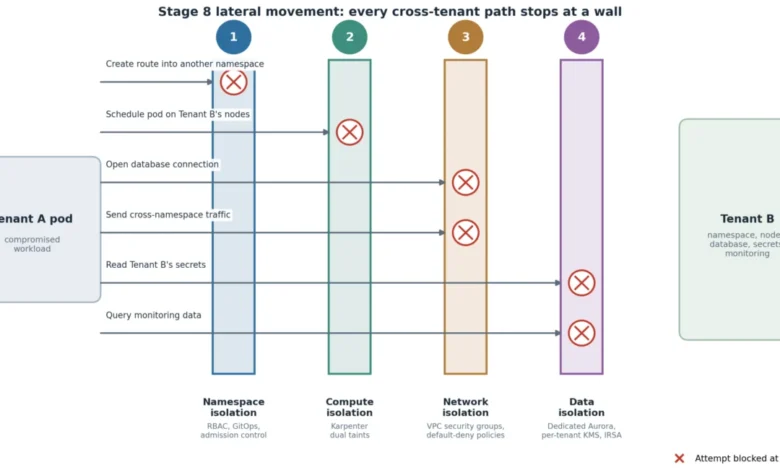
ReadyOn’s architecture interlocks four independent barriers, each operating at a completely different layer of the technology stack and requiring fundamentally distinct techniques to compromise. This layered strategy ensures that an unauthorized user or a compromised container must defeat multiple, disparate security controls simultaneously to achieve lateral movement.
Wall 1: Namespace Isolation and GitOps-Enforced Consistency
The foundation of the Four Walls model begins at the most visible boundary in Kubernetes: the namespace. While acknowledging the inherent limitations of namespaces as standalone security mechanisms, ReadyOn utilizes them as the logical baseline upon which all subsequent hardening layers are constructed.
To eliminate human error and configuration drift, ReadyOn implements strict GitOps principles using Argo CD ApplicationSets. When onboarding a new enterprise tenant, engineers simply add a single entry to a configuration manifest stored in a centralized Git repository. This automation immediately triggers the generation of all necessary tenant resources, including the namespace itself, associated network policies, RBAC bindings, resource quotas, and secret configurations. Consequently, there are no legacy tenants operating under outdated or weaker security policies; every tenant receives an identical, hardened security posture by design.
Furthermore, dynamic admission control frameworks validate all incoming resources against a rigorous policy set that enforces strict security contexts, blocks privileged configurations, and prevents the unauthorized creation of high-risk resource types such as DaemonSets or ClusterRoles. A continuous reconciliation loop instantly detects and reverts any manual or unauthorized modifications within seconds, ensuring that production clusters remain strictly aligned with the declared Git state without human intervention via kubectl.
Wall 2: Compute Isolation Powered by Karpenter
Moving beyond the Kubernetes API layer, Wall 2 addresses the physical and virtual compute layer—the actual underlying infrastructure where tenant application code executes. In the Harmony platform, tenants do not share compute nodes.
ReadyOn achieves this through an advanced dual-taint strategy managed by Karpenter, an automated node autoscaler for Kubernetes. Karpenter provisioners dynamically create compute nodes stamped with two specific taints: a unique tenant-identifier taint (e.g., tenant=acme-corp) and a workload-type taint (e.g., workload=frontend). To be successfully scheduled, a pod must explicitly tolerate both taints. Consequently, Tenant A’s frontend nodes are physically and logically segregated from Tenant A’s batch-processing nodes, and both are entirely isolated from Tenant B’s computing infrastructure.
Additional security hardening at this layer includes the strict enforcement of Instance Metadata Service Version 2 (IMDSv2) with a reduced hop limit on all application nodes, effectively preventing containerized workloads from querying instance metadata. Additionally, IAM roles attached to individual nodes are strictly scoped to a single tenant’s resources, containing the blast radius of any theoretical container escape.
Wall 3: Network Isolation at the Amazon VPC Layer
While the first two walls operate within the abstractions of Kubernetes, Wall 3 drops below the container orchestrator entirely, enforcing rigorous isolation at the Amazon Virtual Private Cloud (Amazon VPC) and security group level. This infrastructure is entirely outside the control plane of Kubernetes, meaning a compromised pod with limited internal access cannot manipulate these boundaries.
Each tenant’s dedicated Amazon Aurora database cluster is protected by a dedicated security group that permits inbound connections exclusively from the security group attached to that specific tenant’s application nodes. Under this AWS software-defined network rule, Tenant A’s nodes are mathematically and network-wise incapable of opening a TCP connection to Tenant B’s database.
The underlying VPC architecture is partitioned into four distinct tiers: a public perimeter tier housing only load balancers; an application tier containing EKS worker nodes within private subnets; a database tier consisting of Aurora clusters entirely devoid of internet access; and a control plane tier restricted to private EKS API endpoints accessible solely via VPN with mandatory OIDC and multi-factor authentication. Default-deny Kubernetes network policies and Amazon VPC Flow Logs complement these measures, ensuring that all unauthorized inter-namespace traffic is systematically blocked and logged.
Wall 4: Data Isolation via Dedicated Amazon Aurora and AWS KMS
The ultimate objective of any enterprise security architecture is the protection of data at rest and in transit. ReadyOn’s Wall 4 ensures that even if all preceding network, compute, and API layers were somehow compromised, data isolation remains intact.
Many multi-tenant architectures utilize shared database topologies, placing the entire burden of isolation on application-layer query logic—where a single omitted WHERE tenant_id = ? clause can result in catastrophic data leakage. ReadyOn avoids this risk entirely by provisioning dedicated Amazon Aurora clusters for every individual tenant. There are no shared tables and no row-level filters to misconfigure; Tenant A’s code lacks the database endpoint, the credentials, and the network path required to communicate with Tenant B’s data store.
Moreover, these dedicated Aurora clusters are encrypted using unique AWS Key Management Service (AWS KMS) keys assigned on a per-tenant basis. Even in the highly improbable event of raw storage exposure, one tenant’s distinct cryptographic key cannot decrypt the data of another. Workloads authenticate to AWS APIs exclusively through short-lived credentials issued via AWS Security Token Service (AWS STS) using IAM Roles for Service Accounts (IRSA), eliminating long-lived credentials entirely.
Implications and Industry Significance
ReadyOn’s comprehensive architectural approach arrives at a time when enterprise adoption of cloud-native infrastructure is accelerating, yet cybersecurity threats are growing increasingly sophisticated. By systematically mapping their defenses against recognized frameworks like MITRE ATT&CK—particularly focusing on lateral movement scenarios—the engineering team has demonstrated that robust zero-trust principles can be successfully operationalized within complex Kubernetes environments.
Industry analysts note that as regulatory compliance standards tighten globally, architectures that decouple tenant environments at the hardware, network, and data layers will increasingly become the benchmark for enterprise software vendors. ReadyOn’s rigorous adversarial testing regimen—which regularly simulates worst-case container compromise scenarios without yielding a single successful cross-tenant breach path—underscores the efficacy of the Four Walls model.
Ultimately, the architecture proves that organizations do not need to sacrifice operational velocity or cost-efficiency to achieve elite-level security. By thoughtfully integrating native cloud services with disciplined GitOps automation and immutable infrastructure patterns, ReadyOn has established a scalable, resilient reference architecture for secure multi-tenancy on Amazon EKS, offering a valuable roadmap for the broader enterprise technology sector.
Related posts: