Enterprise Technology Bulletin: How ReadyOn Redefines Multi-Tenant Cloud Security with its Four Walls Model on Amazon EKS

The modern enterprise software landscape increasingly relies on multi-tenant cloud architectures to balance operational efficiency, scalability, and cost-effectiveness. However, running multi-tenant platforms that handle highly sensitive data—such as payroll records, organizational hierarchies, and operational analytics—introduces formidable security challenges. ReadyOn, an AWS Partner and a prominent provider of an intelligent Labor Orchestration Platform for Fortune 100 enterprises, recently published a comprehensive technical blueprint detailing its "Four Walls" security architecture. Operating on Amazon Elastic Kubernetes Service (Amazon EKS), the company’s Harmony platform processes workforce intelligence spanning hundreds of thousands of employees. Because a data breach or cross-tenant contamination would trigger severe regulatory liabilities and erode client trust, ReadyOn engineered an advanced, multi-layered defense mechanism that transcends traditional cloud security boundaries.
The Inherent Vulnerabilities of Standard Kubernetes Multi-Tenancy
Kubernetes has cemented its position as the de facto standard for container orchestration, serving as the core infrastructure engine for enterprise IT environments. Yet, out-of-the-box Kubernetes deployments are rarely secure by default. Historically, upstream Kubernetes permitted anonymous requests to reach the API server where they were obstructed solely by Role-Based Access Control (RBAC). Furthermore, default configurations allow pods to run with root privileges, while network policies remain entirely absent unless explicitly defined by platform administrators.
While securing a single-tenant Kubernetes cluster is a well-documented engineering task, introducing a multi-tenant threat model fundamentally alters the calculus. The primary security objective shifts from preventing unauthorized external access to mitigating the risk of lateral movement—specifically, ensuring that Tenant A cannot access the data or compute resources of Tenant B.
Historically, many multi-tenant platforms rely exclusively on Kubernetes namespaces as their primary isolation boundary. However, Kubernetes architects never designed namespaces to function as hard security boundaries. A compromise of the control plane or an API vulnerability can easily breach namespace restrictions. Recognizing that Fortune 100 enterprises require absolute data segregation, ReadyOn abandoned the single-wall paradigm in favor of a compound defense strategy where four independent layers must be simultaneously breached to compromise tenant isolation.
Chronology and Architectural Evolution of the Four Walls Model
The development of ReadyOn’s Harmony platform required a systematic overhaul of how enterprise workloads are provisioned, scheduled, networked, and stored. The architectural journey began with the recognition that software-defined perimeters must operate across distinct layers of the technology stack, ensuring that a failure in one layer does not precipitate a system-wide compromise.
Wall 1: Logical Isolation via Namespace and GitOps Enforcement
At the uppermost abstraction layer, ReadyOn utilizes Kubernetes namespaces as the foundational logical boundary. Rather than relying on manual administrative intervention, the company enforces absolute consistency through a GitOps-driven deployment pipeline powered by Argo CD.
When a new enterprise tenant is onboarded, engineers simply add a single configuration entry to a centralized Git manifest. Automated workflows immediately generate all mandatory tenant resources, including namespaces, network policies, RBAC bindings, resource quotas, and secret configurations. This automated lifecycle management ensures that "legacy" tenants with weaker security postures cannot exist within the ecosystem.
RBAC bindings strictly confine API access to a tenant’s designated namespace, completely prohibiting any principal from listing, getting, or modifying resources belonging to another organization. Additionally, admission control frameworks validate all deployed resources against stringent security profiles, blocking privileged configurations and unauthorized object creation. Continuous reconciliation loops provided by Argo CD ensure that any manual configuration drift or unauthorized modification is automatically detected and reverted within seconds.
Wall 2: Compute Isolation via Karpenter-Managed Dedicated Node Pools
Moving down from the Kubernetes API layer, Wall 2 addresses the physical and virtual compute environments where tenant code executes. In the Harmony platform, tenants never share underlying compute nodes.
ReadyOn leverages Karpenter, an automated node autoscaling project for Kubernetes, to provision dedicated node pools governed by a rigorous dual-taint strategy. Each provisioned node carries a specific tenant-identifier taint (e.g., tenant=enterprise-alpha) alongside a workload-type taint (e.g., workload=frontend). Consequently, application pods must possess explicit tolerations for both taints to be scheduled. This ensures that Tenant A’s frontend and batch processing nodes remain entirely isolated from one another, while sharing zero physical infrastructure with Tenant B.
To fortify this layer against container escapes, all nodes enforce Instance Metadata Service Version 2 (IMDSv2) with strict hop limits, blocking unauthorized attempts by containerized workloads to query the instance metadata endpoint. Furthermore, IAM roles attached to individual nodes are strictly scoped to a single tenant’s resources, preventing lateral expansion even if container isolation is compromised.
Wall 3: Network-Level Defense via Amazon VPC Security Groups
While the first two walls operate within the Kubernetes abstraction, Wall 3 drops beneath the container orchestrator to enforce infrastructure isolation at the Amazon Virtual Private Cloud (Amazon VPC) and security group level.
ReadyOn divides its VPC architecture into four distinct tiers:
- Public Perimeter Tier: Restricted exclusively to external load balancers.
- Application Tier: Houses EKS worker nodes operating securely within private subnets.
- Database Tier: Dedicated to backend data stores completely devoid of direct internet access.
- Control Plane Tier: Encompasses private EKS API endpoints accessible solely via secure VPN connections augmented by OIDC and multi-factor authentication (MFA).
Crucially, each tenant’s Amazon Aurora database cluster is shielded by a dedicated security group that permits inbound traffic exclusively from the exact security group attached to that specific tenant’s application nodes. AWS software-defined networking enforces these rules, meaning Tenant A’s nodes lack the network path required to initiate a TCP connection to Tenant B’s database. Furthermore, default-deny Kubernetes network policies and comprehensive Amazon VPC Flow Logs ensure that all inter-namespace traffic is aggressively scrutinized and logged.
Wall 4: Data-Layer Isolation via Dedicated Amazon Aurora and KMS Keys
The final and most critical barrier protects the enterprise data itself. Many multi-tenant architectures utilize shared databases, placing the entire burden of security on application-level query logic. In such environments, a single omitted WHERE tenant_id = ? clause can result in catastrophic data leakage.
ReadyOn eliminated this vulnerability by provisioning dedicated Amazon Aurora clusters for every individual tenant. Because there is no shared database, there are no row-level security filters that can be misconfigured. Tenant A’s application code cannot construct a connection to Tenant B’s database because it lacks the requisite network path, endpoint credentials, and IAM permissions.
Moreover, ReadyOn implements unique AWS Key Management Service (AWS KMS) encryption keys for each tenant. Data at rest is encrypted using distinct keys, ensuring that even in the highly improbable event of raw storage exposure, one tenant’s cryptographic key cannot decrypt another’s data.
To maintain operational integrity without relying on long-lived credentials, workloads authenticate to AWS services using short-lived credentials issued through IAM Roles for Service Accounts (IRSA) and OIDC federation. Application pods hold zero static access keys, and tokens expire automatically within minutes.
Adversarial Testing and Threat Mitigation Analysis
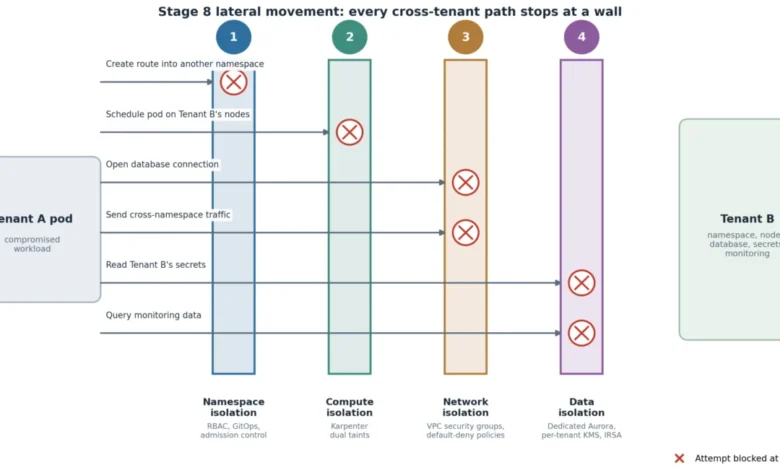
To validate the efficacy of the Four Walls model, ReadyOn maps its defensive posture against its comprehensive 10-stage multi-tenant threat model, aligning directly with MITRE ATT&CK adversarial techniques. The critical juncture in this model occurs during Stage 8: Lateral Movement. In this scenario, an adversary who has successfully compromised a low-privilege pod within Tenant A attempts to pivot toward Tenant B’s infrastructure.
Regular adversarial penetration testing exercises simulate this exact attack vector, granting simulated hostile actors restricted access within a tenant pod. Empirical results from these internal stress tests indicate that the compound defense model successfully terminates all lateral movement attempts:
- Attempts to route traffic into another namespace are blocked at Wall 1.
- Attempts to schedule malicious pods onto neighboring compute nodes are blocked at Wall 2.
- Attempts to establish cross-tenant database connections or transmit unauthorized network packets are blocked at Wall 3.
- Attempts to query monitoring data or retrieve sensitive secrets are blocked at Wall 4.
To date, repeated adversarial simulations have failed to identify a viable path capable of breaching all four walls simultaneously.
Industry Implications and the Future of Cloud-Native Multi-Tenancy
The technical approach pioneered by ReadyOn offers profound implications for software-as-a-service (SaaS) providers and enterprise IT organizations operating in regulated sectors. As regulatory frameworks regarding data privacy—such as the GDPR, HIPAA, and emerging global AI and workforce compliance mandates—grow increasingly stringent, reliance on logical isolation alone is no longer tenable for high-stakes workloads.
Industry analysts note that ReadyOn’s architecture redefines the benchmark for zero-trust cloud engineering. By harmonizing native cloud services—such as Amazon EKS, Karpenter, Amazon VPC, and Amazon Aurora—into a unified, GitOps-controlled continuum, organizations can achieve uncompromising security without sacrificing the economic advantages and rapid deployment velocities inherent to multi-tenant models.
For enterprise CTOs and cloud architects navigating the complexities of modern infrastructure, the Four Walls model serves as a validated reference architecture. It demonstrates that robust, defense-in-depth security is not achieved by seeking a single silver bullet, but by engineering multiple independent, overlapping barriers that require an attacker to defeat fundamentally different layers of the technology stack concurrently.
Related posts: