AWS Announces Major Redesign of the Well-Architected Framework to Streamline Cloud Governance and Accelerate Automation

Amazon Web Services (AWS) has rolled out a comprehensive update to the AWS Well-Architected Framework, introducing sweeping architectural changes designed to modernize cloud governance, reduce administrative overhead, and facilitate automated architecture reviews. Spanning all six core pillars—Operational Excellence, Security, Reliability, Performance Efficiency, Cost Optimization, and Sustainability—the latest iteration radically restructures how enterprises design, build, and operate their cloud environments.
The most significant structural modification in this release is the division of the Framework into two distinct domains: Well-Architected Cloud Foundations and Well-Architected Cloud Workloads. By separating account- and organization-wide best practices from application-specific workload guidance, AWS aims to eliminate redundancy, allowing engineering teams to establish foundational governance guardrails once at the environment level while maintaining laser-focused evaluations for individual workloads.
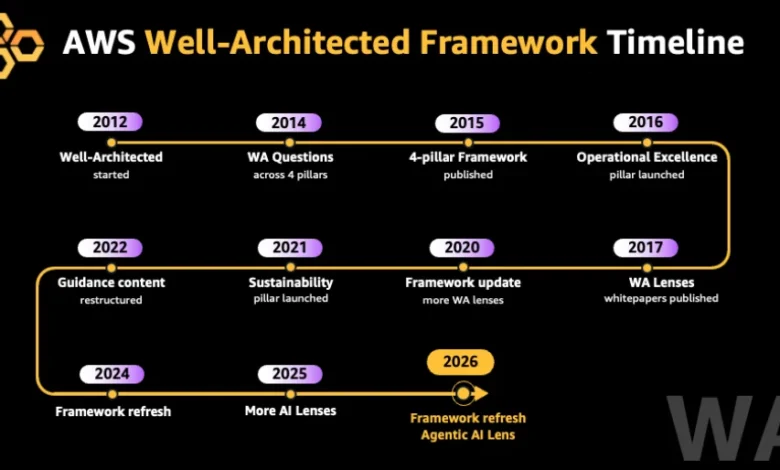
Evolution of the Framework: A 14-Year Journey
To understand the scale of the current redesign, one must examine the evolution of the AWS Well-Architected Framework since its inception. Launched in 2012 as a foundational set of design principles, the Framework initially served as a static whitepaper meant to guide cloud architects toward building resilient and secure infrastructures. Over the ensuing decade, as enterprise cloud adoption accelerated globally, the initiative expanded into a comprehensive body of architectural knowledge.
In 2017, AWS introduced the Operational Excellence pillar, recognizing that human processes and operational procedures are just as critical to cloud success as underlying technology. Subsequent years saw the release of pillar-specific whitepapers, industry- and technology-specific Well-Architected Lenses, and the integration of Sustainability as the sixth pillar in 2021 to address escalating enterprise demands for environmentally conscious computing.
By the early 2020s, the rapid proliferation of generative artificial intelligence and agentic workflows presented new challenges. Architecture reviews—traditionally manual processes conducted via periodic questionnaires—began to bottleneck agile development cycles. The 2026 restructuring directly addresses this friction, adapting the Framework to support automated validation by AI agents and modern continuous integration pipelines.
Decoupling Foundations from Workloads
Historically, enterprise cloud architects faced redundant evaluations. Best practices governing multi-account hierarchies, enterprise identity management, and baseline cost controls had to be reviewed repeatedly for every individual workload deployed within an organization.
The introduction of Well-Architected Cloud Foundations resolves this inefficiency. The newly consolidated foundations layer comprises 45 precise best practices distributed across seven core capabilities: Multi-account environment, Identity and access management, Central observability management, Resource and inventory management, Security and compliance, Cloud financial management, and Networking and connectivity. Of these, 33 best practices have been migrated and rewritten from existing pillars to provide an environment-wide perspective, augmented by newly introduced guidance covering centralized event monitoring, auditable cloud inventory records, and centralized DNS management.
Conversely, Well-Architected Cloud Workloads has been streamlined from 307 down to 216 best practices. By purging environment-wide concerns and retiring qualitative guidelines that relied heavily on subjective human judgment—such as organizational culture and business strategy—AWS has refined the workload layer to focus exclusively on technical architecture decisions. This rigorous trimming ensures that every remaining best practice can be objectively audited, making the framework exceptionally well-suited for programmatic analysis by AI-driven automated review agents.
Pillar-by-Pillar Breakdown of Technical Updates
The technical refinements across the six pillars reflect emerging enterprise priorities, most notably cyber resilience, generative AI integration, and granular resource efficiency.
In Operational Excellence, the update introduces a life-cycle approach spanning observation, insight derivation, change flow management, deployment, support, incident response, and continuous evolution. The pillar now includes explicit guidance on managing the rollouts of external dependencies and expands directives on leveraging AI assistants and agents to construct telemetry, draft operational dashboards, and investigate active incidents—always governed by explicit performance baselines and named human ownership.
The Security pillar shifts macro-level concerns—such as root account protection, sign-in mechanisms, emergency access, and forensic readiness—into the Cloud Foundations layer. Within the workload domain, Security introduces targeted best practices for centralized workload permissions management, detection metrics, dashboards, and rigorous secure coding guidelines designed to mitigate application-layer vulnerabilities.
Reliability undergoes a strategic realignment by transferring networking prerequisites—such as IP subnet allocation, hub-and-spoke topologies, and non-overlapping address ranges—into the centralized networking capability of Cloud Foundations. Simultaneously, the Reliability workload layer introduces a critical new best practice centered on cyber resilience for backup data, providing enterprises with standardized mechanisms to protect immutable backups against ransomware and sophisticated cyber assaults.
Performance Efficiency refines its approach to architectural selection by requiring strict validation of workload requirements paired with continuous Key Performance Indicator (KPI) tracking. Redundant guidelines have been consolidated; for instance, compute configuration practices are now unified under compute selection, while load testing is merged directly into overarching workload performance evaluations.
Cost Optimization transfers all account-level financial controls, billing tools, and cost attribution models into the Cloud Financial Management capability within Cloud Foundations. Within individual workloads, Cost Optimization introduces a prominent new best practice focusing on the application of generative AI to drive operational and financial efficiency, alongside streamlined resource lifecycle management directives.
Sustainability adopts a mature operational model inspired by enterprise feedback, converting general historical guidance into actionable best practices. The pillar now mandates the use of the most resource-efficient computational approaches—encouraging organizations to deploy less resource-intensive algorithms or smaller, highly optimized machine learning models when they adequately meet operational requirements. Furthermore, sustainability metrics are now explicitly correlated with carbon emissions telemetry drawn from the AWS Sustainability Console, Data Exports, and APIs, establishing measurable baselines to track environmental progress over time.
Industry Implications and Automated Governance
The architectural overhaul of the Well-Architected Framework signals a fundamental shift in how cloud governance is administered. By pivoting toward strictly technical, auditable parameters, AWS has laid the groundwork for native, real-time architecture compliance verification.
Industry analysts note that traditional, manual Well-Architected reviews often suffered from "point-in-time" obsolescence, remaining accurate only for the duration of the audit meeting. By structuring the Framework for machine readability and AI agent verification, organizations can transition from periodic retrospective reviews to continuous, automated architecture monitoring. This transition reduces human error, accelerates remediation cycles, and ensures that cloud environments remain secure, cost-optimized, and resilient at scale.
Deployment and Global Availability
The updated AWS Well-Architected Framework is immediately accessible through the official AWS documentation portals. To support global enterprise teams, AWS has confirmed that the revised framework will soon be rolled out across 11 languages, including English, Spanish, French, German, Italian, Japanese, Korean, Indonesian, Brazilian Portuguese, Simplified Chinese, and Traditional Chinese.
Organizations are encouraged to adopt the bifurcated approach by first establishing robust Well-Architected Cloud Foundations across their multi-account management hierarchies, followed by systematic workload-level evaluations to foster a continuous culture of operational excellence and architectural resilience.