Architecting the Future of Enterprise AI: A Comprehensive Blueprint for Governed, Observable, and Autonomous Agents

As artificial intelligence rapidly transitions from experimental chat interfaces to autonomous enterprise workers, organizations face a critical architectural imperative. An enterprise AI agent is fundamentally distinct from a traditional single-turn chatbot. While a chatbot simply consumes an input message and returns a localized response, an autonomous agent operates on a continuous, multi-step cognitive loop designed to fulfill a overarching business goal. It must parse user intent, construct a dynamic execution plan, retrieve relevant contextual knowledge, evaluate multiple lines of reasoning, invoke external software tools, and rigorously verify its intermediate results before deciding whether to iterate further or return a finalized outcome.
Because each phase of this complex lifecycle directly interacts with sensitive corporate data, backend databases, and mission-critical APIs, robust governance, strict observability, and comprehensive trust controls must be embedded into every single tier of the underlying infrastructure. Industry leaders have increasingly recognized that failing to treat agentic systems with this holistic, multi-layered rigor leads to severe operational bottlenecks, uncontrollable token expenditures, and unacceptable security vulnerabilities. To address these systemic challenges, enterprise architects are establishing standardized reference blueprints, mapping complex cognitive loops to proven cloud infrastructure to ensure scalability, cost-efficiency, and absolute compliance.
The Shift from Static Chatbots to Dynamic Autonomous Agents
The enterprise motivation for moving beyond single-turn conversational interfaces is rooted in tangible business outcomes. Organizations are under constant pressure to automate routine administrative and operational workflows, thereby empowering human talent to focus on higher-value creative and strategic initiatives. By deploying agents capable of executing multi-step workflows independently, companies can accelerate product delivery, optimize customer support experiences, and drive productivity gains without requiring linear increases in headcount.
However, this transition introduces complex architectural hurdles in orchestration, state management, and enterprise governance. During prominent industry gatherings such as AWS re:Invent, technology leaders have repeatedly emphasized that developers succeeding with generative intelligence are those who think in distributed systems and build with extreme precision. The organizations pulling ahead are not necessarily those that rushed to adopt the newest foundation models first, but rather those that treat the entire deployment as a tightly integrated system, keenly aware that a design decision made at the infrastructure layer will invariably impact performance, security, and cost across all surrounding layers.
Defining the core characteristics of these systems requires looking closely at their foundation model (FM) reasoning cores. Augmented with specialized tool registries, persistent memory caches, and automated guardrails, an AI agent can tackle complex, multi-layered assignments that span hours or days. Rather than generating a single response and terminating the session, an agent dynamically cycles through understanding, planning, retrieval, reasoning, and execution until the user’s objective is fully realized or safely escalated to a human supervisor.
The Five-Layer Reference Architecture
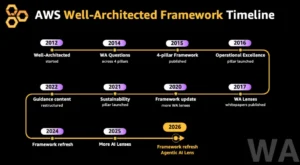
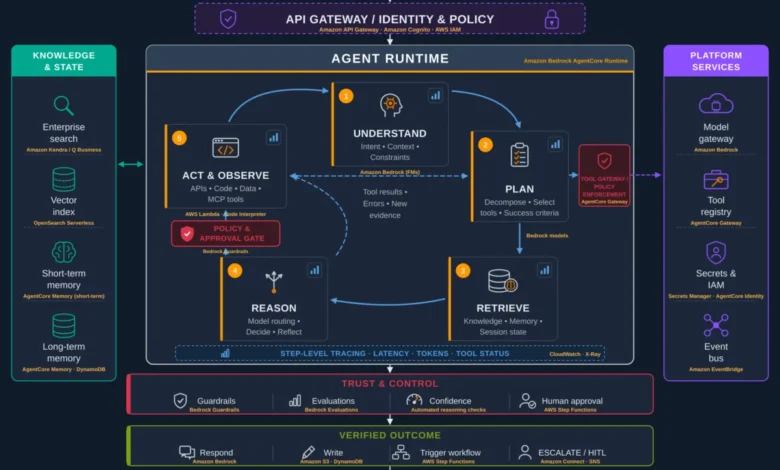
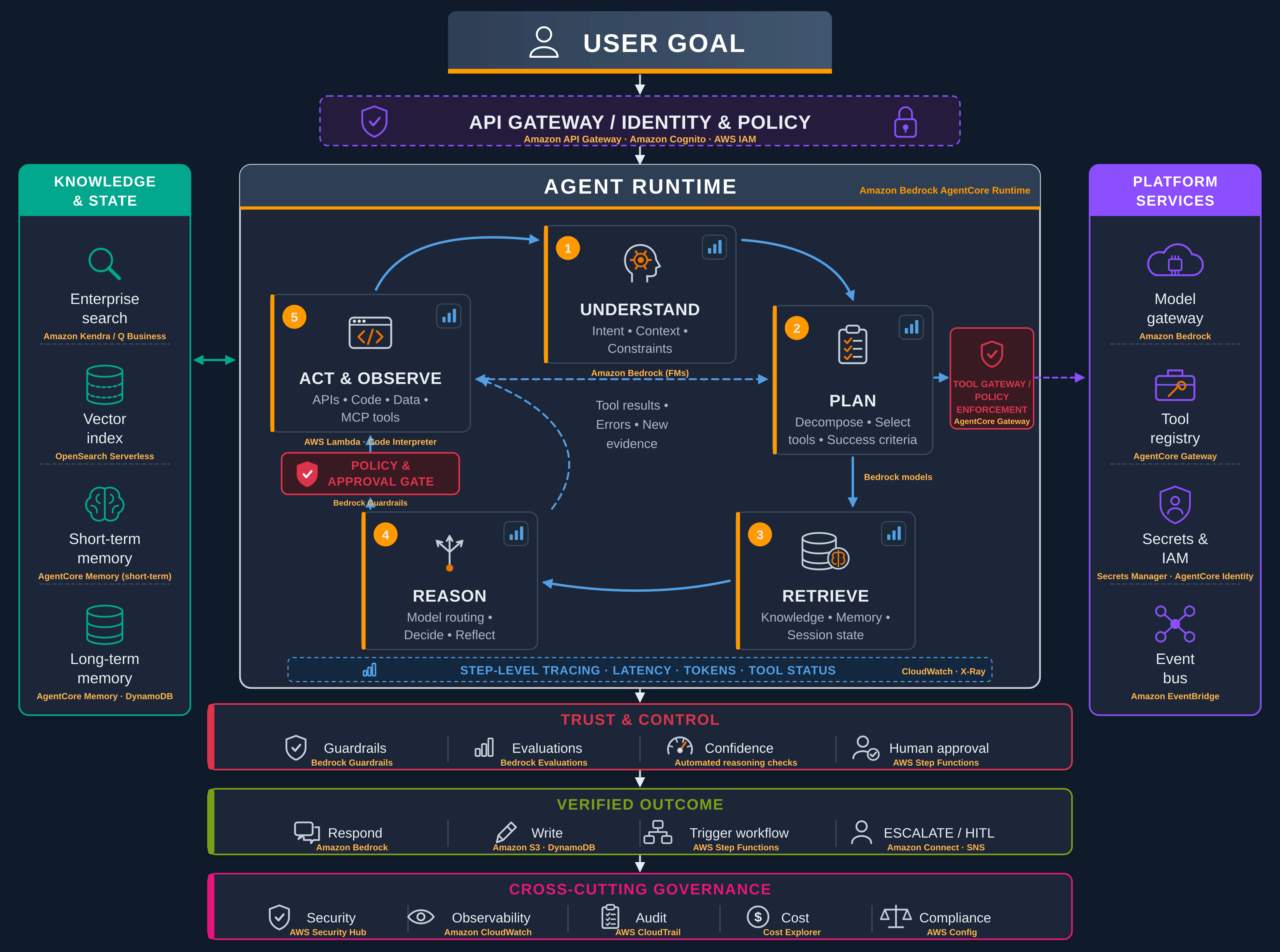
To operationalize autonomous agents reliably at scale, architects are turning to structured, five-layer reference frameworks. This modular approach aligns closely with established engineering principles such as the AWS Well-Architected Framework Generative AI Lens, mapping out specific responsibilities from the initial API request down to verified operational outcomes.
Layer 1: Entry Point, API Gateway, Identity, and Policy
Every agentic interaction begins with a plain-language user goal—ranging from simple queries regarding quarterly financial metrics to complex, multi-faceted requests involving calendar scheduling and project documentation synthesis. Before this natural language intent ever reaches the cognitive runtime, it must pass through a highly secure entry point.
The API gateway serves as the primary ingress vector, handling Transport Layer Security (TLS) termination, managing REST and WebSocket connections for real-time streaming, and enforcing strict rate-limiting policies. Crucially, the identity and authentication tier validates incoming OAuth 2.0 or OpenID Connect (OIDC) tokens, resolving the caller’s unique identity and binding their specific roles, organizational permissions, and session context to the execution request. This context travels alongside the payload through every subsequent phase of the loop, guaranteeing that downstream data lookups and software tool invocations strictly adhere to the principle of least privilege. Concurrently, policy enforcement engines evaluate role-based access control (RBAC), tool-level permissions, and usage quotas to prevent unauthorized actions.
Layer 2: The Agent Runtime and the Five-Phase Cognitive Loop
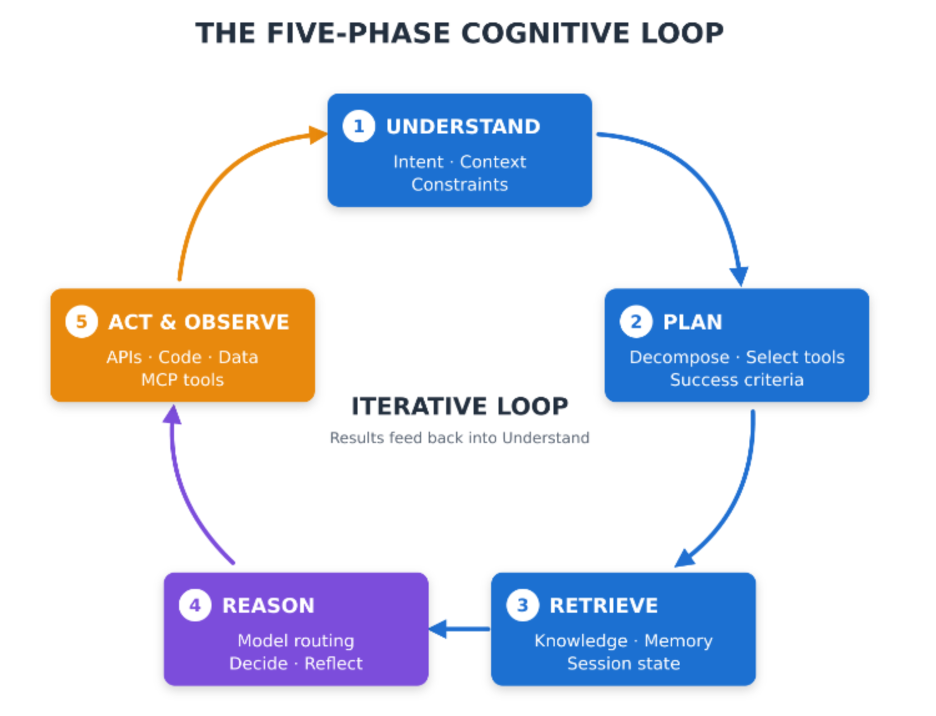
At the heart of the architecture lies the agent runtime, executing a continuous, iterative loop comprising five distinct cognitive phases: Understand, Plan, Retrieve, Reason, and Act and Observe. This structured workflow synthesizes proven concepts from robotics, advanced prompting techniques like ReAct (Reasoning and Acting), and self-reflection paradigms such as Reflexion, where a model critiques its own prior attempts to optimize subsequent iterations.
- Understand: The agent ingests user inputs, extracts core intent, identifies relevant context, and processes behavioral constraints. Input filters and system prompts shape the agent’s persona while scrubbing potential prompt injection vectors.
- Plan: The foundation model decomposes the overarching business goal into an ordered task graph, often represented as a directed acyclic graph (DAG), selecting appropriate tools and defining explicit success criteria for each sub-task.
- Retrieve: The agent grounds its upcoming reasoning steps in verified data by querying enterprise knowledge bases, vector indexes, and session memory stores via a robust Retrieval-Augmented Generation (RAG) pipeline.
- Reason: The model synthesizes retrieved evidence, evaluates potential pathways, performs model routing, and continuously reflects on interim progress against established success metrics.
- Act and Observe: The agent executes authorized tool calls against external systems, immediately capturing the resulting data, error codes, or telemetry to feed back into the cognitive loop.
To prevent runaway resource consumption, architects implement strict safeguards against anti-patterns such as infinite reasoning loops. By imposing hard ceilings on loop iterations, setting strict timeout budgets, and establishing automated human escalation pathways, engineering teams ensure that a confused or deadlocked agent cannot continuously drain token budgets and saturate backend infrastructure.
Layer 3: Knowledge and State Management
An enterprise agent requires robust data infrastructure to maintain factual grounding and conversational continuity. This knowledge and state tier is typically partitioned into four specialized components: enterprise search systems for full-text and semantic retrieval across organizational wikis; vector index stores containing embeddings for high-speed semantic similarity matching; short-term memory buffers handling immediate session context windows; and long-term memory repositories preserving user preferences and learned operational patterns across extended time horizons. Fully managed vector databases and high-performance caching layers ensure that these memory operations occur with minimal latency.
Layer 4: Platform Services Infrastructure
Underpinning the runtime are essential platform services designed to abstract away operational complexity. A centralized model gateway sits in front of diverse foundation model providers, handling intelligent model routing, automatic failovers, rate limiting, token metering, and response caching. By normalizing API schemas across different providers, this gateway allows engineering teams to swap underlying models seamlessly without refactoring core agent logic.
Additionally, a comprehensive tool registry catalogs every available API, function, and connector via standardized OpenAPI schemas, detailing exact input-output parameters and declared side effects. Secrets management systems securely store and automatically rotate API keys and database credentials, while asynchronous event buses track agent lifecycle events to maintain decoupled, highly observable system architectures.
Layer 5: Trust, Control, and Cross-Cutting Governance
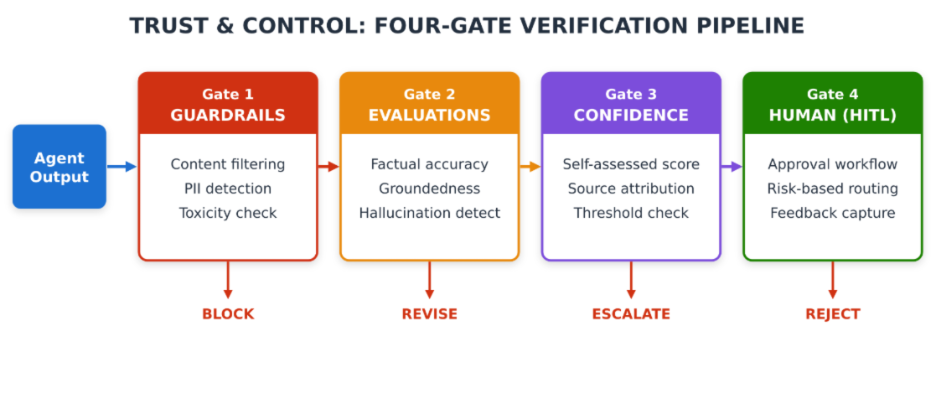
The final architectural layer addresses the primary barrier to enterprise AI adoption: trust and regulatory compliance. Operating between the runtime engine and the final output delivery, this layer deploys a rigorous, four-gate verification pipeline:
- Gate 1: Guardrails scan outgoing responses for toxic content, hate speech, regulated Personally Identifiable Information (PII), and denied topics.
- Gate 2: Automated Evaluations assess output groundedness, perform hallucination detection, and utilize independent "judge" models to verify the factual accuracy of primary model generations.
- Gate 3: Confidence Scoring requires the agent to evaluate its own certainty, attribute claims directly to source documents, and compare its confidence levels against predefined operational thresholds.
- Gate 4: Human-in-the-Loop (HITL) Approval routes high-risk actions—such as financial transactions, data modifications, or external communications—through mandatory human review checkpoints where operators can inspect reasoning traces before granting final authorization.
Cross-cutting governance frameworks tie these controls directly to recognized standards such as the NIST AI Risk Management Framework and emerging legislation like the European Union’s Artificial Intelligence Act. By continuously enforcing security, detailed auditability, precise cost tracking, and rigorous compliance, organizations can systematically mitigate legal and operational exposure.
Production Implementations and Real-World Impact
Real-world deployments across various industries validate the efficacy of multi-layered agentic architectures. Prominent enterprise software and data security providers have successfully deployed multi-agent ecosystems built upon managed cloud services, achieving remarkable productivity gains. Case studies from organizations utilizing sophisticated agentic frameworks indicate dramatic improvements in incident resolution times, with significant percentages of routine customer technical issues resolved entirely through autonomous agent workflows. Furthermore, automotive enterprises utilizing structured agentic solutions have successfully transitioned dozens of production-grade AI agents into active service within remarkably compressed development windows, drastically reducing manual investigative overhead.
Industry experts continually advise engineering teams to adhere to proven design patterns when constructing these systems. Implementing "graduated autonomy"—where agents are initially deployed in read-only modes and granted write permissions progressively as they earn organizational trust—significantly reduces deployment risk. Similarly, establishing "fail-safe defaults" ensures that whenever an agent encounters ambiguous requests, API timeouts, or missing tools, it defaults to asking clarifying questions or escalating to human operators rather than executing potentially destructive guesses. Adopting a multi-model strategy—deploying smaller, highly efficient models for lightweight intent classification while reserving larger, more expensive foundation models for complex planning and reasoning phases—further optimizes overall compute economics without sacrificing functional quality.
Conversely, engineering teams are strongly cautioned against anti-patterns such as building monolithic, all-encompassing agents. Instead, architectural best practices dictate the deployment of specialized, single-purpose agents coordinated by a centralized supervisor agent, ensuring cleaner testability, modular scalability, and simplified debugging. Crucially, governance, guardrails, and observability must never be treated as secondary, "trust-later" considerations; they must be engineered as core operational primitives from the very first day of development.
Conclusion
The primary challenge of deploying enterprise-grade artificial intelligence has never been the raw capability of the underlying foundation models. Rather, the true complexity lies in engineering the comprehensive infrastructure surrounding the model—the robust identity contexts that accompany every request, the persistent memory systems, the rigorous verification gates, and the granular step-level tracing required to audit non-deterministic behaviors. Organizations that master these architectural principles transform generative AI from a clever novelty into a dependable, highly scalable business asset. By embracing governed, observable, and multi-layered agentic frameworks, engineering leaders can successfully navigate the complexities of autonomous enterprise automation and deliver secure, verifiable value across their entire operations.