Amazon EventBridge introduces enhanced custom event buses to revolutionize multi-account architecture scaling.

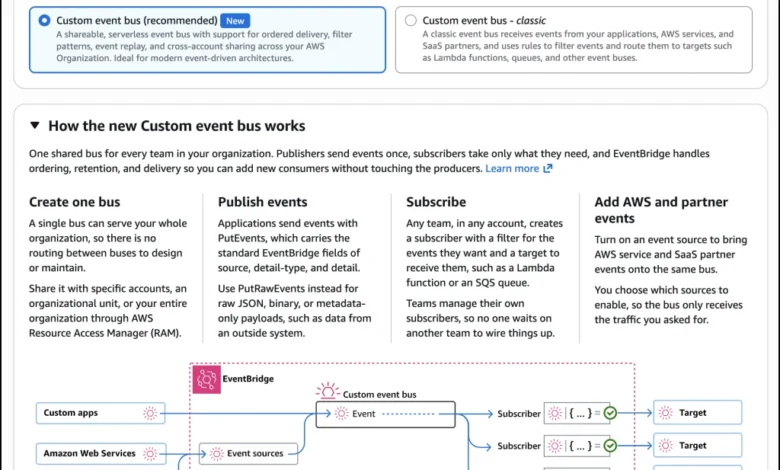
For organizations leveraging serverless architectures, the rapid expansion of event-driven applications often leads to a paradoxical outcome: as the system grows, the operational burden of managing that system increases in tandem. Historically, Amazon EventBridge users operating within multi-account environments faced significant friction when trying to scale their event infrastructure. While the standard practice of using individual custom event buses within dedicated accounts is ideal for isolated teams, it creates a "spaghetti" of cross-account rules and bus-to-bus configurations as organizations mature. Today, Amazon Web Services (AWS) has announced the general availability of an enhanced custom event bus for Amazon EventBridge, a transformative update designed to centralize event management, ensure message ordering, and simplify cross-account collaboration.
The Evolution of Event-Driven Complexity
The rise of the microservices paradigm has placed immense pressure on event buses. In a typical enterprise setup, platform teams are tasked with maintaining visibility and governance over dozens, if not hundreds, of disparate event streams. Under the previous architecture, if Team A needed to consume events from Team B across an account boundary, engineers were required to manually configure cross-account permissions and establish specific routing rules. This not only introduced potential points of failure but also created a significant billing overhead, as costs associated with bus-to-bus routing accumulated rapidly.
Furthermore, the lack of native, large-scale sequencing capabilities meant that teams requiring strict event ordering—such as those handling financial transactions or real-time logistics tracking—were forced to build intricate workarounds. This often involved injecting additional middleware, such as Amazon Simple Queue Service (SQS) buffers, between the bus and the final compute target. This practice, while functional, added latency and complexity, contradicting the very essence of serverless agility.

A New Architectural Paradigm
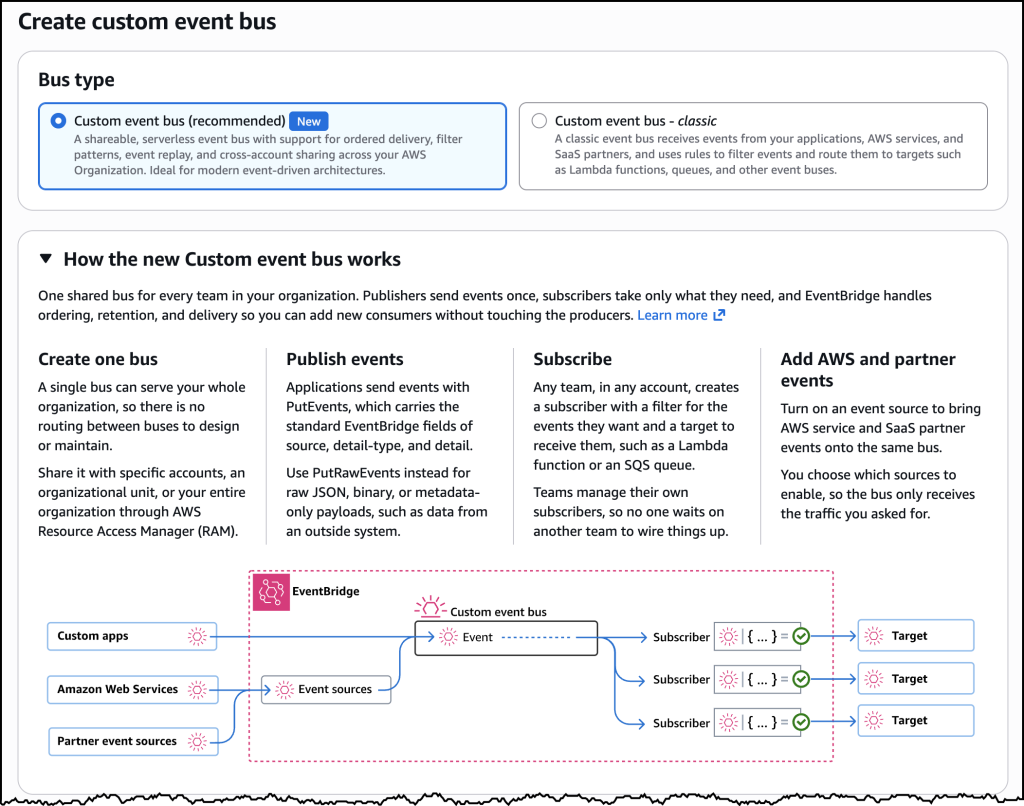
The enhanced custom event bus serves as a centralized event backbone. By allowing a single bus to be shared across an entire AWS Organization, the update effectively collapses the complex web of cross-account routing. By leveraging AWS Resource Access Manager (AWS RAM), platform teams can now define precisely which accounts or organizational units have access to the bus, providing a unified control plane for publishers and subscribers alike.
This shift marks a departure from the "classic" EventBridge model. While the legacy system remains fully supported for existing workloads, the new enhanced bus introduces three fundamental improvements: native event sequencing, a simplified Subscriber resource model, and a consumption-based pricing structure designed for high-scale environments.
Chronology of Scalability Challenges
The journey toward this release can be traced through the iterative feedback cycles of the AWS developer community over the past three years.
- Initial Phase (2021-2022): Organizations began moving from monolithic applications to event-driven architectures. Early adopters thrived, but those scaling to hundreds of accounts reported "rule fatigue," where the sheer volume of EventBridge rules became impossible to audit manually.
- Optimization Phase (2023-2024): Developers began implementing secondary tools to manage event ordering and deduplication, acknowledging that the native EventBridge toolset, while powerful, required too much "glue code" for specialized use cases.
- The Enhanced Release (2026): AWS addressed these systemic limitations by introducing the enhanced bus, effectively integrating the features previously requiring third-party plugins or complex Lambda wrappers directly into the core infrastructure.
Technical Deep Dive: Ordering and Deduplication
One of the most significant features of the enhanced bus is the introduction of the EventGroupId. By tagging events with a unique identifier, publishers can guarantee that all events sharing that ID are delivered in strict sequence to the subscriber. This is a game-changer for industries where state is paramount. Previously, developers had to rely on at-least-once delivery semantics, which often resulted in out-of-order execution when retries occurred.

The enhanced bus also introduces content-based deduplication. In distributed systems, network jitters or service timeouts often lead to "double-sends," where a source transmits the same event twice. By enabling content-based deduplication, EventBridge can now inspect the payload, hash the contents, and automatically drop redundant events within a five-minute window. This provides developers with "exactly-once" delivery semantics without requiring them to manage their own idempotency tokens or tracking databases.
Streamlined Subscription Management
The introduction of the "Subscriber" resource is a major shift in how developers interact with event data. In the past, consuming an event required the creation of an EventBridge Rule, a target configuration, and potentially separate retry policies. The new Subscriber resource acts as a container for all these elements. It encapsulates:
- Filter Patterns: Defining exactly which events the consumer receives.
- Target Configuration: Specifying the endpoint (e.g., Lambda, SQS, API Destination).
- Retry and Dead-Letter Policies: Establishing how the system behaves during a failure.
- Variable Start Time: Allowing developers to hydrate new services with historical event data or "replay" events following a system recovery.
This consolidation reduces the resource footprint by roughly 40% in complex environments, as it eliminates the need for managing orphaned rules that often persist after a service is decommissioned.
Economic Impact and Pricing Efficiency
The economic model of event-driven architecture has historically been difficult to predict due to the "routing tax" associated with moving events between buses. The enhanced custom event bus moves toward a more transparent, throughput-based pricing model. Publishers pay for the ingestion of events, and subscribers pay for the delivery. By eliminating the multi-bus routing charges, organizations can expect a more linear cost scaling curve. For large-scale enterprises, this is expected to significantly lower the Total Cost of Ownership (TCO) for event-driven systems, as the infrastructure costs are now directly tied to the value-adding activity of event processing rather than the maintenance of the transport layer.
Broader Implications for DevOps
Industry analysts note that this release signals AWS’s intent to position EventBridge as the primary orchestrator for the next generation of enterprise-grade serverless applications. By reducing the "operational noise" associated with cross-account configuration, platform teams can shift their focus from infrastructure plumbing to data governance and business logic.
The inclusion of JSONata support for event transformation is another critical addition. It allows subscribers to reshape incoming data on the fly, reducing the need for intermediate "transformation" functions that were previously necessary to map event schemas to downstream service requirements. This represents a "shift-left" in data processing, where the event bus itself handles the heavy lifting of data formatting before the payload ever touches the compute layer.
Availability and Adoption
As of the current rollout, the enhanced custom event bus is available in major global regions, including US East (N. Virginia, Ohio), US West (Oregon), and key hubs in Europe and Asia Pacific. AWS has explicitly stated that this is an opt-in architecture. Existing workloads currently running on the "Classic" bus will continue to operate without disruption. Organizations are encouraged to adopt the enhanced bus for new projects, while migration paths for legacy buses are being provided through the EventBridge console.
For platform architects, the immediate recommendation is to evaluate the new Subscriber resource model. By migrating existing, rule-heavy integrations into the Subscriber-based architecture, teams can immediately realize gains in visibility and management simplicity. The ability to set up a central event backbone that spans the entire AWS organization is not just an incremental update—it is a foundational shift that promises to make event-driven architecture significantly more accessible to organizations of all sizes.