AWS announces enhanced custom event bus for Amazon EventBridge to simplify enterprise-scale event-driven architectures.

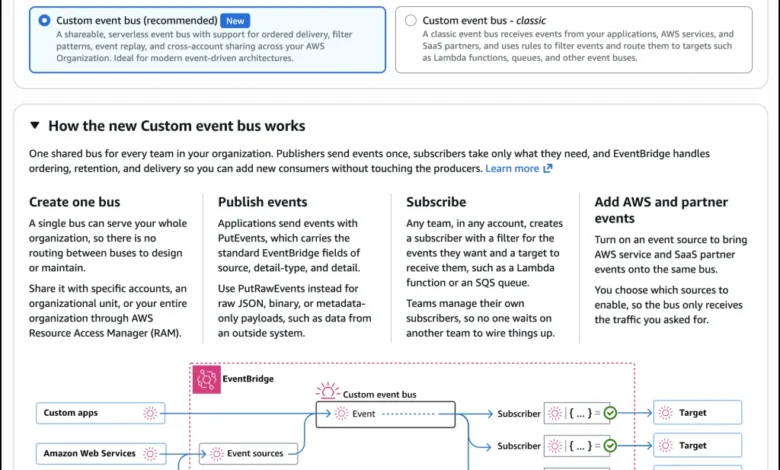
The landscape of modern software development is increasingly defined by event-driven architectures, where decoupled services communicate through asynchronous messages. For years, Amazon EventBridge has served as the backbone for these systems on AWS. However, as organizations scaled their operations across hundreds of accounts, the architectural patterns initially designed for simpler use cases began to face significant friction. Today, AWS is addressing these challenges by introducing an enhanced custom event bus for Amazon EventBridge, designed specifically to streamline cross-account communication and provide native support for event ordering and centralized management.
The Evolution of Event-Driven Complexity
In the early stages of cloud adoption, organizations typically utilize a single custom event bus within a single AWS account. This approach is intuitive and efficient for small teams. As organizations grow, however, they adopt a multi-account structure to satisfy security, compliance, and team-autonomy requirements. Under the previous model, this transition necessitated the creation of multiple event buses connected via complex cross-account rules or intricate bus-to-bus configurations.
This "workaround" architecture frequently led to what engineers call "operational debt." Platform teams reported significant challenges in maintaining visibility, as tracking event lineage across fragmented bus configurations became increasingly difficult. Furthermore, the economic model of the previous iteration often resulted in compounding costs as events were routed across multiple hops. Beyond cost and visibility, the lack of native event ordering forced developers to integrate additional services—such as Amazon Simple Queue Service (SQS) or third-party message brokers—to ensure that critical events, such as those in logistics or financial transaction pipelines, were processed in the correct sequence.
A New Architectural Paradigm
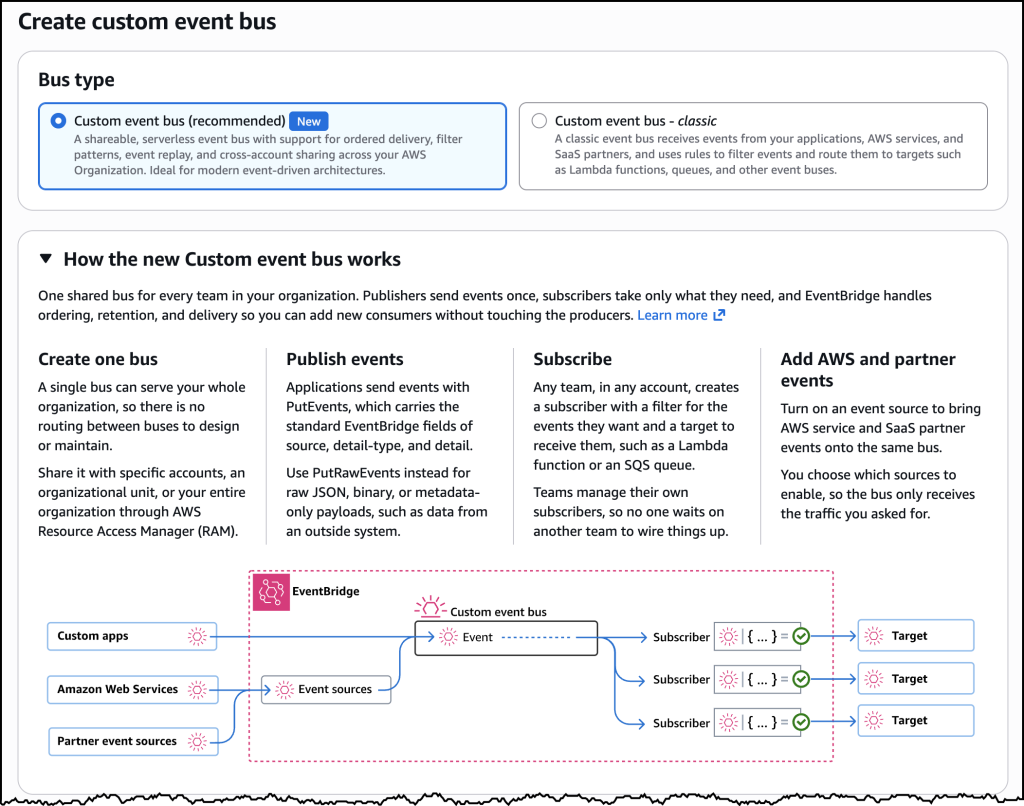
The introduction of the enhanced custom event bus marks a fundamental shift in how AWS handles event orchestration at scale. By moving from a fragmented, multi-bus model to a centralized event backbone, organizations can now share a single bus across an entire AWS organization. This is facilitated through seamless integration with AWS Resource Access Manager (AWS RAM), allowing administrators to define fine-grained access policies without manual cross-account permission configurations.

A key feature of this release is the introduction of the "Subscriber" resource. Previously, developers had to manage a collection of rules, targets, and retry policies as distinct entities. The new Subscriber resource aggregates these components into a single, cohesive unit. This consolidation simplifies the lifecycle management of event consumers, enabling teams to define filter patterns, target destinations, and error-handling policies within one manageable construct.
Addressing the Need for Sequencing and Reliability
One of the most requested features in the evolution of serverless event-driven systems has been native event ordering. In high-stakes environments—such as real-time inventory management, healthcare monitoring, or financial trading—the sequence of events is as important as the data itself.
The enhanced custom event bus introduces the EventGroupId parameter. By assigning an ID to specific event streams, publishers can ensure that events within the same group are delivered sequentially to subscribers who require ordered processing. Crucially, this does not force a "one-size-fits-all" approach on the bus. While some subscribers consume events in strict sequence, others on the same bus can continue to consume events asynchronously, maintaining high throughput for less latency-sensitive tasks.
Furthermore, the integration of synchronous invocation for targets like AWS Lambda represents a significant leap in architectural simplicity. By confirming successful processing before acknowledging the event, the system removes the requirement for intermediate buffers, such as SQS queues, which were previously necessary to guarantee delivery in critical workflows. This refinement reduces both the latency and the total number of components that teams must monitor and maintain.
Strategic Implications and Economic Impact
The transition to this new model is supported by a revised pricing structure designed to align with the needs of large-scale enterprises. The previous per-event model, which often saw costs balloon due to routing overhead, has been replaced by a throughput-based ingress and egress model. This change is expected to provide greater cost predictability and allow for more granular cost allocation, as organizations can clearly distinguish between publisher and subscriber consumption patterns.

From a platform engineering perspective, the impact is substantial. By providing a centralized, scalable backbone, platform teams can reclaim visibility into their organization’s event flows. With a default quota of 10,000 subscribers per bus, the pressure to fragment infrastructure into smaller, disconnected buses is significantly reduced. This scalability ensures that as an organization’s event volume grows, the infrastructure can adapt without requiring a complete overhaul of the underlying topology.
Data Integrity and Advanced Payload Handling
Beyond routing and sequencing, the enhanced bus addresses data integrity through content-based deduplication. In distributed systems, network jitters or service timeouts often result in the same event being sent multiple times. The new capability allows EventBridge to detect duplicate payloads by hashing event contents and collapsing matches that occur within a five-minute window. This provides "exactly-once" delivery semantics for many common failure scenarios, reducing the need for application-level idempotency logic.
Additionally, the adoption of JSONata expressions for event transformation provides developers with powerful tools to reshape data on the fly. This capability is particularly useful when disparate services expect different schema formats. Furthermore, the native support for deserializing Apache Avro or Protocol Buffers into JSON allows teams to maintain strict schema definitions while benefiting from the filtering and routing capabilities of EventBridge.
Chronology of Availability and Rollout
The deployment of the enhanced custom event bus follows a multi-phase rollout strategy. As of today, the service is available in a wide range of global regions, including US East (N. Virginia, Ohio), US West (Oregon), and multiple regions across Europe and the Asia Pacific.
AWS has explicitly stated that existing "Classic" event buses will continue to function without interruption, ensuring that organizations can migrate to the enhanced architecture at their own pace. This commitment to backward compatibility is a hallmark of AWS’s strategy for long-term platform support, allowing for a phased transition where teams can evaluate the new capabilities in staging environments before committing to enterprise-wide adoption.
Industry Context and Future Outlook
The shift toward centralized, ordered, and managed event buses reflects a broader trend in cloud-native computing. As organizations move beyond the initial phase of "serverless experimentation" and into the "industrialization of serverless," the demand for more robust, enterprise-grade tooling has grown. The industry has long grappled with the trade-offs between the agility of decentralized event-driven design and the control required for governance and reliability.
By incorporating features like native ordering and the centralized Subscriber resource, AWS is effectively narrowing the gap between managed cloud services and the bespoke message-broker architectures that enterprises previously had to build themselves. This development signals a maturation of the event-driven ecosystem, where the focus is shifting from "how to connect services" to "how to manage high-volume data streams with strict governance."
As enterprises continue to embrace microservices and distributed event meshes, the role of the event bus as a central nervous system becomes increasingly critical. The ability to manage these systems with reduced operational overhead—without sacrificing the granular control required for complex business logic—positions the enhanced custom event bus as a foundational component for the next generation of serverless applications. For developers and architects, the path forward involves evaluating current event-routing complexities and identifying which workflows will benefit most from the streamlined, ordered, and cost-efficient capabilities now available in the AWS ecosystem.
Related posts: