ReadyOn Deploys Innovative Four Walls Isolation Architecture on Amazon EKS to Secure Enterprise Multi-Tenant Workloads

In the landscape of modern enterprise information technology, the security of multi-tenant cloud environments remains one of the most persistent and intricate challenges for architects and DevOps engineers. ReadyOn, an AWS Partner specializing in intelligent labor orchestration for Fortune 100 enterprises, has confronted this complexity head-on. Managing a sophisticated multi-tenant platform on Amazon Elastic Kubernetes Service (Amazon EKS) that handles some of the most sensitive data in corporate IT—including detailed payroll records, complex organizational hierarchies, and expansive operational analytics for hundreds of thousands of employees—requires an exceptional standard of digital fortification. Recognizing that default Kubernetes configurations are notoriously permissive out of the box, ReadyOn engineered a groundbreaking security framework known as the "Four Walls" model. This architecture establishes four independent, overlapping layers of defense designed to prevent cross-tenant data access, thereby setting a new benchmark for zero-trust multi-tenancy on AWS infrastructure.
The inherent vulnerabilities of default Kubernetes deployments have long been a subject of scrutiny among cybersecurity professionals. Historically, upstream Kubernetes configurations permit anonymous requests to reach the API server, where they rely solely on Role-Based Access Control (RBAC) for denial, allow pods to run as root by default, and lack network policies entirely until administrators explicitly define them. While securing single-tenant clusters is a well-documented engineering task, the introduction of multi-tenancy fundamentally alters the threat model. The primary security concern shifts dramatically from preventing unauthorized external users from reaching the cluster to ensuring that Tenant A cannot under any circumstances access the data or compute resources of Tenant B.
Historically, many multi-tenant Kubernetes platforms have relied heavily on a single isolation mechanism: the namespace. However, Kubernetes designers never intended namespaces to serve as an impenetrable security boundary. For an enterprise like ReadyOn, whose Harmony platform processes highly confidential workforce data, a single security failure or cross-tenant data leak would carry catastrophic consequences. Such an incident would instantly trigger complex regulatory reporting obligations across multiple multi-jurisdictional compliance frameworks and severely damage the hard-earned trust that enterprise clients place in their technology partners. Understanding that the stakes demanded far more than a single wall of defense, ReadyOn embarked on a comprehensive architectural overhaul to implement a compound defense strategy.
To eliminate single points of failure, ReadyOn’s Four Walls model combines Kubernetes namespaces, Karpenter-managed dedicated node pools, Amazon Virtual Private Cloud (Amazon VPC) security groups, and per-tenant Amazon Aurora databases. This multi-layered approach ensures that in order to successfully cross a tenant boundary, an unauthorized user or compromised process would need to simultaneously defeat the Kubernetes API, the node scheduler, the underlying AWS software-defined network, and the isolated data storage layer.
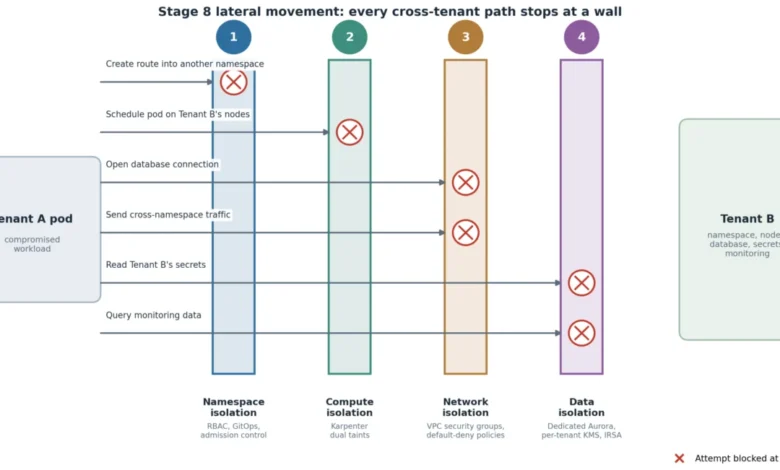
The architectural journey began with a rigorous reassessment of how modern cloud-native applications are provisioned and managed. At the foundation of the Four Walls model is Wall 1: Namespace isolation on Amazon EKS. While acknowledging the limitations of namespaces as standalone security barriers, ReadyOn utilizes them as the critical logical foundation upon which higher-level security controls are constructed. To maintain absolute consistency across the entire infrastructure, ReadyOn implemented GitOps-enforced consistency via Argo CD ApplicationSets. When onboarding a new enterprise tenant, engineers simply add a single entry to a centralized configuration manifest stored securely in Git. Automated pipelines instantly generate all required resources—including the dedicated namespace, associated network policies, granular RBAC bindings, resource quotas, and secret configurations. This automated lifecycle management guarantees that there are no "legacy" tenants operating under weaker security postures; every single tenant receives an identical, hardened security profile by construction.
Furthermore, Wall 1 incorporates stringent RBAC and admission control frameworks. Role bindings strictly restrict API access, ensuring that a tenant principal can never list, get, or modify resources residing in another namespace. An advanced admission control framework validates all incoming resource definitions against a comprehensive policy set, actively blocking privileged configurations and prohibiting the unauthorized creation of cluster-scoped resource types. To maintain state integrity, ReadyOn employs self-healing drift correction through its GitOps controller, which continuously reconciles the live cluster state against the declared state in Git. Any manual modification or unauthorized alteration is automatically reverted within seconds, enforcing a strict policy where human operators never execute direct commands against production environments.
Moving deeper into the compute infrastructure, Wall 2 establishes compute isolation using Karpenter, dropping below the Kubernetes API layer to control the physical machines where tenant code executes. In the Harmony platform, tenants do not share compute nodes. ReadyOn utilizes a dual-taint strategy wherein Karpenter provisioners dynamically spin up nodes featuring two distinct taints: a tenant-identifier taint (such as tenant=acme-corp) and a workload-type taint (such as workload=frontend). Consequently, a pod must successfully tolerate both taints to be scheduled. Tenant A’s frontend nodes are physically and logically segregated from Tenant A’s batch processing nodes, and both are entirely isolated from Tenant B’s infrastructure. Even if an attacker were able to forge pod tolerations, an admission controller validates that the claims align perfectly with the namespace’s true tenant identity, preventing the scheduler from executing cross-tenant placements. Moreover, all application nodes enforce IMDSv2 with reduced hop limits to block unauthorized access to instance metadata endpoints, while node-level IAM roles are strictly scoped to single-tenant resource boundaries.
While the first two walls operate within the Kubernetes abstraction layer, Wall 3 drops below Kubernetes entirely to enforce strict network isolation at the Amazon VPC and security group level. This infrastructure layer is entirely decoupled from the Kubernetes control plane and cannot be manipulated by pods possessing limited API access. Each tenant’s Amazon Aurora database cluster is protected by dedicated security groups that exclusively permit inbound connections originating from the specific security group attached to that tenant’s application nodes. As a result, Tenant A’s worker nodes are fundamentally incapable of opening a TCP connection to Tenant B’s database. This network-level enforcement is managed directly by the AWS software-defined network, meaning an adversary would have to overcome the underlying networking layer itself to breach the boundary. The VPC is meticulously segmented into four distinct tiers: a public perimeter tier housing only load balancers, an application tier containing EKS worker nodes within private subnets, a database tier featuring isolated Aurora clusters completely devoid of internet access, and a secure control plane tier utilizing private EKS API endpoints accessible exclusively via VPN with strict OIDC and MFA requirements. Additionally, default-deny Kubernetes network policies and comprehensive Amazon VPC Flow Logs ensure that all unauthorized inter-namespace traffic is immediately dropped and recorded for anomaly detection.
The ultimate line of defense is found at Wall 4: Data isolation with Amazon Aurora. Recognizing that shared database architectures place the entire burden of security on application-layer query logic—where a single omitted filter can result in catastrophic data exposure—ReadyOn opted for dedicated Amazon Aurora clusters for every single tenant. Because there are no shared tables, there is no reliance on row-level security filters that developers might inadvertently forget. Tenant A’s application code cannot construct a connection string to Tenant B’s database because it lacks the requisite endpoint, credentials, and network path. Furthermore, dedicated Aurora clusters enable the implementation of unique AWS Key Management Service (AWS KMS) encryption keys per tenant. Data at rest is encrypted using distinct keys, ensuring that even in the highly unlikely event of raw storage exposure, one tenant’s key cannot decrypt another’s data.
To eliminate long-lived credentials, ReadyOn implements IAM Roles for Service Accounts (IRSA). Workloads authenticate to AWS APIs exclusively through short-lived credentials issued by the AWS Security Token Service (AWS STS) via OIDC federation. Workloads hold no permanent access keys, and credentials expire within minutes. Combined with per-tenant observability pipelines routing metrics, logs, and traces through OpenTelemetry, the architecture guarantees complete operational segregation.
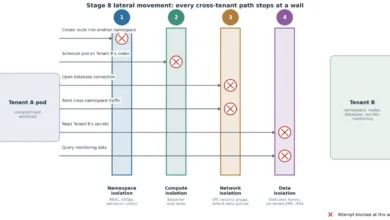
To validate the efficacy of this multi-layered defense, ReadyOn systematically maps its security controls against its internal 10-stage multi-tenant threat model, aligning each stage with MITRE ATT&CK techniques. The critical inflection point occurs at Stage 8—lateral movement—where an adversary inside a compromised Tenant A pod attempts to breach Tenant B’s resources. Rigorous adversarial simulations and penetration testing exercises have repeatedly demonstrated that every single cross-tenant attack vector is successfully intercepted and neutralized by the corresponding wall, validating the resilience of the architecture.
In conclusion, ReadyOn’s Four Walls model provides a robust reference architecture for organizations seeking to deploy zero-trust multi-tenant workloads on Amazon EKS. By harmonizing native AWS services with advanced Kubernetes governance, enterprises can achieve uncompromising security without sacrificing the operational agility and economic efficiencies inherent in cloud-native multi-tenancy.
Related posts: