ReadyOn Deploys Innovative Four Walls Architecture on Amazon EKS to Secure Enterprise Multi-Tenant Workloads

In the landscape of modern enterprise information technology, the deployment of multi-tenant cloud platforms presents a formidable security challenge. ReadyOn, an Amazon Web Services (AWS) Partner specializing in intelligent labor orchestration for Fortune 100 enterprises, has unveiled a comprehensive architectural framework designed to address the inherent security vulnerabilities of shared infrastructure. Operating its Harmony platform on Amazon Elastic Kubernetes Service (Amazon EKS), ReadyOn processes highly sensitive organizational data, including payroll records, complex corporate hierarchies, and operational analytics for hundreds of thousands of employees. Given the critical nature of this data, the company developed a multi-layered defense system known as the "Four Walls" model, engineered to eliminate cross-tenant data exposure and establish a zero-trust environment within Kubernetes.
The Evolution of Kubernetes Security and Multi-Tenancy
Kubernetes has become the de facto standard for orchestrating containerized applications, yet its native architecture is notoriously complex and lacks robust out-of-the-box security for multi-tenant environments. Historically, upstream Kubernetes permitted anonymous requests to reach the API server, defaulted to running pods with root privileges, and required manual configuration for network policies. While securing a single-tenant cluster presents well-documented hurdles, introducing multi-tenancy fundamentally alters the threat model. In a multi-tenant setup, the primary security objective shifts from preventing external unauthorized access to ensuring absolute isolation between distinct tenants sharing the same physical and logical infrastructure.
Traditionally, many organizations relied primarily on Kubernetes namespaces to segregate tenant environments. However, Kubernetes architects never designed namespaces to serve as a secure cryptographic or network boundary. Recognizing that a single compromised layer could expose sensitive corporate intelligence—triggering severe regulatory penalties and eroding client trust—ReadyOn abandoned the conventional single-barrier approach. Instead, the company engineered a compound defense mechanism that integrates four distinct, independent isolation layers across the technology stack.
Anatomy of the Four Walls Model
The Four Walls architecture instituted by ReadyOn operates on the principle of defense-in-depth, ensuring that no single security failure can compromise the entire platform. Each wall functions at a completely different layer of the infrastructure stack, requiring an attacker to employ entirely disparate techniques to breach successive barriers.
Wall 1: Namespace Isolation and GitOps Consistency
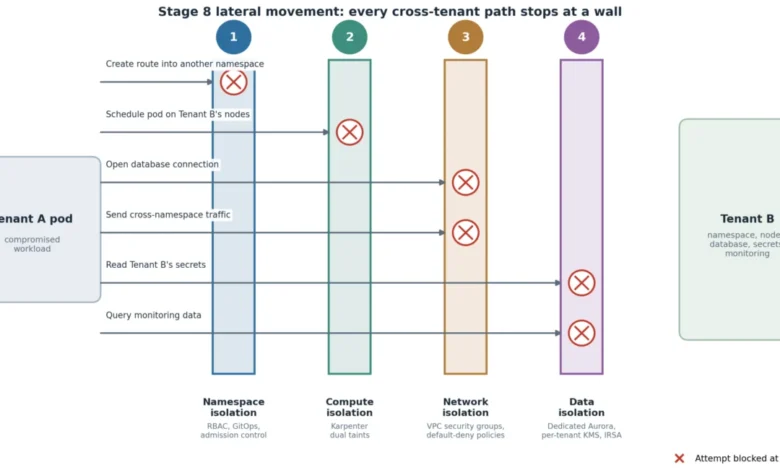
The first layer establishes the logical foundation of the platform through Kubernetes namespaces, enforced rigorously via GitOps methodologies using Argo CD ApplicationSets. When onboarding a new enterprise client, an automated process generates all required resources from a single configuration manifest maintained in a Git repository. This ensures that every tenant receives an identical, uncompromised security posture by construction, eliminating legacy configurations with weaker controls.
Furthermore, namespace-scoped Role-Based Access Control (RBAC) bindings restrict API access exclusively to a tenant’s designated resources. An admission control framework actively validates all submitted resources against strict policy sets, blocking privileged configurations and unauthorized object creation. To maintain state integrity, the GitOps controller continuously reconciles the live cluster state with the declared state in Git, automatically neutralizing manual or unauthorized modifications within seconds.
Wall 2: Compute Isolation via Karpenter
Moving beneath the Kubernetes API layer, Wall 2 addresses the physical and virtual compute machines where tenant code executes. In the Harmony platform, tenants never share compute nodes. ReadyOn utilizes Karpenter, an automated cluster autoscaler, to provision nodes configured with a dual-taint strategy. Each node incorporates a tenant-identifier taint and a workload-type taint, mandating that pods possess specific tolerations to be scheduled. Consequently, frontend nodes for Tenant A are entirely distinct from its batch processing nodes and completely isolated from Tenant B’s infrastructure.
To fortify this layer further, admission controllers verify that pod toleration claims precisely match the namespace’s tenant identity, preventing misdirected workload placement. All application nodes enforce Instance Metadata Service Version 2 (IMDSv2) with strict hop limits to thwart container metadata access, while attached IAM roles are strictly scoped to individual tenant resources.
Wall 3: Network Isolation at the VPC Layer
Transcending the Kubernetes abstraction entirely, Wall 3 enforces rigorous isolation at the Amazon Virtual Private Cloud (Amazon VPC) and security group level. Each tenant’s Amazon Aurora database is protected by dedicated security groups that exclusively permit inbound traffic from the application nodes assigned to that specific tenant. This prevents lateral network connections across tenants at the AWS software-defined network layer.
The overarching VPC architecture is partitioned into four distinct tiers: a public perimeter handling load balancers only, an application tier containing EKS worker nodes in private subnets, a database tier housing isolated Aurora clusters with zero internet access, and a control plane tier restricted to private EKS API endpoints accessible solely via VPN with multi-factor authentication (MFA). Kubernetes network policies implement default-deny rules for inter-namespace traffic, complemented by Amazon VPC Flow Logs for continuous anomaly detection.
Wall 4: Data Isolation and Cryptographic Separation
The innermost defense addresses the ultimate target: the data repository. Rather than utilizing a shared database architecture that relies heavily on application-layer query logic—where a single omitted filter could lead to catastrophic data leakage—ReadyOn deploys dedicated Amazon Aurora clusters for every tenant. This structural separation ensures that tenant applications lack the network path, credentials, and endpoints required to access foreign databases.
In addition to architectural database separation, ReadyOn implements unique AWS Key Management Service (AWS KMS) encryption keys for each tenant. Data-at-rest encryption keys are strictly segregated, ensuring that even in the unlikely event of raw storage exposure, one tenant’s key cannot decrypt another’s data. Workloads authenticate to AWS APIs exclusively through short-lived credentials issued by AWS Security Token Service (AWS STS) via OIDC federation, eliminating long-lived access keys entirely.
Systematic Threat Mitigation and Adversarial Validation
ReadyOn maps its defense mechanisms against a comprehensive 10-stage multi-tenant threat model aligned with MITRE ATT&CK techniques. The critical juncture within this model is the lateral movement stage, wherein a compromised pod with limited access attempts to breach boundaries and access neighboring resources. Through rigorous adversarial simulation exercises, the company regularly tests its infrastructure by deploying simulated compromised workloads designed to probe every potential cross-tenant path. To date, these stress tests have consistently demonstrated that the Four Walls model successfully neutralizes all attempted breaches, preventing lateral escalation at every individual barrier.
Implications for Enterprise Cloud Architecture
The implementation of the Four Walls model by ReadyOn offers a vital architectural blueprint for organizations seeking to scale multi-tenant applications on Amazon EKS without compromising security or operational efficiency. By orchestrating native AWS and Kubernetes services into a cohesive, multi-layered defense strategy, enterprises can satisfy stringent regulatory compliance standards while maintaining the high availability and performance demanded by Fortune 100 clients. As cloud-native environments continue to evolve, structured defense-in-depth methodologies such as the Four Walls framework represent the gold standard for securing mission-critical enterprise data against sophisticated threats.
Related posts: