How Mux Transformed Its Sales Strategy by Automating Hyper-Personalized Product Demos


In the hyper-competitive landscape of B2B software-as-a-service (SaaS), capturing a prospective client’s attention within the first few minutes of a demonstration can make the difference between a closed deal and a lost opportunity. For video infrastructure provider Mux, standard software demonstrations featuring generic feature lists and static dashboard walkthroughs were failing to produce the desired engagement. Prospective clients consistently struggled to bridge the conceptual gap between out-of-the-box product capabilities and their own internal video workflows. Recognizing that leaving product contextualization to guesswork fundamentally undermines sales efficiency, Mux engineered an innovative, automated demo generation pipeline. By combining automated web-scraping technologies with dynamic asset ingestion, the company has fundamentally redefined how technical products are showcased to prospective enterprise clients.
The Evolution of the B2B Demonstration Problem
For decades, the standard B2B software demonstration has relied heavily on generic environments, mock data, and hypothetical use cases. While this approach allows sales teams to demonstrate broad product utility, it often places an undue cognitive burden on the prospective buyer. Clients are routinely forced to mentally translate abstract features into concrete solutions for their unique business challenges. In the video infrastructure sector—where workflows involve complex processing, automated transcription, translation, clipping, and AI-driven content analysis—this translational gap becomes even more pronounced.
Mux executives quickly realized that when introducing advanced tooling like Mux Robots, a list of specifications or a pre-recorded dashboard walkthrough failed to deliver the emotional and practical resonance necessary to drive purchasing decisions. Prospective clients could see that the technology worked, but they struggled to connect those abstract capabilities to their existing video libraries and immediate business needs. This realization prompted a strategic pivot away from traditional, one-size-fits-all presentations toward an architecture centered on radical personalization. Instead of expecting prospects to imagine how the product might function within their ecosystem, Mux decided to build a system that injects the prospect’s actual brand identity, visual assets, and content directly into the live demonstration environment.
Leveraging Web-Scraping APIs for Instant Brand Profiling
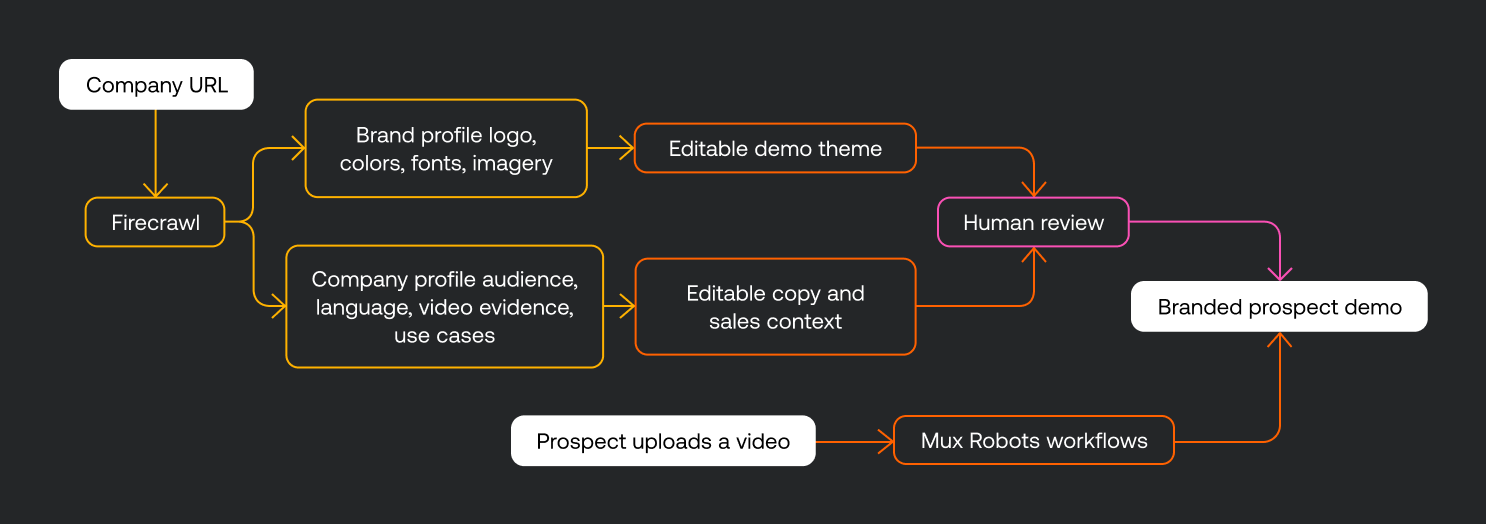
At the core of Mux’s newly developed demo engine is the integration of advanced web-scraping and data extraction tools, specifically utilizing the web-scraping API Firecrawl. When a sales representative prepares for a prospect interaction, entering the target company’s URL into the internal system initiates an automated extraction process. This technical pipeline instantly harvests three critical layers of data from the prospective company’s digital footprint: brand identity markers, technical contexts, and strategic business profiles.
The brand profile extraction captures fundamental visual elements including official logos, corporate color palettes, typography, and primary imagery styles. Simultaneously, the company profile analyzer parses the prospect’s public-facing web presence to identify target audiences, core messaging language, existing video content evidence, and distinct use cases. This automated discovery phase eliminates hours of manual research that sales teams traditionally spend reviewing prospect websites prior to initial discovery calls.
Once the data is extracted, the underlying platform dynamically generates a customized demonstration page. This involves applying the prospect’s exact visual theme, drafting headlines utilizing their specific industry lexicon, and populating relevant use-case descriptions pulled directly from their corporate site. However, Mux recognized the inherent risks of relying entirely on automated generation. To maintain absolute professional rigor, the system routes the scraped data and drafted narrative through a mandatory human review phase. Sales professionals review the generated story, refine the framing, and ensure the messaging accurately aligns with the nuanced realities of the prospect’s business before any external link is shared.
Bridging the Gap Through Prospect-Provided Content
While visual branding establishes immediate familiarity, true technical validation in the video infrastructure space requires processing actual media files. Mux addressed this requirement by integrating a streamlined, secure upload mechanism into the personalized demo framework. Following the initial outreach, sales representatives provide prospects with a private, branded upload link.
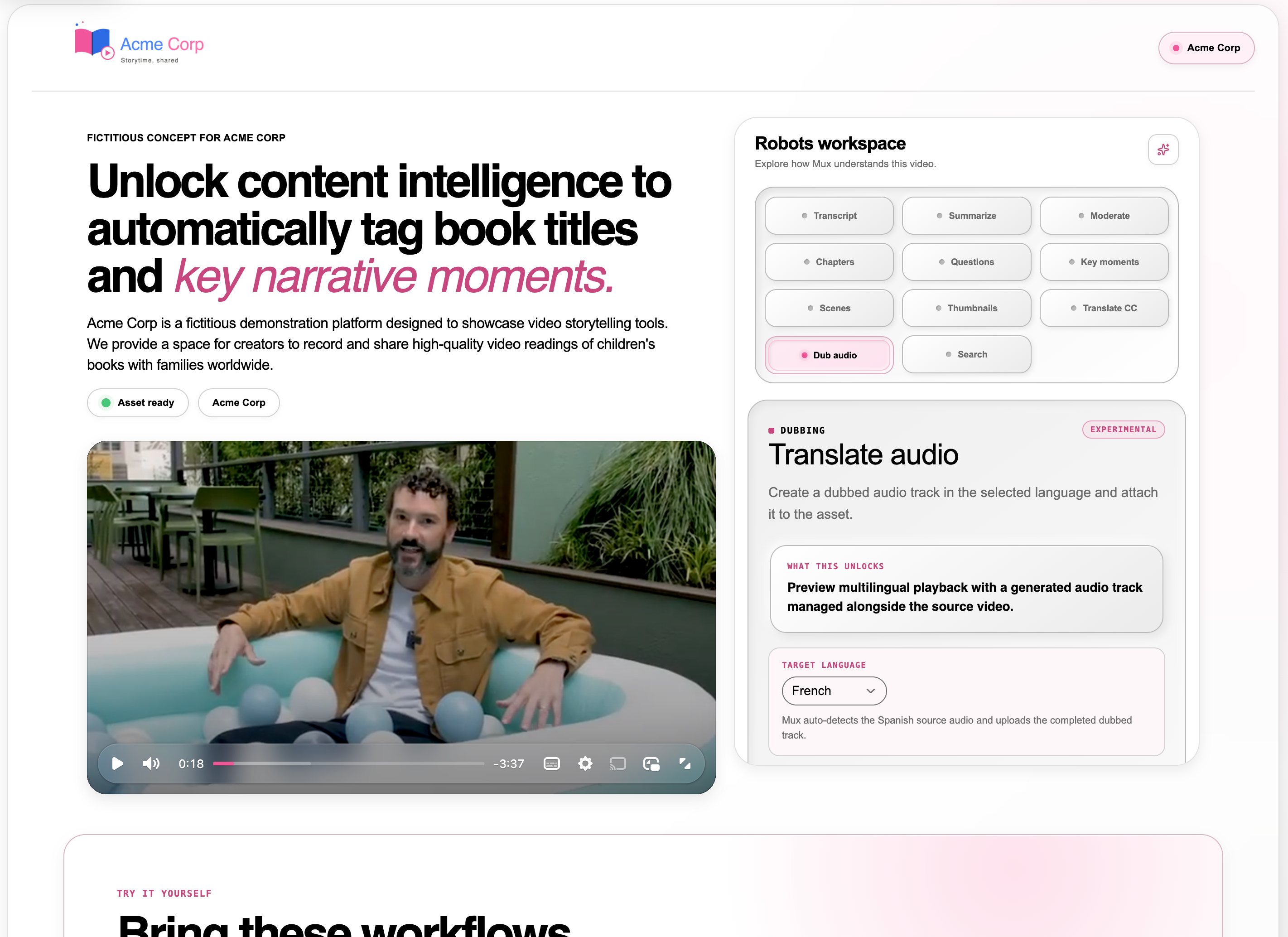
Upon receiving the link, the prospect can upload a raw video file directly from their own library. Once uploaded, the file is instantly embedded into the custom-branded demo page and automatically ingested into the Mux Robots processing workflow. This end-to-end integration drastically shortens the psychological distance between theoretical evaluation and practical validation. Instead of watching a sales representative manipulate a fictitious video file, the prospect observes Mux Robots performing automated tasks—such as audio translation, metadata generation, and content summarization—on their own proprietary media assets.
By the time the scheduled sales call commences, the demonstration environment has transformed from a generic software preview into a fully functional workspace reflecting the prospect’s own operational reality. During the call, sales engineers can display real summaries, automated clips, and contextual question-and-answer outputs derived directly from the client’s uploaded file. This immediate, hands-on exposure consistently accelerates the technical validation phase, prompting prospects to pivot naturally from exploratory questioning to practical integration discussions.
Empowering Sales Teams with AI-Driven Conversation Briefs
Personalizing the interface and processing the media file represent only half of Mux’s revamped go-to-market strategy. The second half focuses on equipping sales representatives with precise, data-driven talking points that connect product capabilities directly to the prospect’s documented business challenges.
Utilizing the insights gathered during the initial web-scraping phase, the internal system generates a comprehensive "Conversation Brief" for the sales team. These briefs provide structured frameworks—such as the Find, Focus, and Outcome methodology—alongside specific, numbered talking points tailored to the prospect’s industry. For instance, if the scraped data indicates the prospect operates a short-form video catalog, the briefing document highlights automated thumbnail ranking and timestamped scene generation.
Crucially, these conversation briefs are designed as collaborative guides rather than rigid scripts. Sales representatives retain the flexibility to edit points, adjust the narrative arc, and incorporate qualitative insights gathered during live conversations. Furthermore, the platform integrates instant clipping APIs, allowing sales engineers to isolate key moments from the prospect’s video during the call and generate shareable, short-form clip links on the fly.
Industry Implications and the Future of B2B Sales Engineering
Mux’s transition toward automated, hyper-personalized demonstration environments reflects a broader, maturation-driven shift across the B2B software industry. As enterprise buyers face mounting pressure to optimize technology expenditures and accelerate time-to-value, patience for protracted, highly abstracted software evaluations continues to dwindle. Companies that successfully eliminate friction in the evaluation phase consistently outperform competitors relying on legacy sales methodologies.
The technical architecture developed by Mux demonstrates the practical convergence of modern web-scraping, automated content generation, and cloud-based media processing. By transforming a manual, labor-intensive customization process into an automated workflow augmented by human oversight, Mux has scaled personalization without overburdening its sales engineering teams.
While the company acknowledges that the system is continually being tuned and optimized based on conversion metrics and user feedback, early indicators validate the core premise. By removing guesswork and placing authentic context directly into the hands of the buyer, Mux has redefined the benchmark for technical sales presentations. As software products become increasingly specialized and modular, the ability to instantly demonstrate real-world utility using a prospect’s own brand and data will likely transition from an innovative competitive advantage to an essential baseline requirement for enterprise software sales.