Trump Unveils White House Helipad Amid Media Boycott, Legal Battles, and Midterm Pressures

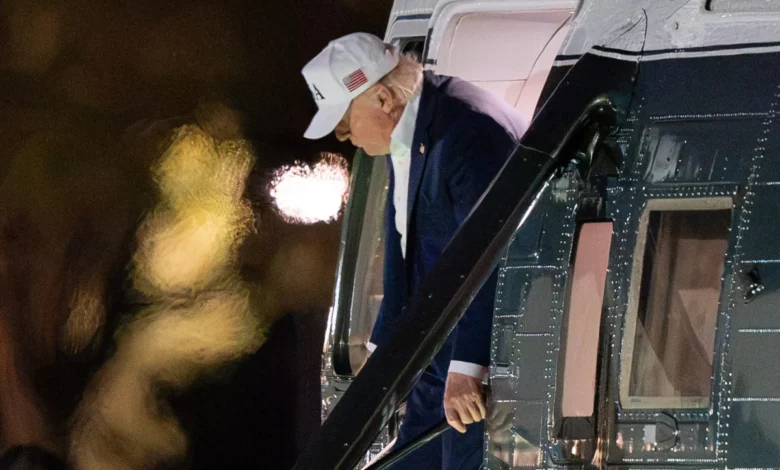
President Donald Trump inaugurated the newly constructed White House helicopter landing pad on Monday, using the ribbon-cutting ceremony to project an image of routine governance even as a profound First Amendment controversy and ongoing political headwinds overshadowed the event.
Standing on the South Lawn under a light drizzle, the president used an oversized pair of gold scissors to snip a red, white, and blue ribbon. He subsequently exchanged handshakes with project administrators and construction workers outfitted in green smocks and hardhats. However, any spoken remarks intended to mark the occasion were entirely drowned out by the deafening roar of Marine One idling nearby.
The symbolic opening was designed to showcase the culmination of months of intensive groundskeeping and infrastructure modifications initiated earlier this year. Yet, the absence of standard television broadcast crews starkly underscored the escalating tensions between the administration and major news organizations. In a coordinated display of solidarity following the administration’s decision to bar CNN from White House grounds, camera crews from ABC, CBS, NBC, and Fox News collectively opted to skip the ceremony.
The media boycott comes on the heels of a federal lawsuit filed by CNN, MS Now, and Politico. The legal action challenges a decree announced late last week by President Trump explicitly banning these outlets from covering executive branch events. This move represents a sharp escalation in the administration’s persistent efforts—pursued through both judicial channels and administrative mandates—to restrict news coverage deemed unfavorable or objectionable. Consequently, the ribbon-cutting ceremony for the multimillion-dollar landing pad was captured with notably limited independent broadcast journalism, forcing the public to rely primarily on official statements and social media broadcasts.
Chronology of the Construction and Diplomatic Preparations
The unveiling of the helipad serves as a central milestone in President Trump’s self-styled role as "builder-in-chief" during his second term, a period heavily characterized by high-profile architectural overhauls across the federal capital. Planning for the South Lawn modification began in June, driven primarily by logistical necessity. According to administration officials, the legacy Vietnam War-era helicopters historically utilized for presidential transport are currently being phased out in favor of modern Sikorsky aircraft. These newer, larger, and significantly heavier choppers generate exhaust and downwash powerful enough to cause structural damage to the traditional White House lawn.
To accommodate the heavier fleet, construction crews tore up extensive sections of the historic grounds. The project involved laying extensive granite slabs—which the president boasts possess a "million-year life"—along with a prominent presidential seal embedded directly into the landing surface. In addition to the helipad itself, workers removed the original Tennessee flagstone along the West Wing’s colonnade, replacing it with black granite, and similarly refurbished the traditional walkway from the diplomatic entrance using white granite and upgraded asphalt.
The rushed timeline of the project was heavily influenced by upcoming diplomatic engagements. President Trump has repeatedly emphasized that the modernized infrastructure is intended to impress foreign heads of state, most notably Chinese President Xi Jinping, whose arrival in Washington for a high-stakes state visit is scheduled for Wednesday. The president has spent weeks focusing on preparations for the summit, even as his administration navigates complex foreign policy crises, including the ongoing war in Iran, which has weighed heavily on voter sentiment.
Financial Discrepancies and Public Funding Questions
Financing for the ambitious infrastructural projects undertaken during Trump’s second term has frequently sparked debate regarding transparency and the allocation of public versus private funds. Regarding the helipad, the president stated in July that the construction would be entirely privately funded, estimating total costs at up to $6 million. Furthermore, Trump credited Sikorsky Aircraft—a subsidiary of major defense contractor Lockheed Martin, which manufactures the replacement helicopters—with footing the bill, going so far as to publicly thank Lockheed Martin’s chief executive in a social media post following Monday’s maiden voyage.
However, independent estimates regarding the true cost of the helipad project remain difficult to verify. Extensive foundational work required to level the rolling terrain of the South Lawn introduced auxiliary expenditures that complicate the final accounting. This mirrors past controversies surrounding executive renovations, most notably the demolition of the East Wing to construct a $400 million presidential ballroom. While initially pitched as entirely donor-funded, the administration subsequently requested $1 billion from Congress to cover supplementary security and structural enhancements.
Critics point to these financial ambiguities alongside aesthetic concerns stemming from prior municipal projects. Observers have noted that grand promises regarding infrastructural durability—such as Trump’s previous assertion that the refurbishing of the Lincoln Memorial’s Reflecting Pool would last a century—frequently fall short when paint fades and liners peel prematurely, raising questions about the long-term viability and fiscal stewardship of these rapid architectural overhauls.
Political Implications Ahead of Midterm Elections
The convergence of the helipad inauguration, the unfolding media access lawsuit, and imminent foreign dignitary visits occurs at a politically sensitive juncture. With the midterm elections looming approximately six weeks away, the administration faces mounting pressure from a shifting electorate. Public approval ratings have experienced downward pressure, largely driven by voter anxieties concerning persistent inflation, economic uncertainty, and the protracted conflict in Iran.
In an effort to galvanize the Republican base, President Trump has increasingly utilized campaign-style rhetoric, recently characterizing political opponents as communists while stumping for congressional candidates. Yet, domestic controversies regarding freedom of the press threaten to overshadow these electoral messaging strategies. Legal analysts note that the systematic exclusion of specific media outlets from the White House complex raises profound constitutional questions that will likely face rigorous scrutiny in federal courts, potentially setting a landmark precedent for executive branch press access.
Following Monday’s brief ribbon-cutting ceremony, President Trump boarded Marine One for its maiden flight from the newly certified heliport, departing for New York ahead of his scheduled address at the United Nations General Assembly beginning Tuesday. As the administration pivots from domestic beautification projects to international diplomacy at the U.N., the unresolved fallout from the media bans and the pending courtroom showdowns ensure that the battles over transparency and constitutional rights will remain at the forefront of the national discourse.
Related posts: