Navigating the El Niño Winter: Why Warmer Forecasts Spell Hidden Dangers for Freight Fleets and How AI-Driven Risk Tools Are Transforming Logistics

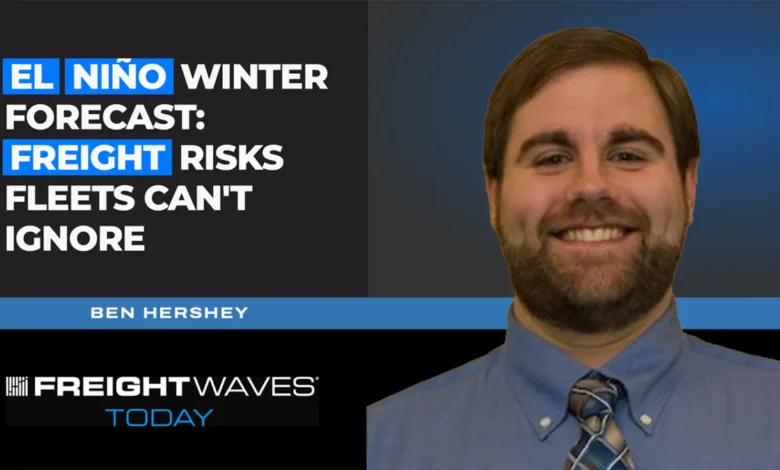
As the strongest El Niño weather pattern in recent years establishes its grip across North America, commercial freight carriers and fleet operators are facing a paradox of winter forecasting. While conventional meteorology points toward a predominantly warmer-than-average season across much of the central United States, logistics experts warn that milder temperatures do not equate to a safer or smoother operational landscape. Instead, the winter ahead promises heightened volatility, significant localized hazards, and severe disruptions along critical transcontinental supply chain corridors.
Ben Hershey, product manager of transportation and logistics at DTN, emphasizes that carriers hauling freight across western mountain passes and the central plains must prepare for a complex and high-risk operating environment. To combat these mounting threats, the transportation sector is increasingly turning to advanced weather intelligence platforms, such as DTN’s newly launched WeatherHub. Featuring a patent-pending crash risk index and hyper-localized data delivery powered by artificial intelligence, these tools are redefining how dispatchers and fleet managers make critical, real-time routing decisions.
Understanding the El Niño Winter Outlook for Logistics
The prevailing El Niño phenomenon is characterized by warmer-than-average ocean temperatures in the equatorial Pacific, which fundamentally alters global jet stream patterns. For the continental United States, this typically translates to milder conditions through the central corridor. However, logistics professionals are cautioned against falling into a false sense of security based on broad regional temperature averages.
Meteorological data underscores that significant, disruptive snow events remain entirely possible across the northern, central, and southern plains. Furthermore, even in a robust El Niño year, sharp drops in temperature can still plunge parts of the South into below-freezing conditions for brief yet hazardous windows. These sudden freezes create treacherous black ice scenarios, catching drivers and supply chain planners off guard when they least expect it.
The most acute operational risks, however, are concentrated in the American West. The current weather pattern heavily favors a substantially wetter winter season for western mountain ranges. High-volume, mission-critical corridors—including vital passes throughout the Sierra Nevada and the Rocky Mountains—are expected to face repeated waves of heavy precipitation.
"We’re looking at a potential of a much wetter winter season, which could challenge those operators trying to travel those mountain passes," Hershey explains. For logistics companies moving freight from the western seaboard into the central and eastern markets, navigating these towering elevations will test the limits of driver endurance, equipment readiness, and scheduling precision.
The Evolution of Weather Intelligence: Introducing WeatherHub and Predictive AI
Historically, fleet management relied on static weather maps and broad regional forecasts that lacked the granular detail necessary for modern, time-sensitive freight operations. Recognizing this gap, DTN developed WeatherHub within the last few months to bridge the divide between complex meteorological data and actionable dispatch intelligence.
WeatherHub allows users to scroll through road-network conditions hour by hour across the entire United States. The platform tracks essential micro-variables, including air temperature, road-surface temperature, and localized precipitation states. Dispatchers can input an origin and destination to view projected conditions along a specific route, carefully timed to match when their drivers are expected to traverse each mile. The system also offers intelligent alternate routing options to bypass developing hazards before trucks encounter them.
At the core of this technological leap is the integration of artificial intelligence. Processing the immense volume of historical weather records, real-time traffic updates, and predictive meteorological models used to require hours of computing power. In a fast-moving logistics environment, data that takes hours to process is effectively obsolete.
"Now we’re able to do this in minutes," Hershey notes, highlighting how modern AI infrastructure enables near-instantaneous computation. Crucially, DTN’s approach avoids replacing traditional, peer-reviewed meteorological science with unproven algorithms. Instead, the company layers AI tools on top of core atmospheric models to enhance speed, accuracy, and operational utility.
Patent-Pending Crash Risk Index: Shifting from Weather to Probability
Perhaps the most significant innovation accompanying the rollout of WeatherHub is its patent-pending crash risk index. Rather than forcing dispatchers to interpret raw radar loops and decide whether a storm poses a threat, the system directly translates meteorological and traffic data into a forward-looking probability of an accident along a given route.
The crash risk index fuses decades of historical crash records—analyzing precise geographic locations, exact times of day, and concurrent weather conditions—with real-time traffic flow data and advanced weather forecasts. This synthesis produces hyperlocal predictions down to a resolution of just a few miles, looking ahead across a rolling 72-hour operational window.
According to industry feedback gathered by DTN, the 72-hour horizon was intentionally chosen to align with how fleet operators realistically manage their supply chains. While long-range meteorological models extend much further into the future, the three-day window represents the critical period during which dispatchers make definitive commitments regarding driver schedules, equipment positioning, and route selections.
"We are trying to apply it to their operations—giving them a potential risk of a crash in that situation heightens their attention to the weather conditions," Hershey describes. By quantifying danger rather than merely describing it, the index serves as an operational forcing function, prompting proactive safety measures before a crisis materializes on the highway.
Integration and Financial Implications for Fleet Operators
Recognizing that modern supply chains utilize a diverse array of software ecosystems, DTN has designed its technology for maximum flexibility. While WeatherHub functions as a comprehensive standalone platform, carriers and third-party logistics (3PL) providers can also access the crash risk index and full weather datasets via robust application programming interfaces (APIs). This allows logistics enterprises to seamlessly embed predictive weather intelligence directly into their existing transportation management systems (TMS) without disrupting established workflows.
Beyond the paramount concern of driver safety and cargo protection, the implementation of precise weather intelligence carries profound financial implications. In an era defined by economic pressures, volatile fuel costs, and tight operating margins, freight carriers constantly face the threat of financial penalties from shippers for late deliveries.
When severe weather disrupts transit schedules, fleets frequently find themselves absorbing financial penalties through no fault of their own. However, armed with hyper-accurate, time-stamped weather and road-condition data generated by platforms like WeatherHub, carriers possess verifiable documentation to contest late-delivery penalties. This capability transforms weather data from an operational safety net into a vital commercial lever, protecting bottom lines in competitive freight markets.
Broader Industry Impact and Future Outlook
The convergence of El Niño volatility and advanced predictive analytics underscores a broader transformation within the commercial trucking industry. As climate patterns become increasingly erratic, traditional reactive approaches to winter storms are giving way to predictive, data-driven resilience.
For motor carriers, the stakes have never been higher. Navigating mountain passes choked with snow and ice requires more than experienced drivers and well-maintained equipment; it demands synchronized intelligence that anticipates danger hours before wheels touch compromised asphalt. Tools that translate atmospheric physics into crash probabilities represent the next evolutionary step for fleet management.
As the winter season progresses, the performance of platforms like WeatherHub will be closely watched by industry leaders. By demonstrating that warmer general forecasts do not eliminate severe, localized risks, technology providers are helping fleets protect their most valuable assets: their drivers, their equipment, and the reliability of the national supply chain.