Knight-Swift Transportation Exceeds Q2 Expectations Amid Accelerating Truckload Fundamentals, Raises Q3 Outlook

Knight-Swift Transportation Holdings Inc. (NYSE: KNX), the nation’s largest asset-based truckload carrier, reported robust second-quarter financial results on Wednesday after the market closed, significantly surpassing both analyst expectations and its own guidance. The company highlighted a substantial acceleration in truckload market conditions as the quarter progressed, signaling a tightening supply-demand dynamic that continues to benefit carriers. This stellar performance provides critical insight into the health and trajectory of the broader freight market, positioning Knight-Swift as a bellwether for the logistics and transportation sector.
Strong Financial Performance Outpaces Projections
For the second quarter, Knight-Swift posted adjusted earnings per share (EPS) of 63 cents. This figure not only represented a significant 28-cent increase year-over-year but also comfortably exceeded the consensus estimate of 51 cents by 12 cents. More impressively, it landed well above the company’s own adjusted EPS guidance range of 45 to 49 cents, underscoring a stronger-than-anticipated operational environment.
Total revenue for the quarter reached $2.1 billion, marking a 13% increase compared to the same period last year. Excluding fuel surcharges, revenue still saw a healthy 6% year-over-year climb, outpacing the consensus revenue estimate of $2.04 billion. These top-line and bottom-line beats demonstrate Knight-Swift’s ability to capitalize on prevailing market conditions and execute effectively across its diverse operational segments.
Looking ahead, Knight-Swift issued optimistic adjusted EPS guidance for the third quarter, projecting figures between 71 and 77 cents. This forward-looking outlook immediately surpassed the standing consensus estimate of 71 cents at the time of the earnings release, further reinforcing confidence in sustained momentum and favorable market dynamics.
Market Dynamics: A Rapid Progression in Truckload Conditions
Adam Miller, CEO of Knight-Swift, encapsulated the market sentiment in the company’s news release, stating, “The second quarter saw a continued and rapid progression in truckload market conditions, with supply-driven tightening pushing spot rates, tender rejection rates, and contractual negotiations higher over the course of the quarter.” This statement is key to understanding the underlying forces driving Knight-Swift’s exceptional performance and, by extension, the broader freight industry.
The "supply-driven tightening" Mr. Miller refers to is a multifaceted phenomenon. The trucking industry has been grappling with persistent challenges, including a chronic shortage of qualified drivers exacerbated by the pandemic, stringent regulatory requirements, and high operational costs, particularly for new equipment and maintenance. These factors collectively constrain the available capacity in the market. Simultaneously, robust consumer demand, fueled by e-commerce growth, and a recovering industrial sector have maintained strong freight volumes. This imbalance between limited supply and strong demand creates upward pressure on pricing across all segments of the freight market.
Spot rates, which are prices for immediate freight movements, are typically the first to react to changes in market tightness. As capacity tightens, shippers become more reliant on the spot market, bidding up prices. Tender rejection rates, which measure how often carriers decline contracted loads, serve as another crucial indicator. High rejection rates signify that carriers have ample demand and can afford to be selective, often opting for more lucrative spot market opportunities. Finally, these dynamics inevitably translate into higher contractual rates as shippers seek to secure reliable capacity, acknowledging the increased cost of transportation. The progression described by Miller indicates that these favorable conditions not only persisted but intensified throughout the second quarter.
Segmental Deep Dive: Performance Across the Portfolio
Knight-Swift’s operational structure spans several key transportation segments: truckload (TL), less-than-truckload (LTL), logistics, and intermodal. A detailed examination of each segment reveals varied performance, each contributing to the overall success.

Truckload Segment: As the core of Knight-Swift’s operations and the nation’s largest asset-based TL carrier, this segment’s performance is paramount. Truckload revenue increased 3% year-over-year to $1.1 billion. This growth was primarily driven by a robust 6% increase in revenue per tractor, indicating enhanced pricing power and efficiency. This positive trend was only partially offset by a 3% decline in average trucks in service, suggesting the company is optimizing its fleet utilization or strategically managing capacity. The segment achieved an impressive 91% adjusted operating ratio (OR), translating to a 9% adjusted operating margin. This OR represented a significant 360 basis point improvement year-over-year, highlighting substantial gains in operational efficiency and cost management within the crucial truckload division. A lower operating ratio indicates greater profitability, a key metric for transportation companies.
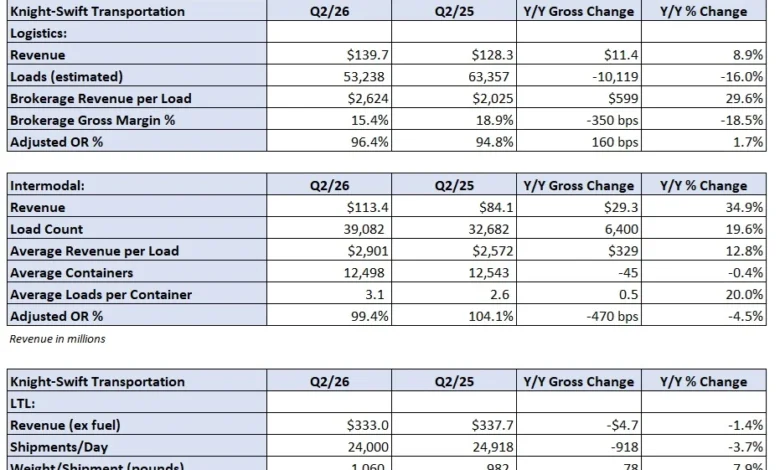
Less-Than-Truckload (LTL) Segment: The LTL segment, which handles smaller freight shipments from multiple customers on a single trailer, experienced a slight revenue dip, down 1% year-over-year to $333 million. This was a result of complex internal dynamics: a 4% increase in tonnage was counteracted by a 4% decline in yield (revenue per hundredweight or per shipment). Shipments per day were down 4% in the quarter, but this was offset by an 8% increase in weight per shipment. The higher shipment weights exerted downward pressure on the yield metric, as heavier shipments often command lower per-pound rates. However, a 5% increase in the average length of haul partially mitigated this yield drag. Despite the revenue decrease, the LTL unit recorded a 92.1% adjusted OR, which was 100 basis points better year-over-year. This improved operating ratio indicates that even with revenue challenges, the LTL segment managed to enhance its operational efficiency and profitability.
Logistics Segment: The logistics segment, encompassing brokerage and other third-party services, saw a healthy 9% year-over-year revenue increase. A notable highlight was the 30% higher brokerage revenue per load, indicating strong demand for brokered services and effective pricing strategies. However, this growth came with challenges: elevated purchased transportation costs led to a 350 basis point erosion in gross margin year-over-year. Consequently, the adjusted OR for the logistics segment was 96.4%, 160 basis points worse year-over-year. This suggests that while demand for logistics services was strong, the tight capacity in the underlying freight market drove up the cost of securing transportation, squeezing profitability for brokerage operations.
Intermodal Segment: The intermodal segment, which combines different modes of transport such as truck and rail, showcased a strong resurgence, returning to profitability with a 99.4% adjusted OR. Revenue in this segment surged by 35% year-over-year, driven by a 20% increase in volumes and a 13% rise in revenue per load. The return to profitability and significant revenue growth in intermodal reflect improving rail service, increased efficiency in transfers, and a strategic shift by some shippers to utilize intermodal for cost savings and environmental benefits amidst high truckload rates.
Broader Financial Context and Tailwinds
The adjusted second-quarter EPS result also factored in several non-operational elements. It excluded certain deal-related, restructuring, severance, and non-cash impairment costs, providing a clearer picture of core operational profitability. Furthermore, the period benefited from lower interest expenses, likely due to effective debt management or a favorable interest rate environment for its existing debt, and higher gains on equipment sales, which contributed a 5-cent year-over-year tailwind to EPS. These factors, while not indicative of ongoing operational trends, certainly bolstered the quarter’s financial outcomes.
Industry Implications and Market Significance
Knight-Swift’s robust second-quarter results and optimistic third-quarter guidance serve as a crucial barometer for the entire freight and logistics industry. As the largest asset-based truckload carrier in the United States, its performance often foreshadows trends for smaller carriers, logistics providers, and even shippers. The consistent theme of "supply-driven tightening" resonates across the sector, suggesting that the current inflationary environment and supply chain disruptions continue to favor carriers with strong asset bases and efficient operations.
The sustained increase in spot rates and tender rejections indicates that shippers are still facing challenges in securing capacity, reinforcing the need for strategic partnerships and long-term contracts. For investors, Knight-Swift’s performance highlights the resilience and potential profitability of the transportation sector, even amid broader economic uncertainties. The ability to pass on increased costs through higher rates and improve operating ratios suggests strong management and adaptability.
Looking ahead, the industry will closely monitor several factors that could influence future performance. Fuel prices, which have been volatile, remain a significant operational cost. The ongoing driver shortage continues to be a structural challenge, prompting companies to invest in recruitment, training, and retention programs. Furthermore, any significant shift in consumer spending patterns or a broader economic slowdown could impact freight volumes, potentially easing the tight capacity conditions observed in Q2. However, for now, Knight-Swift’s earnings report paints a picture of a strong market, skillfully navigated by a leading player.
The company is scheduled to host a conference call at 5:30 p.m. EDT on Wednesday to further discuss its second-quarter results and provide additional insights into its forward strategy and market outlook, an event keenly awaited by analysts and investors alike for deeper understanding and clarification on these favorable trends.