Qilin Ransomware Affiliates Target Critical Palo Alto Networks Vulnerability to Breach Corporate Networks Globally


The Qilin ransomware collective has emerged as a primary threat actor exploiting a critical authentication bypass vulnerability within Palo Alto Networks’ PAN-OS software, a development that underscores the persistent risk to global enterprise infrastructure. According to a detailed technical analysis released by cybersecurity firm Arctic Wolf, multiple affiliates of the Qilin ransomware-as-a-service (RaaS) operation have been observed leveraging the flaw, identified as CVE-2026-0257, to gain unauthorized access to corporate environments. This vulnerability affects the GlobalProtect gateway and portal, components that are central to the secure remote access strategies of tens of thousands of organizations worldwide.
The exploitation of this flaw marks a significant escalation in the tactics employed by Qilin, a group known for its sophisticated double-extortion methods and aggressive targeting of high-value sectors. By bypassing security restrictions on the GlobalProtect VPN, attackers are able to establish unauthorized connections that grant them a foothold within a victim’s internal network, often leading to full-scale domain encryption and data exfiltration.
Technical Overview of CVE-2026-0257
The vulnerability at the heart of these attacks, CVE-2026-0257, is an authentication bypass flaw located in the PAN-OS GlobalProtect portal and gateway. When successfully exploited, the flaw allows a remote, unauthenticated attacker to bypass existing security controls and establish a VPN session as if they were a legitimate user. This type of vulnerability is particularly dangerous because it circumvents the "front door" of an organization’s perimeter defense, rendering traditional multi-factor authentication (MFA) or password policies ineffective if the bypass occurs at the protocol level.
Palo Alto Networks initially disclosed the vulnerability on May 13, 2026, releasing patches for various versions of PAN-OS. At the time of the initial disclosure, the company indicated that it was aware of only "limited" exploit attempts. However, the situation deteriorated rapidly as security researchers began to see widespread scanning and successful intrusions. The flaw’s severity is compounded by the fact that GlobalProtect is a cornerstone of the modern "work-from-home" and hybrid office infrastructure, meaning these devices are almost always exposed to the public internet to facilitate employee access.
Chronology of the Exploitation Campaign
The timeline of the CVE-2026-0257 exploitation reveals a classic "race against the clock" between defenders and threat actors. Following the patch release on May 13, it took only four days for broader exploitation to be documented.

On May 17, 2026, cybersecurity firm Rapid7 reported that it had observed the flaw being used against numerous customers. This prompted a revised warning from Palo Alto Networks, acknowledging that attackers were actively abusing unpatched devices. By May 29, the United States Cybersecurity and Infrastructure Security Agency (CISA) officially added CVE-2026-0257 to its Known Exploited Vulnerabilities (KEV) catalog. This designation carried a mandate for federal civilian executive branch agencies to remediate the flaw within a strict three-day window, reflecting the extreme risk the vulnerability posed to national security and government data integrity.
In June 2026, Arctic Wolf Labs began investigating a series of distinct intrusions that all shared a common point of origin: the exploitation of the Palo Alto Networks firewall appliances. These investigations revealed that the post-exploitation activity led directly to the deployment of Qilin ransomware. The researchers noted that while the initial entry point was consistent, the subsequent behavior of the attackers varied, suggesting that different "affiliates" within the Qilin RaaS network were sharing the exploit.
Analysis of Qilin’s Tactical Shift
Qilin, which originally surfaced in late 2022 under the name "Agenda," has evolved into one of the most prolific ransomware operations in the current threat landscape. The group operates under a RaaS model, where core developers maintain the ransomware code and leak sites, while affiliates carry out the actual intrusions in exchange for a percentage of the paid ransoms.
The group’s adoption of CVE-2026-0257 signifies a shift toward targeting edge devices and infrastructure vulnerabilities rather than relying solely on traditional phishing or credential harvesting. This "living-off-the-edge" strategy allows attackers to move faster and bypass many endpoint detection and response (EDR) solutions that may not be present on a firewall or VPN appliance.
Arctic Wolf’s investigation found that some Qilin affiliates opted for "rapid encryption-only" operations, aiming to lock down files as quickly as possible to maximize disruption. In contrast, other affiliates engaged in "full double-extortion" campaigns, which involve a more methodical approach: moving laterally through the network, identifying sensitive data stores, exfiltrating hundreds of gigabytes of information, and then finally deploying the encryptor. This variety in tradecraft is a hallmark of the RaaS model, where the skill levels and objectives of affiliates can differ significantly.
The Scale of Global Exposure
The impact of a vulnerability in Palo Alto Networks’ hardware is difficult to overstate. The company serves over 70,000 customers globally, including 90% of the Fortune 10 and the majority of major financial institutions in the United States.

Data from internet monitoring services highlights the massive attack surface available to Qilin and other threat actors. Shadowserver, an internet threat watchdog, currently tracks over 167,000 GlobalProtect VPN instances that are exposed to the public internet. Similarly, the search engine Shodan identifies over 172,000 unique IP addresses with a GlobalProtect fingerprint. While many of these devices may have been patched since the May 13 announcement, a significant portion likely remains vulnerable due to delayed maintenance cycles or a lack of visibility within complex corporate IT environments.
The Qilin group has already demonstrated its ability to cause massive disruption. Their victim list includes more than 2,000 organizations, with high-profile targets such as Nissan, the automotive giant Yanfeng, and the Japanese brewery Asahi. Perhaps most notably, Qilin was linked to a devastating attack on Synnovis, a pathology services provider in the United Kingdom, which resulted in the cancellation of thousands of operations and appointments across several London hospitals.
Official Responses and Industry Impact
The cybersecurity community has responded to the Qilin-PAN-OS threat with urgent calls for patching and enhanced monitoring. Palo Alto Networks has urged all administrators to ensure they are running the latest version of PAN-OS and to review their GlobalProtect logs for any signs of unauthorized sessions established prior to patching.
CISA’s intervention has been a critical driver for remediation within the public sector, but the private sector remains a patchwork of readiness. Security analysts suggest that the exploitation of CVE-2026-0257 is likely to continue for several months as attackers move down the list of smaller, less-resourced organizations that are slower to update their infrastructure.
"Arctic Wolf Labs assesses with moderate confidence that intrusions leveraging CVE-2026-0257 and leading to Qilin ransomware deployment are likely ongoing," the company stated in its June report. This assessment is based on the volume of scanning activity and the inherent nature of the RaaS model, where successful exploits are rapidly distributed among a wide network of criminal collaborators.
Broader Implications for Enterprise Security
The Qilin-Palo Alto incident highlights a growing trend in the cybercrime ecosystem: the weaponization of "N-day" vulnerabilities in critical infrastructure. As perimeter defenses become more robust, attackers are focusing their energy on the very tools designed to provide security, such as VPNs, firewalls, and managed file transfer systems.
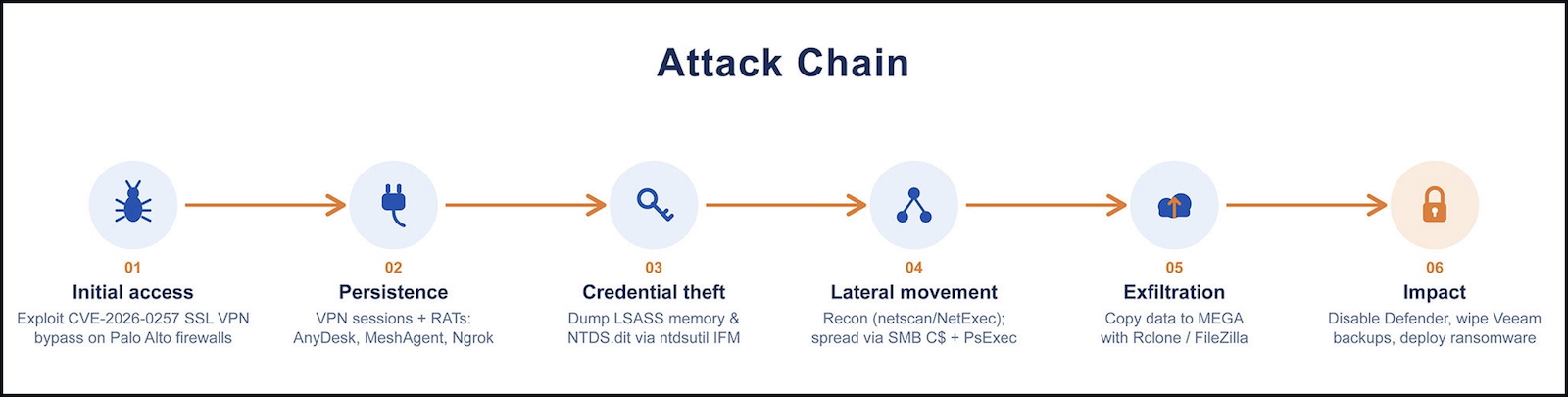
For enterprise security teams, this event serves as a reminder that the "perimeter" is a high-priority target. The speed at which Qilin affiliates moved from a patch announcement to full-scale domain encryption—less than a month—demonstrates that the window for remediation is shrinking. Organizations can no longer afford weeks-long testing cycles for critical security patches on edge devices.
Furthermore, the incident emphasizes the need for a "defense-in-depth" strategy. While the initial breach occurred at the VPN level, the eventual deployment of ransomware required lateral movement and credential escalation within the internal network. Implementing zero-trust architectures, network segmentation, and robust monitoring of internal traffic can help contain the damage even when a perimeter device is compromised.
As the Qilin ransomware group continues to refine its tactics and exploit high-impact vulnerabilities like CVE-2026-0257, the global business community must remain vigilant. The combination of a critical flaw in a market-leading security product and a highly organized RaaS operation represents a potent threat that requires immediate and sustained attention from IT and security professionals worldwide. The ongoing nature of these attacks suggests that the full toll of the CVE-2026-0257 exploitation has yet to be fully realized.