AI-Powered Dolphin X Remote Access Trojan Emerges to Automate High-Value Target Profiling and Credential Theft

Cybersecurity researchers have uncovered a sophisticated new strain of malware known as Dolphin X, a remote access trojan (RAT) that distinguishes itself from the crowded landscape of cybercrime tools through the integration of an artificial intelligence-powered profiling engine. This feature, advertised as a revolutionary "AI Profiler," is designed to solve a significant operational bottleneck for threat actors: the overwhelming volume of data harvested from infected machines. By automatically scoring and ranking victims based on their perceived value, Dolphin X allows attackers to prioritize high-stakes targets, such as corporate executives, cryptocurrency whales, and cloud administrators, while ignoring low-value infections.
The malware first came to light after being analyzed by Daniel Kelley, a prominent researcher at Varonis Threat Labs. Kelley identified the tool being aggressively marketed on underground cybercrime forums by a vendor operating under the alias "Kontraktnik." Positioned as an all-in-one solution for surveillance and data exfiltration, Dolphin X represents a growing trend in the "Malware-as-a-Service" (MaaS) ecosystem, where developers leverage automation and machine learning to increase the efficiency of criminal operations.
The Operational Mechanics of Dolphin X
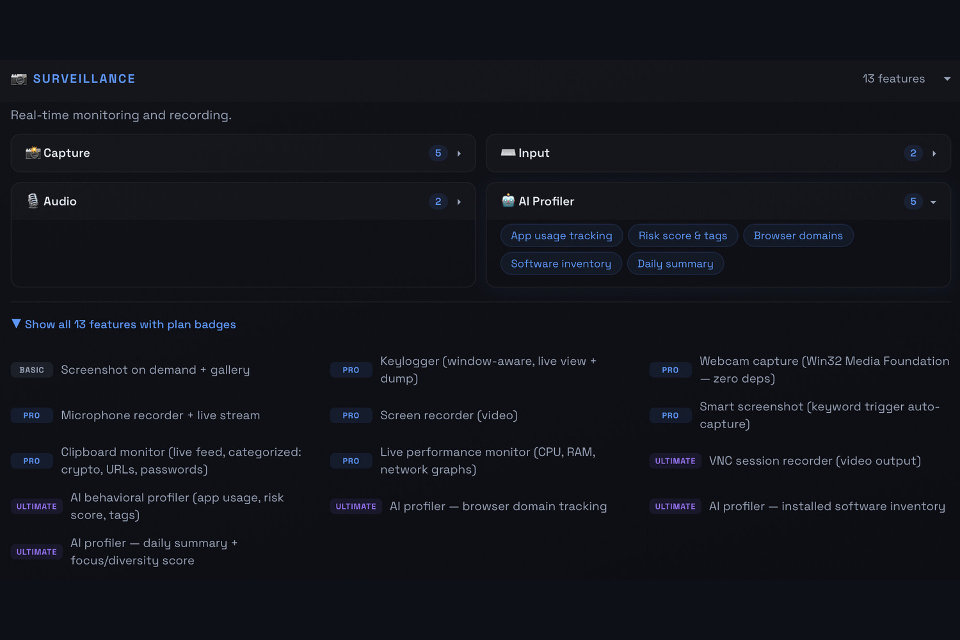
According to the analysis provided by Varonis, the Dolphin X operator panel is a comprehensive command-and-control (C2) interface boasting 329 distinct features categorized into ten specialized modules. These modules cover a wide range of malicious activities, including remote desktop access, file manipulation, and extensive credential theft. However, the most significant innovation lies within the surveillance tab, which houses the AI Profiler.
The vendor describes the AI Profiler as a behavioral analysis tool capable of tracking application usage, generating risk scores, and providing daily summaries of victim activity. In the context of modern cyberattacks, where a single campaign might result in thousands of infected "bots," the ability to filter through the noise is invaluable. Traditionally, attackers had to manually inspect logs or use rudimentary scripts to identify which victims possessed access to sensitive corporate networks or significant financial assets. Dolphin X automates this triage process, acting as a digital headhunter for cybercriminals.

The operator panel indicates that the AI Profiler processes a variety of telemetry data from the infected host, including:
- Application Usage Tracking: Monitoring which programs the victim uses most frequently.
- Risk Scoring and Tagging: Assigning a numerical value to a victim based on their potential for exploitation.
- Browser Domain Analysis: Reviewing the types of websites visited (e.g., banking portals, cloud consoles, or developer forums).
- Installed Software Inventories: Identifying high-value software such as IDEs, VPN clients, or enterprise resource planning (ERP) tools.
Technical Forensics and Discovery
Varonis Threat Labs conducted its investigation by obtaining the Dolphin X operator panel and its associated malware builder. To ensure safety and prevent accidental infection, the researchers analyzed the toolset within an isolated lab environment. Rather than executing a live agent on a production machine, they focused on the builder’s logic and the network traffic patterns generated by the control panel.
During this deep dive, Kelley confirmed that the AI Profiler is not merely a marketing gimmick but a functional component of the software’s architecture. The research team discovered several technical strings within the panel’s code that support the profiling workflow, including Auto-Start AI Profiler, ProfilerStart, ProfilerGetData, risk_score, risk_factors, and categoryusage. These strings suggest a robust backend designed to ingest victim data and return actionable intelligence to the operator.
While the presence of the profiling logic is confirmed, the specific artificial intelligence engine or machine learning model used to generate these rankings remains a mystery. Without analyzing a live, running sample of the Dolphin X agent in communication with its C2 server, researchers cannot definitively state whether the "AI" involves a local neural network, a cloud-based API, or a complex heuristic-based algorithm. Regardless of the underlying technology, the intent is clear: to optimize the "return on investment" for the threat actor.
Extensive Data Exfiltration Capabilities
Beyond its profiling capabilities, Dolphin X serves as a highly effective credential stealer. The operator panel claims the malware can target more than 300 different applications, making it a "Swiss Army knife" for data theft. Its reach extends across multiple sectors of the digital environment:

- Web Browsers: The malware targets nine Chromium-based and Gecko-based browsers, extracting saved passwords, cookies, and autofill data.
- Cryptocurrency: It is designed to pillage 100 different cryptocurrency wallet extensions and 65 desktop-based crypto wallets, representing a massive threat to individual and institutional digital asset holders.
- Password Managers: Ten popular password management tools are specifically targeted for data extraction.
- Cloud and Development Tools: Perhaps most concerning for enterprises is Dolphin X’s ability to steal over 30 cloud command-line interface (CLI) tools, SSH keys,
.envfiles (which often contain hardcoded API keys), and cloud access tokens.
By focusing on developer credentials and cloud tokens, Dolphin X is clearly built for more than just simple financial fraud. It is a tool for initial access, designed to facilitate lateral movement into cloud environments and production systems, potentially leading to large-scale data breaches or ransomware deployment.
The Broader Context of AI in Cybercrime
The emergence of Dolphin X is part of a broader, accelerating trend where artificial intelligence is being weaponized by the criminal underground. In recent months, researchers have observed the rise of tools like SpamGPT, which uses large language models (LLMs) to craft highly convincing phishing emails, and autonomous AI agents capable of conducting end-to-end cyberattacks with minimal human intervention.
Historically, the bottleneck for cybercriminals was the "human element"—the need for a person to sit at a desk and decide which victim to hack next. Dolphin X effectively removes this barrier. By using AI to solve the "operational problem" of data overload, the developers of Dolphin X have created a force multiplier. This allows even relatively unsophisticated attackers to manage large-scale botnets with the precision of an Advanced Persistent Threat (APT) group.
Implications for Cybersecurity Defense
The arrival of AI-augmented RATs like Dolphin X necessitates a shift in defensive strategies. For years, cybersecurity professionals have relied on the fact that attackers are often overwhelmed by the volume of their own success. If an attacker steals 10,000 sets of credentials, they might only have the time to check 100 of them. Dolphin X ensures that those 100 checked accounts are the 100 most dangerous to the victims.
Industry analysts suggest that this development will put increased pressure on Security Operations Centers (SOCs). "The window of opportunity between initial infection and high-value exploitation is shrinking," says one industry expert. "When the attacker’s tools can instantly tell them they have infected a Chief Technology Officer or a Cloud Admin, the time-to-exploit drops from days to minutes."
To counter these threats, organizations are encouraged to adopt a "defense-in-depth" posture:
- Multi-Factor Authentication (MFA): Stealing credentials becomes less effective if a physical token or biometric check is required for access.
- Endpoint Detection and Response (EDR): Monitoring for the specific behaviors of RATs—such as unauthorized API calls or unusual network traffic to known C2 nodes—is critical.
- Secrets Management: Enterprises must move away from storing sensitive credentials in
.envfiles or plain-text scripts, which are prime targets for Dolphin X. - Zero Trust Architecture: By assuming that an endpoint might already be compromised, organizations can limit the lateral movement that Dolphin X aims to facilitate.
Conclusion and Chronology
The discovery of Dolphin X serves as a stark reminder that the "AI arms race" is not limited to legitimate software development. Since its first appearance on cybercrime forums in mid-2024, the malware has rapidly evolved, with "Kontraktnik" continuously updating the feature set to maintain a competitive edge in the illicit market.
As Varonis continues to monitor the situation, the cybersecurity community is on high alert for live samples of the malware. The ability to independently verify the efficacy of the AI Profiler will be the next step in understanding how significant a threat Dolphin X poses to global digital infrastructure. For now, the existence of such a tool underscores a new era of automated, intelligent, and highly efficient cyber warfare, where the most vulnerable targets are no longer chosen by chance, but by an algorithm.
Related posts: