The Anatomy of Omnichannel Retention: How Modern Brands Harmonize Email and SMS Marketing

The modern digital marketplace has transformed consumer engagement from a broadcast model into a deeply personal dialogue, particularly with the proliferation of mobile-first communication channels. When a consumer provides a mobile telephone number at a digital or physical point of sale, they are granting a brand direct access to a personal device—a medium traditionally reserved for interpersonal communication with family and friends. Conversely, the traditional email inbox functions as a public digital corridor, easily accessible to commercial senders but frequently saturated with marketing collateral, promotional offers, and unread notifications.
Historically, retail founders and marketing executives have treated these two distinct communication channels as interchangeable conduits, deploying identical messaging strategies across both mediums or inadvertently neglecting one in favor of the other. Industry analysts note that organizations frequently default to email due to its low marginal cost and operational familiarity, while simultaneously adopting SMS marketing reactively to mirror competitor campaigns driven by high initial open rates. However, contemporary data indicates that operating either channel in complete isolation results in diminished customer lifetime value, forfeited revenue, and accelerated subscriber fatigue.
Market research underscores the distinct operational profiles of each medium. Email campaigns consistently demonstrate superior utility for long-form storytelling, comprehensive product education, and detailed customer segmentation. The average email open rate across global retail sectors hovers between 17% and 25%, depending on the industry vertical, while click-through rates generally range from 2% to 4%. These metrics reflect an asynchronous medium where consumers intentionally allocate dedicated time to review brand communications, compare product specifications, and evaluate promotional offers.
In contrast, SMS marketing operates within an immediate, synchronous framework. Industry benchmarks show that text message open rates frequently exceed 98%, with the vast majority of messages read within three minutes of delivery. However, this immediacy comes with strict constraints. Text messaging limits brands to concise, punchy copy—typically constrained by character limits—and carries a significantly higher cost per send compared to email. Furthermore, consumer tolerance for frequency on mobile devices is exceptionally low; over-messaging via SMS is the primary driver of immediate opt-outs and permanent subscription revocations.
To mitigate these operational challenges, successful direct-to-consumer and enterprise retail brands are increasingly adopting an omnichannel framework. This strategy relies on distinguishing message delivery based on temporal urgency, categorization, and consumer intent, ensuring that neither channel is burdened with responsibilities unsuited to its mechanical design.
The strategic division of labor between email and SMS hinges primarily upon a single operational metric: whether the message content possesses an expiration time. Communications that lack immediate temporal constraints—such as brand origin stories, educational content, seasonal lookbooks, and multi-week onboarding sequences—are ideally routed through the email channel. Because email inboxes function asynchronously, the delayed delivery of a brand newsletter by several hours does not diminish its informational or commercial value.
Conversely, time-sensitive communications are routed exclusively through SMS infrastructure. Examples include flash sales expiring at midnight, real-time inventory updates for back-in-stock items, and abandoned cart reminders initiated while purchase intent remains elevated. Industry case studies indicate that abandoned cart recovery sequences deployed via SMS within one hour of session abandonment can recover up to 15% of otherwise lost transactions, a conversion rate substantially higher than email-only recovery workflows.
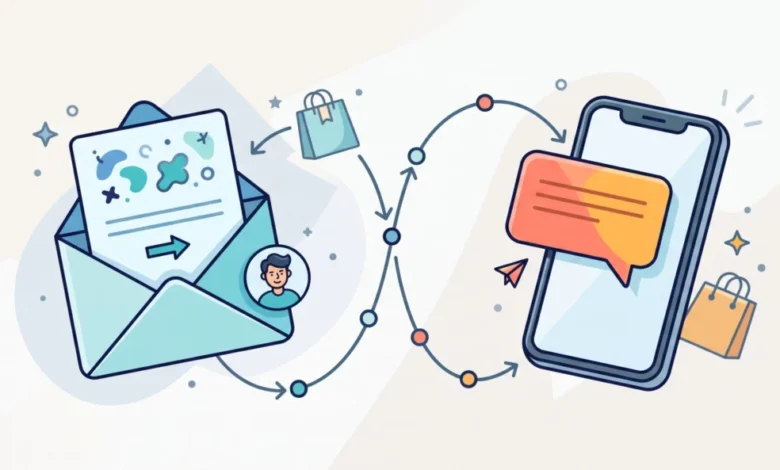
Marketing automation platforms have evolved to support this sequential integration, enabling brands to orchestrate cross-channel workflows rather than broadcasting parallel messages that compete for consumer attention. Under a sequenced automation model, customer onboarding workflows typically initiate with a comprehensive introductory email that establishes brand identity and outlines value propositions. If the recipient fails to complete a purchase within a predefined window—typically 24 to 48 hours—a secondary, brief SMS message is triggered to provide a streamlined pathway back to the storefront.
This sequential handoff prevents message redundancy and respects the consumer’s attention span. Similar multi-channel staging is applied during major retail events such as Black Friday and Cyber Monday (BFCM). During high-volume shopping periods, email carries the primary burden of campaign announcements, gift guides, and extended promotional storytelling, while SMS is strategically reserved for critical conversion milestones, such as sale launches and final-hours countdowns.
The integration of these channels within unified software architectures, such as those provided by enterprise omnichannel vendors like Omnisend, Klaviyo, and Attentive, has streamlined execution for marketing teams. By centralizing behavioral segmentation, purchase history, and browsing data into a single customer view, brands can construct unified workflows that automatically transition a subscriber from an email sequence to a text message based on real-time engagement data. This technical consolidation eliminates the friction of managing disparate platforms and ensures that consumer data remains synchronized across touchpoints.
Industry experts emphasize that restraint is the cornerstone of sustainable SMS marketing. While email distribution lists exhibit high forgiveness regarding frequency—where an additional weekly campaign rarely precipitates a spike in unsubscribes—mobile telephone numbers demand rigorous protection. Data from mobile marketing associations indicates that receiving more than three promotional text messages in a single week is the leading catalyst for mobile opt-out requests. Once a consumer revokes SMS consent, the brand permanently forfeits its highest-converting, most immediate communication channel.
Consequently, marketing compliance and governance have emerged as critical components of retail strategy. Best practices dictate explicit, unbundled opt-in mechanisms at checkout, strict adherence to regional regulatory frameworks such as the Telephone Consumer Protection Act (TCPA) in the United States and the General Data Protection Regulation (GDPR) in Europe, and the scrupulous observation of quiet hours based on the recipient’s local time zone. Maintaining a smaller, highly engaged SMS list of consenting consumers consistently yields a higher return on investment than cultivating an inflated database through aggressive acquisition tactics.
The broader implications of this omnichannel harmonization extend directly to customer acquisition costs (CAC) and customer lifetime value (LTV). As digital advertising costs on major social media and search engines continue to rise, owned marketing channels—specifically email and SMS—represent the most cost-effective avenues for driving repeat purchases and cultivating brand loyalty. Brands that successfully balance the asynchronous depth of email with the synchronous immediacy of SMS are positioned to maximize revenue retention while preserving the long-term integrity of their customer relationships.
Related posts: