Canada Eyes Historic Shift Toward European Union Membership as Trade Pressures Mount From Washington

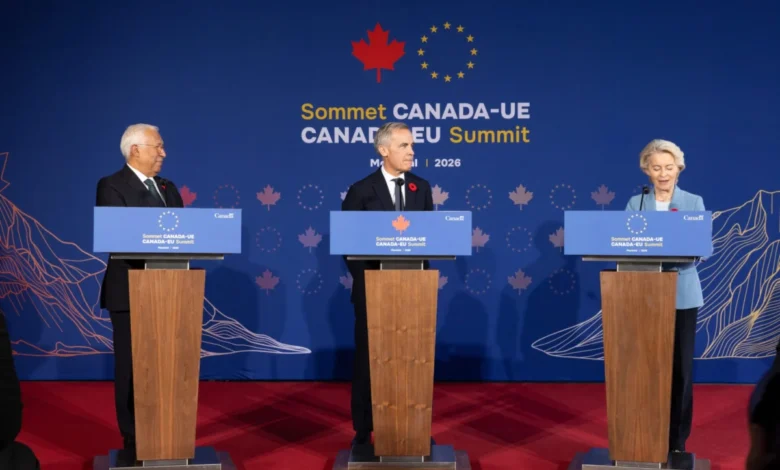
MONTREAL — In a geopolitical realignment of historic proportions, Canadian Prime Minister Mark Carney announced Friday that Ottawa expects to conclude negotiations with the European Union by June to establish Canada as the bloc’s first-ever "associate member." The sweeping initiative, unveiled at the conclusion of a two-day bilateral summit in Montreal, represents a calculated effort by both traditional allies to insulate their economies and bolster their sovereign independence amid an increasingly volatile and unpredictable global order.
The acceleration of these unprecedented economic and security ties has been heavily propelled by ongoing trade pressures and recurring protectionist threats emanating from Washington under U.S. President Donald Trump. With the White House routinely targeting long-standing alliances and weaponizing tariffs, Ottawa and Brussels are proactively moving to reduce their structural reliance on the United States, cementing a partnership designed to withstand future external economic coercion.
The Forging of the Alliance for the Future
The framework of this new relationship was officially introduced as the "Alliance for the Future" during joint statements delivered by Prime Minister Carney, European Commission President Ursula von der Leyen, and European Council President António Costa. The initiative aims to create a robust, multifaceted bridge across the Atlantic, integrating digital economies, pooling technological resources, and deepening defense cooperation.
"What brings us together goes far beyond geography. We see the world through the same eyes," European Commission President Ursula von der Leyen declared during the closing press conference in Montreal. Emphasizing the permanence of the geopolitical shift, she added, "These headwinds won’t stop blowing. This change is permanent."
Carney echoed these sentiments, stressing that the alliance is designed to empower Canada and European nations to chart independent courses rather than bowing to the dictates of more powerful global actors. When queried by journalists whether the alliance could eventually extend an invitation to Washington, Carney declined to offer a direct answer, reiterating instead that the pact is not intended as an act of hostility against any single nation.
"It is about reinforcing sovereignty. Why? So we can live our lives as we choose, our people can live their lives as we choose and have the full freedoms that people enjoy in the European Union and in Canada," Carney stated. "It’s not against anything, it’s for."
Despite the ambitious vision articulated by both Carney and von der Leyen regarding an "associate member" status, the formal joint declaration issued at the end of the summit omitted the specific terminology. Instead, negotiators agreed to outline an "ever-closer association" framework ahead of the next scheduled bilateral summit in 2027. Nevertheless, European leadership confirmed a high-level timeline: Canadian Cabinet ministers and European commissioners are slated to meet in March, setting the stage for Carney to travel to Brussels in June to finalize the terms during European Council meetings.
Trade Realities and Economic Dependence
The urgency driving Canada’s pivot toward Europe is starkly illustrated by recent trade data. In 2025, the United States accounted for a staggering 71.7% of Canada’s total merchandise exports, leaving the Canadian economy acutely vulnerable to American domestic political shifts and trade volatility. Prime Minister Carney has made economic diversification a cornerstone of his administration’s policy, setting a definitive target to double Canada’s export volume to non-U.S. markets over the coming decade.
Canada and the European Union already operate under the Comprehensive Economic and Trade Agreement (CETA), a landmark free-trade pact that has successfully eliminated the vast majority of tariffs between the two jurisdictions since its provisional implementation. The Montreal summit expanded upon this foundation by wrapping up crucial negotiations on a modern digital trade agreement, designed to streamline cross-border commerce for transatlantic enterprises.
Under the newly minted arrangements, a tech startup operating out of Vancouver will encounter a significantly smoother pathway to reaching consumers in major European hubs like Berlin. "Bottom line: less red tape, more growth, more opportunity," Carney remarked, emphasizing the practical domestic benefits of the integration.
Furthermore, the two sides finalized a comprehensive competition agreement aimed at curbing anti-competitive corporate practices and lowering retail prices for consumers. Financial authorities will also explore linking Canadian and European instant-payment infrastructures, a move expected to drastically reduce the cost and transit time of cross-border monetary transfers.
Technological Collaboration and Critical Minerals
A core pillar of the Alliance for the Future involves strategic collaboration in advanced technologies and critical raw materials. Canada secured a landmark agreement enabling the European Investment Bank (EIB) to directly finance critical mineral extraction and processing projects within Canadian borders. This infusion of European capital provides a vital alternative funding source for Canada’s mining sector, which is essential for the global transition to green energy technologies and electric vehicle supply chains.
In addition to resource security, Canada is set to integrate into major European research initiatives, most notably the bloc’s high-performance computing network. Carney highlighted that access to Europe’s JUPITER supercomputer will exponentially accelerate Canadian scientific research, noting that the European system can execute complex calculations in a single day that would require six months on Canada’s most powerful current research infrastructure.
Beyond computing, the summit yielded agreements to study the commercial and environmental feasibility of exporting Canadian liquefied natural gas (LNG) to energy-conscious European markets. Officials also agreed to investigate the installation of new high-capacity undersea telecommunications cables connecting Canada, Europe, and Asia, enhancing digital sovereignty and network resilience.
Educational and cultural ties are likewise slated for expansion. Ottawa and Brussels committed to initiating formal negotiations to broaden Canadian student participation in Erasmus+, the flagship European Union student exchange program, while simultaneously exploring administrative mechanisms to facilitate young professionals living and working across the Atlantic.
Security, Defense, and Geopolitical Implications
Security cooperation formed a critical dimension of the Montreal discussions, extending far beyond traditional economic metrics. The participating leaders agreed upon a comprehensive new border security arrangement, alongside pledged commitments to intensify collaboration in defense procurement, cybersecurity protocols, Arctic sovereignty monitoring, and joint efforts to counter foreign interference campaigns.
European Council President António Costa emphasized the unique structural nature of the emerging partnership, noting that it pushes past the boundaries of conventional international agreements. "Our relationship is so special that we want to create something new: to go beyond a simple association, everything short of full EU membership," Costa stated.
The broader architecture of the Alliance for the Future is intentionally designed with scalability in mind. Officials indicated that the partnership could eventually expand to incorporate other like-minded democracies globally, with Canada and the European Union serving as its institutional core.
Washington’s Reaction and Diplomatic Fallout
The aggressive diplomatic outreach to Brussels has not gone unnoticed in Washington. President Trump has publicly criticized Canada’s pursuit of closer structural integration with the European Union, characterizing the proposed arrangement as a potential "hostile act" and issuing thinly veiled warnings regarding possible retaliatory tariffs on European goods if Washington perceives the partnership as economically or strategically unfriendly.
The American posture underscores the high-stakes balancing act facing Ottawa. While Canadian policymakers maintain that the alliance is driven by a domestic imperative to secure national sovereignty and economic stability, Washington views any concerted effort by traditional allies to bypass American economic primacy with deep suspicion.
As Canadian and European bureaucratic teams prepare for the critical March ministerial consultations ahead of the June Brussels meetings, the international community will be closely watching whether the ambitious timeline holds. If successfully concluded, the agreement will fundamentally redefine Canada’s place in the global architecture, creating a novel bridge between North America and the European continent that could permanently alter Western geopolitical alignments.