U.S. Naval Blockade Chokes Iran’s Economy as Land Routes Prove Incapable of Replacing Gulf Maritime Trade

The ongoing United States naval blockade in the Middle East is exerting unprecedented pressure on the Iranian economy, systematically crippling the nation’s commercial lifelines while desperate efforts by Tehran to reroute trade over land fail to provide meaningful relief. Before the outbreak of the current military conflict, over 80% of Iran’s total trade tonnage moved seamlessly by sea through its critical southern ports. Today, that maritime gateway has been entirely shut off by an ironclad U.S. naval presence, leaving the regime scrambling to sustain its population and industrial base through heavily restricted land corridors.
According to statements released by U.S. Central Command (CENTCOM), military authorities have successfully redirected or intercepted 109 commercial vessels to date, ensuring strict compliance with the sweeping naval blockade. Meanwhile, other Persian Gulf oil-producing nations continue to move vital energy supplies through the Strait of Hormuz, frustrating Tehran’s strategic objectives and highlighting a widening economic disparity across the region.
The Collapse of Maritime Trade and the Rise of Land Convoys
With southern maritime routes effectively closed, international trade has been forced onto overland pathways, creating unprecedented congestion along Iran’s borders with Turkey, Pakistan, Afghanistan, Iraq, and Turkmenistan. Bilateral commerce with immediate neighbors has seen a superficial spike as a result; for instance, trade with Turkey surged by 19% to reach $3.2 billion during the first half of the year. However, this marginal increase masks a broader, catastrophic collapse in national trade volume.
Official figures from Iranian customs authorities covering the five-month period ending August 22 reveal that non-oil exports plummeted by 28% year-over-year to $15 billion, while imports dropped by 26% to $17 billion. The inability of land infrastructure to absorb the sudden, massive influx of goods has generated severe bottlenecks. Bureaucratic hurdles, antiquated customs protocols, and a total lack of scalable logistical architecture have resulted in monumental traffic jams at strategic border crossings.
At one major transit point along the Turkish border, approximately 3,700 freight trucks were recently stranded on the Iranian side. Lines of commercial vehicles now stretch for miles, with drivers enduring agonizing wait times that frequently exceed three weeks to cross international boundaries. A Turkish trucker transporting used cars into Iran reported to the Financial Times that return-trip border delays can stretch up to 24 days. Similarly, an Iranian driver recounted spending 23 days stranded at a commercial crossing along the Afghan border in mid-June. Further north, at the Turkmenistan border, severe shortages of warehousing facilities and inadequate electronic registration processes have heavily constrained the expansion of cross-border rail freight, as noted by the Wall Street Journal.
Astronomical Financial Costs and the Energy Crisis
The forced shift from maritime shipping to overland transport has triggered an astronomical surge in logistical expenditures. Majidreza Hariri, head of the Iran-China Joint Chamber of Commerce, illuminated the stark financial disparity last month. According to Hariri, transporting a single standard shipping container between China and Iran via maritime routes costs approximately $3,000. Bypassing the naval blockade by moving that same container over land quadruples the expense to $12,000.
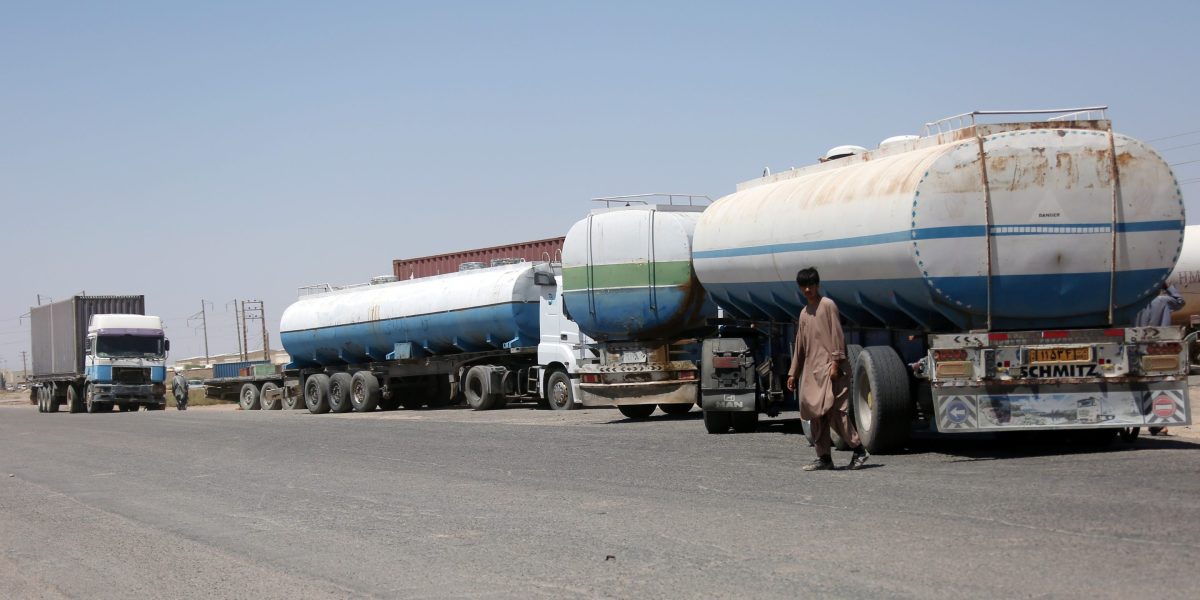
Given that roughly 2 million shipping containers pass through Iran’s southern ports annually during peacetime, the transition to land routes imposes an estimated $18 billion in additional transportation costs every single year. While these overland shipments may provide enough basic necessities to stave off immediate total collapse, macroeconomic indicators point toward inevitable ruin. "Under these circumstances, there is little alternative but to find a way to restore and maintain the southern trade corridors," a member of the Iran Chamber of Commerce told the Financial Times, adding that without maritime access, the domestic economy will eventually "grind to a halt."
The contraction of international trade has directly exacerbated a severe domestic energy crisis. Because Iran lacks sufficient domestic refining capacity to process all the crude oil it extracts, the nation relies heavily on imported refined petroleum products. The collapse of imports has triggered acute gasoline shortages across major urban centers, forcing Tehran to curb soaring domestic demand through abrupt price hikes. Consequently, nationwide inflation has skyrocketed to an alarming 90%, eroding purchasing power and plunging millions of households into severe financial distress.
Contrast in the Persian Gulf: U.S. Operations and Security in the Strait of Hormuz
While Iran’s commercial maritime sector remains entirely paralyzed, neighboring Gulf nations are successfully utilizing the Strait of Hormuz, rendering Tehran’s asymmetrical harassment campaigns largely ineffective. Despite persistent threats, including localized drone and missile attacks orchestrated by Iranian proxy forces designed to deter commercial shipping, international energy transit through the crucial waterway has rebounded significantly.
In a press briefing, CENTCOM Commander Admiral Brad Cooper announced that the U.S. military has safely overseen the transit of 1 billion barrels of oil through the Strait of Hormuz over the past two months alone, successfully escorting and assisting more than 2,000 commercial vessels. Following extensive U.S.-led mine-clearing operations that removed explosive hazards from primary shipping lanes, cargo volumes, liquid natural gas shipments, and crude oil exports passing through the strait over a two-week window reached their highest levels in six months—marking the period immediately following the onset of the conflict.
"And Iran has exported zero barrels thanks to our ironclad blockade," Admiral Cooper emphasized, underscoring the absolute efficacy of the naval quarantine.
Chronology of the Economic Conflict
- Early Phase of the Conflict: Military hostilities break out in the region, prompting the United States Navy to establish a comprehensive blockade of southern Iranian ports and restrict commercial traffic through the Strait of Hormuz.
- Months 1–3: Iranian trade patterns shift drastically. Maritime imports and exports plunge by over 25%, while commercial traffic floods overland borders with Turkey, Iraq, Pakistan, Afghanistan, and Turkmenistan.
- Mid-Year Milestones: Trade deficits widen significantly. Non-oil exports drop to $15 billion while imports fall to $17 billion. Border bottlenecks peak, with thousands of trucks stranded for up to 24 days at checkpoints lacking adequate infrastructure.
- Recent Developments: CENTCOM reports the successful safeguarding of 1 billion barrels of oil through the Strait of Hormuz, while Iran institutes harsh domestic fuel price hikes as inflation surges to 90%, triggering visible anxiety within the political leadership in Tehran.
Strategic Implications and Political Outlook
The deliberate strategy of economic warfare pursued by the U.S. administration aims to fundamentally alter Tehran’s strategic calculus and bring an end to the hostilities. The economic pressure has become so acute that even Supreme Leader Ayatollah Mojtaba Khamenei has publicly expressed deep anxiety regarding macroeconomic stability, currency depreciation, and the erosion of domestic social cohesion.
Nevertheless, geopolitical analysts caution that the Iranian regime’s repressive apparatus is historically insulated from popular discontent. Observers note that the clerical leadership is fully prepared to endure prolonged economic hardship and domestic suffering, calculating that the authoritarian government can weather the crisis longer than American consumers can tolerate elevated domestic gasoline prices and prolonged geopolitical instability. As the economic vice tightens, Iran faces a stark reality: without a diplomatic or military breakthrough that reopens the strategic waters of the Persian Gulf, its national economy faces a slow, structural suffocation from which overland trade routes cannot save it.