Building an Open-Source Secrets Management Stack with CloudNativePG and OpenBao on Kubernetes

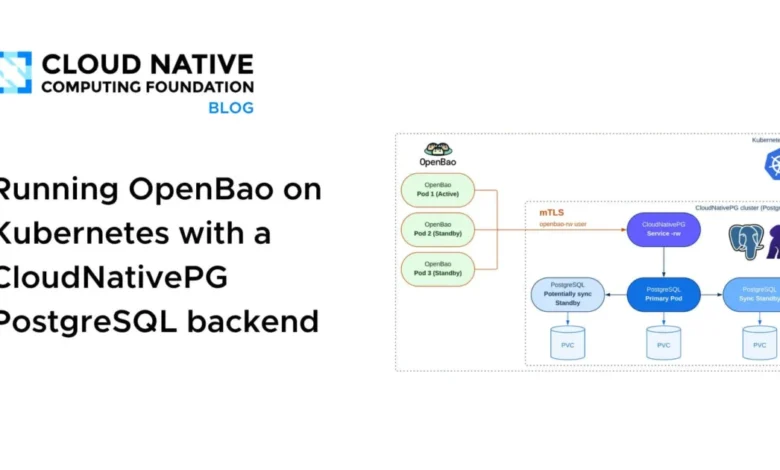
Managing infrastructure secrets within a Kubernetes environment requires a robust, self-healing backend that avoids the pitfalls of vendor lock-in. As organizations increasingly migrate sensitive workloads to cloud-native architectures, the demand for transparent, open-source security primitives has reached a critical inflection point. By integrating OpenBao—the Linux Foundation’s community-driven fork of HashiCorp Vault—with CloudNativePG (CNPG), developers can now construct a resilient secrets management stack that relies entirely on CNCF-graduated and incubating projects. This integration replaces traditional, password-reliant authentication methods with a certificate-based architecture, ensuring that even the most privileged database roles are secured through mutual TLS (mTLS) enforcement.
The Evolution of Cloud-Native Infrastructure Security
The shift toward "secret-less" authentication represents a major evolution in how microservices communicate with stateful backends. Traditionally, applications and storage engines relied on static credentials—passwords or API keys stored in configuration files or environment variables—which are inherently vulnerable to leakage or theft.
OpenBao functions as an encrypted key-value store, while CloudNativePG provides the automated lifecycle management for PostgreSQL instances on Kubernetes. When combined, these projects create a self-healing, synchronously replicated database instance that requires no external cloud database dependency. This architecture is particularly significant for enterprises seeking to maintain strict control over their data plane while benefiting from the operational simplicity of Kubernetes custom resource definitions (CRDs).
Architecture and Operational Blueprint
The architectural strategy relies on the deployment of a three-instance CNPG cluster serving as the storage backend for OpenBao. By leveraging Kubernetes node labels and pod anti-affinity, administrators can ensure that database instances are physically distributed across distinct availability zones, thereby minimizing the risk of correlated failures.
In this setup, the database roles used by OpenBao—specifically the schema-owning role and the runtime application role—do not possess passwords. Instead, authentication is managed via TLS client certificates issued through the DatabaseRole CRD. These certificates are enforced by the pg_hba.conf configuration, which strictly mandates certificate-based authentication and rejects any connection attempt that lacks a valid client-side certificate. This effectively closes the attack surface typically associated with password-based brute force or credential harvesting.

Deployment Chronology and Configuration
To establish this environment, the deployment follows a structured, four-step process designed for reproducibility.
- Environment Provisioning: Using the
cnpg-playgroundrepository, administrators deploy a Kind-based Kubernetes cluster. This environment is pre-configured with the CloudNativePG operator and necessary plugins, such as the Barman Cloud agent for continuous backups. - Database and Role Configuration: The deployment of the
Clusterresource defines synchronous replication, ensuring that at least one standby instance confirms data persistence before a write is acknowledged (RPO=0). Database roles are then provisioned with client certificates, ensuring that even the initial DDL (Data Definition Language) operations are performed without static credentials. - Schema Initialization: A Kubernetes Job is utilized to create the necessary tables for OpenBao’s KV store and HA locks. By revoking default
PUBLICpermissions on the database and schema, the system adheres to the principle of least privilege, ensuring that only the specific role required by OpenBao can interact with the data. - OpenBao Integration: Finally, the OpenBao Helm chart is deployed, with its storage configuration pointed to the PostgreSQL cluster. The configuration explicitly disables the chart’s default local data storage, forcing all state to be managed by the highly available CNPG backend.
Technical Analysis: Resilience and Performance
The choice of synchronous replication within the CNPG framework provides a significant performance and reliability advantage. By setting the replication method to any and requiring confirmation from at least one standby node, the system guarantees data integrity during failover events. Unlike legacy failover mechanisms that often involve manual intervention or complex secondary scripts, the CNPG operator manages the primary promotion process automatically, reducing the Mean Time to Recovery (MTTR) to seconds.
Furthermore, the integration handles the challenges of Kubernetes volume mounts by enforcing 0640 file permissions on secret volumes. Because libpq—the C application programmer’s interface to PostgreSQL—rejects any private key file that is group- or world-readable, this precise permission setting is essential for successful mTLS handshakes between the OpenBao pods and the database instances.
Security Implications and Future Outlook
The broader implications of this stack extend beyond simple secret storage. By offloading secrets management to a self-managed, open-source stack, organizations gain full visibility into their audit logs and encryption keys. There is no reliance on proprietary, black-box managed services, which simplifies compliance with strict data residency and sovereignty regulations.
However, operational challenges remain, particularly regarding certificate lifecycle management. CNPG handles the automatic renewal of client certificates; however, the OpenBao storage plugin does not currently support dynamic reloading of these certificates from the filesystem without a pod restart. Consequently, teams must factor in a rolling restart of the OpenBao stateful set during the certificate renewal window, which typically occurs every 90 days. Ongoing community discussions, such as those found in CNPG issue #11312, are exploring ways to streamline this process, including potential support for per-role certificate duration overrides.
Conclusion
The convergence of CloudNativePG and OpenBao marks a maturation of the cloud-native ecosystem. By moving away from legacy credential patterns and embracing mTLS-based authentication, developers can achieve a significantly higher security posture. As these projects move toward incubation and graduation within the CNCF, they provide a standardized, battle-tested foundation for any organization looking to harden its infrastructure secrets management. The combination of synchronous replication, declarative role management, and strict network-level security rules ensures that the data plane remains protected, resilient, and fully under the control of the infrastructure team. For organizations operating at scale, this open-source stack provides not just a utility, but a strategic advantage in managing the complexities of distributed, multi-cloud environments.
Related posts: