Google Ads Introduces "Missed Growth Opportunity" Insights Directly into Recommendations Tab

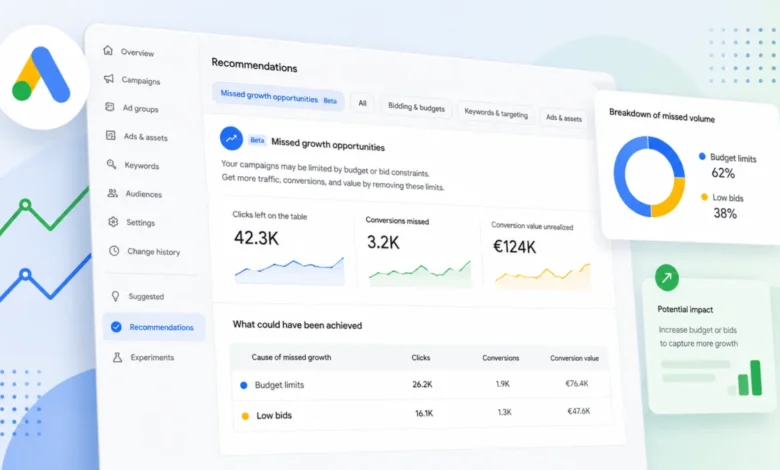
Google Ads is enhancing its recommendations for advertisers by integrating "Missed Growth Opportunity" insights directly into the main Recommendations tab, a move that promises to provide a clearer, more actionable view of potential revenue and conversion gains previously constrained by budget limitations or insufficient bids. This beta feature, now accessible to eligible advertisers, aims to surface critical performance estimates alongside existing optimization suggestions, offering a unified dashboard for strategic campaign adjustments.
Previously residing within the more experimental Google Ads Labs, these "Missed Growth Opportunity" insights were a valuable but less accessible tool for advertisers seeking to understand the ceiling of their campaign performance. By migrating these estimates to the prominent Recommendations tab, Google is significantly increasing their visibility and making them a more integral part of the day-to-day management of Google Ads accounts. This strategic repositioning underscores Google’s commitment to empowering advertisers with data-driven insights to maximize their return on investment.
Unpacking the "Missed Growth Opportunity" Beta
The core of this new beta feature lies in its ability to quantify the potential upside of increasing advertising budgets or adjusting bid strategies. For advertisers operating under tight budget constraints, these recommendations will highlight the estimated traffic, conversions, and revenue that are being forgone. Similarly, for campaigns where bid levels might be too low to compete effectively for valuable ad placements, the feature will project the incremental gains achievable through strategic bid increases.
The visual representation of these insights is designed for immediate comprehension. Within the Recommendations tab, advertisers will see a breakdown of unrealized performance, specifically delineating whether the missed opportunities are attributable to insufficient budgets or sub-optimal bidding. This granular segmentation allows advertisers to pinpoint the exact bottleneck hindering their growth and prioritize their optimization efforts accordingly.
While the specifics of the algorithms employed by Google remain proprietary, these estimates are typically derived from analyzing a vast array of historical campaign data, market trends, and auction dynamics. The goal is to simulate how a campaign would perform under different budget and bid scenarios, providing a data-backed projection of potential growth.
Historical Context and Evolution of Recommendations
Google Ads has a long-standing history of providing optimization recommendations, evolving from basic suggestions to sophisticated, AI-driven insights. The introduction of features like the "Missed Growth Opportunity" tool in Ads Labs represented a significant step towards proactive growth identification. However, the siloed nature of Labs meant that many advertisers might not have encountered or fully utilized these powerful insights.
The shift to integrate these estimates into the main Recommendations tab signifies a maturation of Google’s approach. It reflects an understanding that budget and bid management are fundamental levers for campaign success, and that insights related to these areas should be readily available and actionable. This move aligns with Google’s broader strategy of simplifying the advertising platform and making advanced optimization tools more accessible to a wider range of advertisers, from small businesses to large enterprises.

The beta launch indicates a period of testing and refinement. Google will likely be gathering feedback from advertisers during this phase to ensure the accuracy and utility of the recommendations. This iterative process is crucial for building trust and ensuring that the insights provided are genuinely valuable and lead to positive campaign outcomes.
Why This Matters to Advertisers: The Strategic Imperative of Budget and Bid Optimization
The ability to accurately estimate the impact of budget and bid adjustments is paramount for any advertiser aiming to achieve sustainable growth. These two factors are arguably the most direct controls an advertiser has over their campaign’s reach and competitiveness.
-
Budget Constraints: When a campaign’s budget is exhausted early in the day, it effectively caps the potential for impressions, clicks, and subsequent conversions. The "Missed Growth Opportunity" insights will now provide a tangible number to represent this lost potential, making a compelling case for budget reallocation or increase if the projected return justifies it. For instance, if an advertiser sees an estimated $5,000 in missed revenue due to budget limitations, and their profit margin on that revenue is 20% ($1,000), they can more confidently justify an increase in their daily budget, knowing the potential for a significant return on that additional spend.
-
Bid Strategies: In competitive auction environments, bids determine an advertiser’s ability to appear for relevant search queries and at what position. Low bids can lead to missed opportunities for valuable clicks from high-intent users. The new recommendations will quantify the potential gains from optimizing bids, helping advertisers understand when a slightly higher bid could unlock a significant increase in conversions or revenue. This is particularly relevant in industries with high Cost Per Click (CPC) rates, where even small bid adjustments can have a substantial impact on overall performance.
By quantifying these missed opportunities, Google is providing advertisers with a critical data point to inform their strategic decision-making. This move empowers advertisers to move beyond guesswork and make more informed decisions about where to allocate their advertising spend for the greatest impact.
Expert Reactions and Industry Perspectives
The integration of "Missed Growth Opportunity" insights has already garnered attention from industry experts. Thomas Eccel, a prominent PPC specialist, was among the first to identify and report on this beta feature, noting its strong resemblance to the former Google Ads Labs tool. This observation suggests a rebranding and streamlining rather than a completely novel introduction, but the increased accessibility is the key differentiator.
Eccel’s commentary, shared on professional networks, highlights the significance of making these performance projections more visible. The sentiment within the PPC community often revolves around maximizing efficiency and identifying untapped potential. Features that directly address these concerns are typically met with keen interest.
While the initial reactions are largely positive, the industry also maintains a healthy degree of caution. The effectiveness of these recommendations hinges on the accuracy of Google’s underlying models. As with any automated recommendation system, advertisers are advised to treat these figures as directional insights rather than absolute guarantees. A crucial step before acting on these suggestions is to validate them against an advertiser’s own historical performance data, understanding their specific business goals, and considering market-specific nuances.

Broader Impact and Implications for Advertisers
The "Missed Growth Opportunity" feature, once fully rolled out, has the potential to become an indispensable tool for advertisers of all sizes.
-
Enhanced Budget Planning: This feature can revolutionize how advertisers plan their budgets. Instead of relying solely on past performance, they can now use projected growth figures to set more ambitious yet data-driven budgets. This is particularly beneficial for businesses looking to scale their advertising efforts.
-
Optimized Bid Management: For advertisers who may not have the resources for constant bid monitoring, these recommendations can provide clear guidance on where to adjust bids to capture more valuable traffic. This can lead to a more competitive presence in search results and a higher likelihood of converting leads.
-
Increased Accountability: By clearly outlining the potential revenue lost due to budget or bid limitations, Google is implicitly encouraging advertisers to be more proactive in their campaign management. This can foster a culture of continuous improvement and optimization.
-
Democratization of Advanced Insights: The move to integrate these insights into the main Recommendations tab democratizes access to what were once more specialized tools. This benefits smaller advertisers who may not have dedicated teams to explore every corner of the Google Ads platform.
However, it is crucial for advertisers to maintain a critical perspective. The estimates provided are based on Google’s interpretation of data and market dynamics. Factors unique to an individual business, such as proprietary sales conversion rates, complex customer journeys, or specific promotional calendars, may not be fully captured by these models. Therefore, a thorough understanding of one’s own business metrics remains paramount.
The Road Ahead: Validation and Strategic Implementation
The success of this beta feature will ultimately be determined by its ability to consistently deliver accurate and actionable insights that lead to measurable improvements in advertiser performance. As the feature rolls out more broadly, advertisers should:
- Monitor Performance Closely: When implementing changes based on these recommendations, track the results meticulously. Compare the actual performance against the projected gains to assess the accuracy of the estimates.
- Contextualize Recommendations: Always consider the recommendations within the broader context of your business objectives, profit margins, and competitive landscape.
- Experiment and Iterate: Use the recommendations as a starting point for experimentation. Test different budget levels and bid strategies, and refine your approach based on what works best for your specific campaigns.
- Provide Feedback: Actively participate in the beta program by providing feedback to Google. This helps in the refinement of the feature and ensures it meets the needs of the advertising community.
In conclusion, the integration of "Missed Growth Opportunity" insights into the Google Ads Recommendations tab represents a significant evolution in how advertisers can identify and capitalize on potential growth. By making these crucial estimates more visible and accessible, Google is equipping advertisers with a powerful new tool to drive performance and achieve greater success on its platform. The key for advertisers will be to leverage these insights strategically, combining them with their own business acumen and performance data to unlock their full advertising potential.