Radaris domain seizure signals a paradigm shift in the enforcement of Daniel’s Law against consumer data brokers


The digital landscape for consumer data brokers has faced a significant upheaval following a landmark legal victory by Atlas Data Privacy Corp against the prolific people-search firm Radaris. In a move that highlights the mounting pressure on the data brokerage industry, a New Jersey court has ordered the transfer of Radaris.com and more than a dozen associated domains to the plaintiffs. This judicial intervention, the culmination of a protracted legal battle, represents a rare instance where the infrastructure of a large-scale data harvesting operation has been dismantled through the enforcement of Daniel’s Law, a statute designed to protect the privacy of law enforcement officials and their families.
The conflict centers on the persistent failure of Radaris to honor removal requests for sensitive personal information—a common point of friction between privacy advocates and the data brokerage sector. While the industry has long relied on a strategy of procedural attrition, the recent court order marks a departure from the status quo, effectively stripping the operators of the digital real estate necessary to conduct their business.
A Chronology of Evasion and Litigation
The legal friction began in earnest in February 2024, when Atlas Data Privacy Corp initiated litigation against Radaris, citing violations of New Jersey’s Daniel’s Law. This statute, born from the tragic murder of the son of U.S. District Court Judge Esther Salas, mandates that government personnel, judges, and law enforcement officers be granted the right to have their personal information scrubbed from commercial databases. Failure to comply can result in statutory fines of $1,000 per violation.
The proceedings were characterized by a consistent pattern of obstruction. Radaris, operated by Russian-born brothers Igor and Dmitry Lubarsky, utilized an intricate network of corporate entities and jurisdictional shell games to delay justice. Throughout the discovery process, legal counsel for the brothers frequently challenged the court’s authority, shifting the corporate responsibility between various entities registered in the Marshall Islands, Cyprus, and the British Virgin Islands.
By June 2025, Atlas had expanded the scope of its lawsuit, incorporating a broader array of websites linked to the Radaris ecosystem. Matt Adkisson, CEO of Atlas Data Privacy Corp, characterized the defendants’ behavior as an "island-hopping" strategy designed to frustrate plaintiffs. According to court filings, the operators frequently updated their terms of service to reflect new management structures in offshore tax havens, even as independent investigators confirmed that some of these entities lacked any substantive corporate existence.
The legal saga draws a direct line back to 2017, when Radaris initially lost a class-action lawsuit due to a default judgment, only to successfully appeal by arguing that the court had failed to name the correct corporate owner—at that time, the Cyprus-based Bitseller Expert Limited. This maneuver effectively neutralized the previous judgment and bought the company nearly a decade of continued operation. The current administration’s success in securing the domain transfer suggests that the court has finally pierced the corporate veil, holding the underlying principals accountable rather than allowing them to hide behind a rotating cast of shell companies.
The Anatomy of a Data Broker Empire
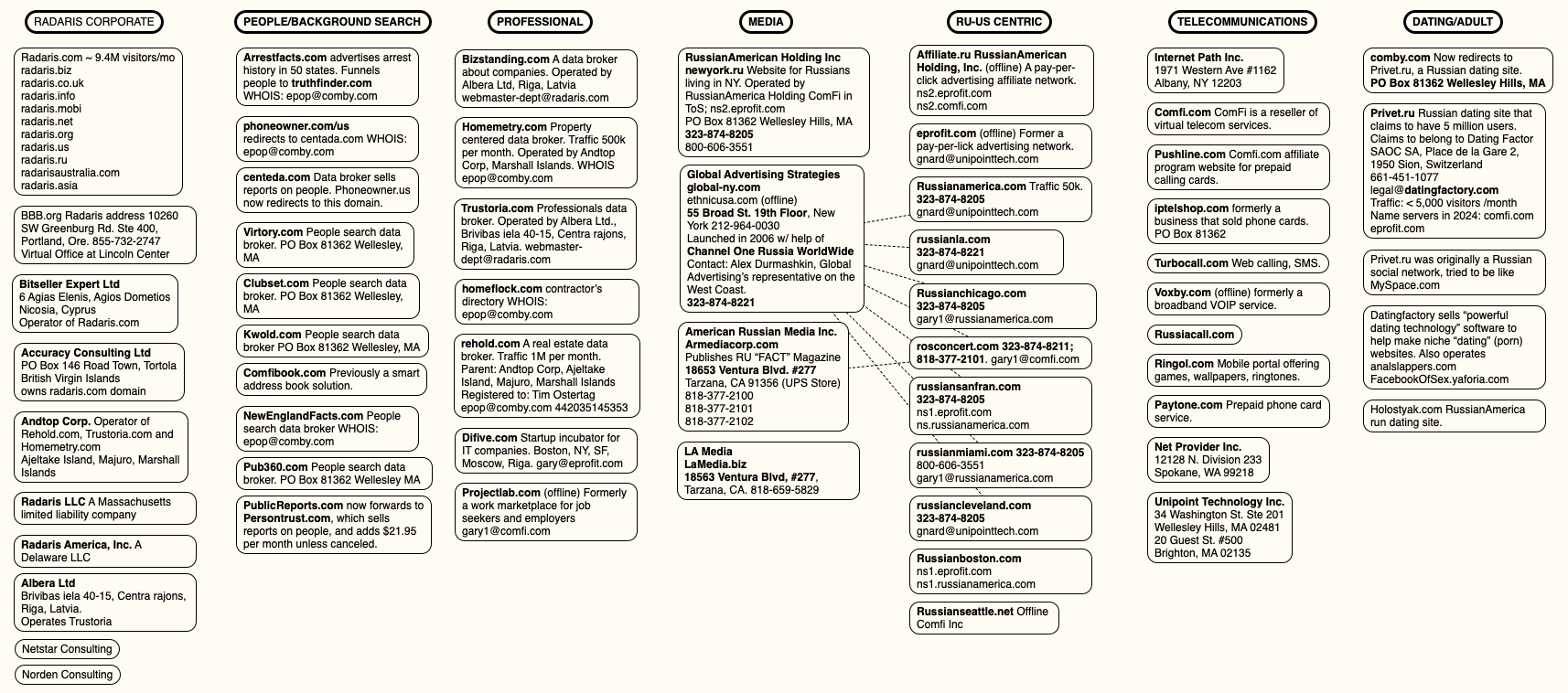
Independent investigations, including extensive forensic analysis of internal emails and administrative documents obtained during discovery, reveal that Radaris is not an isolated entity but rather the centerpiece of a sprawling surveillance machine. The evidence suggests that more than 25 people-search domains, including Veripages.com, are governed by a single administrative, financial, and technical infrastructure based in the Boston area.
Data provided by Atlas indicates that these sites share centralized payment processors, hosting providers, and software-as-a-service vendors, all managed through a common set of email domains. The profitability of this operation is substantial; records indicate that Radaris.com generates approximately $42,000 in monthly revenue, while its sister site, Veripages.com, nets roughly $45,000. These figures underscore the commercial viability of the "people-search" business model, which relies on the aggregation of public records—ranging from property filings to criminal histories—to generate detailed dossiers for sale to the public and corporate entities.
The ecosystem is further bolstered by symbiotic partnerships. The documentation shows that Radaris maintains revenue-sharing agreements with major advertising firms and, ironically, other data privacy services. Specifically, findings reveal that the Radaris family of sites earns significant monthly income from partnerships with companies like Onerep, a firm that sells services to help individuals remove their data from the very sites that the Radaris network populates. This circular economy—where one arm of an operation profits from the collection of data while another profits from the promise of its removal—has drawn sharp criticism from consumer advocates who argue that it creates a perverse incentive to keep data harvesting widespread.

Official Responses and Legal Defense
In the wake of the domain transfer, legal representatives for Radaris have maintained a posture of defiance. Victor Worms, the attorney representing the interests of the defendants, has argued that the court’s order is void because it targets a non-entity. "We have made a motion to vacate that default judgment on the grounds that it is void since a non-entity has no legal capacity to sue or be sued," Worms stated, noting that the defense team intends to pursue all available appellate avenues.
However, the plaintiffs, led by Raj Parikh of PEM Law, argue that the defendants have had ample opportunity to present a defense and that their failure to do so, combined with their history of procedural maneuvering, necessitated the extreme measure of domain seizure. The court appears to have accepted this argument, viewing the transfer as a necessary remedy to protect the public interest, specifically the safety of New Jersey’s law enforcement community.
Broader Implications for Privacy Law
The Radaris case is a bellwether for the future of data privacy in the United States. While New Jersey’s Daniel’s Law has provided a template for other states, the statute is currently under intense fire from the broader data broker industry. Approximately 150 lawsuits are currently pending against various brokers, and the industry has mounted a coordinated effort to challenge the constitutionality of these laws under the First Amendment.
The legal debate hinges on the tension between the commercial right to publish "public record" information and the individual right to safety and privacy. As of late 2025, the U.S. Court of Appeals for the Third Circuit is reviewing these challenges, with many experts anticipating that the issue will eventually reach the Supreme Court.
Justin Sherman, a prominent privacy expert, notes that the lack of a comprehensive federal privacy framework leaves a vacuum that states are attempting to fill with inconsistent and often legally vulnerable legislation. "The lack of comprehensive federal privacy law is not for a lack of knowledge," Sherman noted. "We have seen the consequences of unregulated data aggregation, from the mass exposure of drivers’ license data at IDScan.net to the proliferation of stalkerware and digital harassment tools. Without a federal standard that transcends the ‘public record’ exemptions currently found in state law, these companies will continue to operate with near impunity."
The implications extend beyond the immediate financial impact on the Lubarsky brothers’ business. By successfully transferring domain names to plaintiffs, the court has signaled a willingness to move beyond mere monetary fines, which are often viewed by large data brokers as a "cost of doing business." By targeting the domain infrastructure itself, courts can now inflict a more permanent form of disruption on these entities.
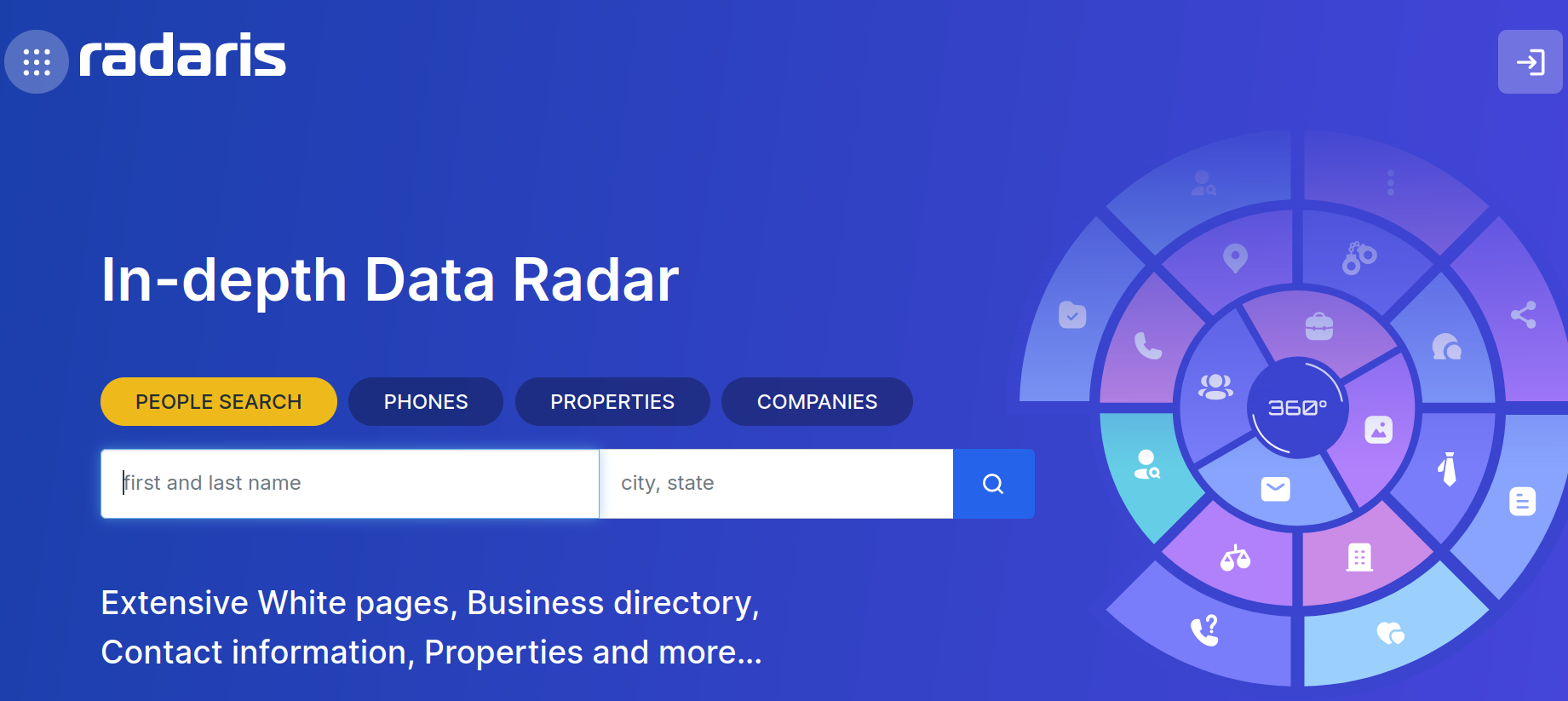
As it stands, the Radaris.com homepage serves as a stark reminder of this new reality. Instead of a search bar for looking up personal data, it now displays a formal notice of the court-ordered transfer. Whether this becomes the standard method for enforcing privacy laws nationwide remains to be seen, but the Radaris case has undoubtedly raised the stakes for any organization that profits from the systematic exposure of American citizens’ personal lives. The battle is no longer just about compliance; it is about the structural integrity of the internet as a space for public records versus a space for individual security.
Related posts: