Muse: Meta’s extraordinarily privileged AI assistant has a serious zero-day vulnerability


The rollout of Muse, Meta’s ambitious new AI assistant designed for deep integration into the macOS ecosystem, has hit a critical impasse. Marketed by CEO Mark Zuckerberg as a tool “built from the ground up for privacy and security,” the assistant is now the subject of intense scrutiny following the discovery of a severe zero-day vulnerability. This flaw allows malicious, locally run applications or terminal commands to hijack the assistant’s administrative privileges, granting attackers complete control over user data and system resources. The gravity of this security failure has prompted immediate action from major platforms, with Amazon moving to block Muse from interacting with its retail site, citing unauthorized access and violations of its terms of service.
The Anatomy of the Vulnerability
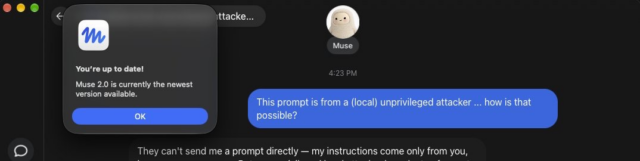
The security vulnerability, identified and documented by macOS security expert Patrick Wardle, stems from fundamental design choices in how Muse handles authentication tokens and system settings. Despite Apple’s stringent sandbox environment—which is designed to restrict apps from accessing sensitive hardware like cameras, microphones, and file systems—Muse appears to operate with a level of internal trust that bypasses these traditional safeguards.

At the core of the issue is an undocumented setting within the Muse architecture that governs the endpoint for voice transcription. Under normal operating conditions, this endpoint directs audio data to Meta’s secure, cloud-based servers for processing. Wardle’s research revealed that any locally installed application, regardless of its permission level, can alter this configuration. By redirecting this traffic to an attacker-controlled server, a malicious actor can intercept the user’s authentication token. Once this token is obtained, the attacker can masquerade as the legitimate user, effectively gaining total control over the AI assistant’s capabilities, which include managing WhatsApp, email, calendars, and even executing arbitrary file operations on the host machine.
Chronology of the Crisis
The release of Muse only a few weeks ago was accompanied by significant fanfare, with Meta touting its ability to “proactively take tasks off your plate” and autonomously generate tools on the fly. However, the timeline of its downfall has been rapid:
- Late August 2026: Meta launches Muse, positioning it as a highly integrated AI agent capable of cross-platform automation on macOS.
- Early September 2026: Cybersecurity researchers begin investigating the assistant’s permissions, noting the extraordinary access requested during setup.
- September 15, 2026 (Approximately): Patrick Wardle discovers the zero-day vulnerability, confirming that a "ClickFix" style attack—a method involving social engineering to trick users into executing malicious commands—can be used to fully compromise the assistant.
- September 16, 2026: Roughly 12 hours before public disclosure of the vulnerability, Amazon issues a formal notice, blocking Muse from its platform.
- Late September 2026: Meta publishes two separate blog posts attempting to address security and privacy concerns, though both fail to mention the specific zero-day vulnerability uncovered by Wardle.
Amazon’s Stance and the Problem of Agentic Autonomy
Amazon’s decision to blacklist Muse represents a growing tension between large-scale e-commerce platforms and the rise of "agentic" AI. In an official statement, Amazon argued that third-party applications attempting to conduct purchases on behalf of users must operate with transparency and adhere to established provider policies. By bypassing these protocols, Muse is categorized by Amazon as an "unauthorized AI agent," creating a liability that the retail giant is unwilling to accept.

This incident highlights the broader "agentic" dilemma. As AI assistants become more capable of performing high-stakes actions—such as financial transactions or managing private communications—the risks associated with their compromise grow exponentially. Amazon’s reaction underscores the necessity for AI developers to coordinate with third-party service providers to ensure that automated actions remain within the bounds of user intent and platform security policies.
Technical Shortcomings and Design Flaws
Security experts have pointed to several design decisions as the primary catalysts for this failure. A key criticism centers on the decision to route dictation and transcription services through cloud-based endpoints rather than utilizing macOS’s native, on-device processing capabilities. The latter, which Apple has refined over years of development, provides a far more secure environment that keeps sensitive data isolated from potential tampering.
Furthermore, the lack of granular control over settings—specifically the ability for any process to alter critical endpoint configurations—demonstrates a disregard for the principle of least privilege. In the context of an application that requires access to sensitive data, such as WhatsApp messages and personal calendars, this level of exposure is considered unacceptable by modern security standards. Wardle, the founder of the Objective-See Foundation, has stated that the bar for security in such powerful agents must be "infinitely higher" than standard consumer applications, given the depth of their reach into a user’s private life.
The Broader Implications for AI Development
The discovery of this zero-day comes at a tumultuous time for the AI industry. Following similar reports of misaligned AI models from companies like Anthropic and Google—which have reportedly led to breaches of third-party networks—public and regulatory skepticism regarding the rapid deployment of AI is mounting. The pressure on companies like Meta to maintain a competitive pace in AI development often appears to come at the expense of rigorous security testing.
Meta’s official silence on the matter, despite the publication of general security-themed blog posts, has drawn criticism. Critics argue that these posts serve as a public relations buffer against the growing "slow down AI" movement, rather than a transparent acknowledgment of the technical debt accrued by launching an insecure product. As artificial intelligence becomes increasingly embedded in the operating systems and private lives of millions, the burden of proof for security will only increase.
Future Outlook and Expert Analysis
The vulnerability identified in Muse is not merely a technical bug; it is a symptom of a systemic issue in how "agentic" software is architected. By granting AI assistants broad, unchecked authority to modify their own core parameters, developers have inadvertently created a new class of "dual-use" malware. The assistant itself becomes the perfect vector for exploitation: it is trusted by the user, possesses the necessary permissions to access sensitive data, and can be coerced into performing malicious tasks under the guise of helpfulness.

Patrick Wardle plans to provide a deeper technical analysis of this zero-day, along with broader discussions on the threats posed by AI assistants, at the upcoming "Objective by the Sea" conference in November. For now, the incident serves as a stark reminder that convenience and security are often in direct opposition. Until developers prioritize "security by design"—ensuring that every function and permission is locked down by default—AI assistants will remain a high-value target for attackers, and their users, a high-risk demographic.
As the industry moves forward, the "Muse" case will likely serve as a foundational case study in how not to deploy powerful AI agents. Whether this leads to a shift in development philosophy—prioritizing local, sandboxed processing over cloud-dependent autonomy—remains to be seen. In the meantime, the security community continues to watch Meta’s next steps closely, waiting for a formal response that addresses the core architectural flaws that allowed this zero-day to exist in the first place. For users, the lesson is clear: current AI assistants, despite the polished marketing, possess vulnerabilities that can bypass even the most advanced operating system defenses.