Inside Anthropic’s Amended S-1: A Deep Dive into Record-Breaking Revenue, Massive Compute Costs, and the Path to IPO

Artificial intelligence pioneer Anthropic has officially filed its amended S-1 registration statement with the U.S. Securities and Exchange Commission (SEC), providing the market with the first fully audited look at its third-quarter financial performance. The newly released figures replace the preliminary data that initially leaked during the company’s investor day last October. The comprehensive financial disclosure paints a portrait of a historic hyper-growth trajectory, characterized by staggering revenue expansion, an immense appetite for high-performance computing infrastructure, and an evolving enterprise customer base that continues to scale at unprecedented velocities.
As the company prepares for its highly anticipated public market debut, the updated filing offers unprecedented transparency into the economic engine driving modern generative artificial intelligence. While top-line growth continues to defy historical SaaS and cloud computing benchmarks, the financials also underscore the massive capital expenditure required to maintain a competitive edge in the rapidly evolving foundational model landscape.
Financial Momentum: Record-Breaking Q3 Revenue and Sequential Growth
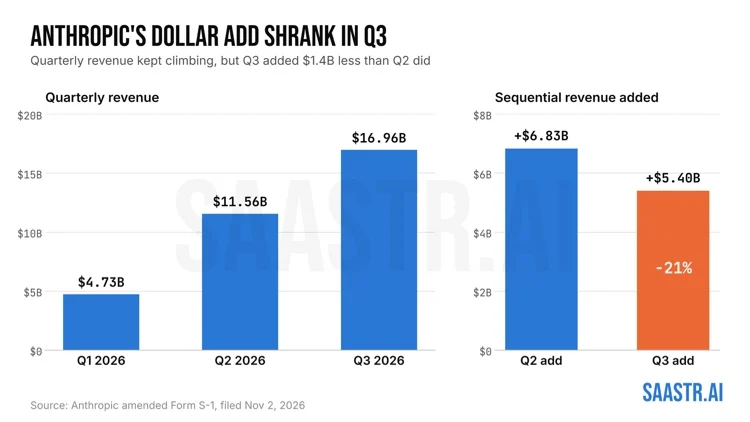
Anthropic reported third-quarter revenue of $16.96 billion, marking a phenomenal 1,127% increase compared to the $1.38 billion recorded during the same period a year prior. On a sequential basis, Q3 revenue grew 47% from the $11.56 billion posted in the second quarter.
The quarterly cadence highlights a business operating at a scale rarely seen in corporate history. Anthropic opened the calendar year with $4.73 billion in first-quarter revenue, followed by a dramatic $11.56 billion in the second quarter—a sequential jump of roughly 140%. While the percentage growth rate naturally decelerated to 47% in the third quarter, the absolute dollar additions remain staggering. Q2 added $6.83 billion over Q1, while Q3 added $5.40 billion over Q2, representing only a minor 21% contraction in absolute dollar growth despite the expanding base.
Total revenue for the first nine months of the calendar year reached $33.24 billion, dwarfing the $4.59 billion generated across the entirety of calendar year 2025. Annualizing the third-quarter performance yields a run rate of approximately $68 billion. However, market expectations remain exceptionally high. Wall Street analysts and recent investor reports indicate that institutional stakeholders are looking for Anthropic to exit the year approaching an annualized revenue run rate of $110 billion. Achieving that target will require a fourth-quarter absolute dollar addition that more than doubles the impressive Q3 expansion, turning the upcoming quarterly net-add metric into one of the most closely watched figures on Wall Street.
The Price of Demand: Short-Term Compute Costs and Operating Margins
Behind the explosive revenue figures lies an equally massive cost structure driven almost entirely by the insatiable demand for AI compute power. For the third quarter, Anthropic posted an operating loss of $567 million, a notable reversal from the $974 million in operating income reported in the second quarter.
The S-1 filing attributes this profitability swing to total third-quarter operating expenses surging to $17.5 billion. This expenditure spike was catalyzed by two primary factors: a $5 billion outlay for short-term, spot-market compute capacity and a $2 billion noncash accounting charge associated with the company’s employee donation matching program. Compute acquired via short-term spot commitments traditionally carries a steep financial premium compared to long-term multi-year infrastructure reservations.
Total compute and infrastructure expenses jumped 78% sequentially to reach $9.86 billion, outpacing the 47% growth in top-line revenue. Consequently, compute costs escalated from roughly 48% of revenue in the second quarter to 58% in the third quarter. This equates to approximately $1.72 of revenue generated for every dollar spent on computing power, closely mirroring the unit economic metrics shared with investors during October briefings.
Industry analysts note that Anthropic faced a critical strategic choice ahead of its public offering: it could have artificially throttled customer usage and rate-limited API access to preserve profit margins, thereby securing two consecutive quarters of GAAP profitability heading into the IPO. Instead, management opted to absorb the premium cost of spot-market capacity to fully satisfy enterprise demand without disruption. On an adjusted basis, Anthropic’s operating income actually rose to $2.5 billion in the third quarter, though the adjusted operating margin contracted from 19% in Q2 to 15% in Q3.
Capital Commitments and Balance Sheet Fortitude
To prevent future exposure to expensive spot-market compute spikes, Anthropic has aggressively locked in long-term supply agreements. The amended S-1 reveals that the company has entered into purchase commitments and lease agreements totaling an aggregate committed spend of approximately $895.4 billion, with substantially all of that capital earmarked for compute infrastructure.
Financial tracking of the regulatory filings indicates that Anthropic layered on an additional $100 billion in new commitments during the five-week window following the close of the third quarter—even as the company marketed its IPO and operated at a net GAAP loss.
Despite these colossal forward-looking liabilities, the company maintains a robust liquidity buffer. The balance sheet reflects $95.6 billion in cash and cash equivalents supplemented by $36.3 billion in short-term investments, bringing total liquid assets to $131.8 billion. Approximately $69.8 billion of the company’s total purchase commitments are scheduled to come due within the 12 months following September 30, a figure roughly equivalent to the company’s current annualized revenue run rate. Market observers view the massive $895 billion commitment pool—amounting to roughly 13 times annualized revenue—as a calculated strategic insurance policy against the compute shortages that necessitated the expensive Q3 spot purchases.
Enterprise Scaling and Net Revenue Retention
Anthropic’s rapid commercial expansion is anchored by an increasingly lucrative enterprise customer cohort. As of September 30, the company recorded more than 11,900 customers generating at least $100,000 in annualized revenue. Furthermore, the higher tiers of the customer pyramid showed robust density: more than 1,900 accounts spend upwards of $1 million annually, while approximately 250 enterprise clients contribute $10 million or more per year. By comparison, the count of customers generating over $100,000 stood at roughly 950 a year prior, representing a 12.5-fold expansion over twelve months.
This aggressive tier-migration propelled Anthropic’s Net Revenue Retention (NRR) rate to an extraordinary 900% at the close of the third quarter. The data indicates that the vast majority of revenue growth is being organically generated from the existing customer base through increased platform utilization rather than purely through the acquisition of new logos.
Product diversification has played a pivotal role in this expansion. More than half of all customers spending at least $100,000 annually now utilize both the core Claude platform and a specialized first-party application, such as Claude Code or Cowork, up significantly from approximately 30% at the end of the previous year. Claude Code has emerged as a particularly potent monetization driver. While enterprise users who relied exclusively on standard enterprise tiers averaged less than $75 a month in incremental spend, the top 5% of users who integrated Claude Code expanded their monthly expenditure by roughly twentyfold.
Despite this success, room for penetration within existing accounts remains vast. The filing notes that Fortune 500 enterprises within the $100,000-plus tier allocated, on average, less than 0.1% of their total operating expenses to Anthropic during the third quarter. Concurrently, the company cautioned investors regarding client concentration risks, noting that any adverse shift in operational demand from its largest enterprise accounts could materially impact future financial performance.
Model Efficiency, Pricing Dynamics, and Industry Implications
The economics of foundational AI models continue to undergo rapid deflationary shifts. Market intelligence derived from the filing reveals that Anthropic absorbed roughly $600 million in top-line impact during the third quarter attributable to proactive price cuts and contractual enterprise discounts, representing approximately 3.5% of total quarterly revenue.
The S-1 highlights the underlying technical drivers behind these adjustments. The introduction of Claude Opus 5.5 reduced customer cost-per-task by approximately 40% compared to its predecessor, the Claude Opus 5. This pricing pressure mirrors broader macroeconomic trends across the artificial intelligence sector, where enterprise buyers actively seek cost efficiencies through a combination of open-weight models originating internationally and competitively priced proprietary models from domestic AI labs.
Anthropic’s strategic thesis relies on the assumption that total platform volume will scale at a pace far outstripping the decline in cost-per-task—a dynamic validated by the company’s 900% NRR metric. This deflationary model generation cycle presents a uniform challenge and opportunity across the entire B2B software ecosystem: as compute and model inference costs drop roughly 40% with each generational leap, application-layer software vendors must choose whether to pass those savings directly to end customers to capture market share or reinvest margin into expanded feature sets.
As Anthropic moves closer to its definitive public market debut, the amended S-1 cements its status as a defining commercial enterprise of the artificial intelligence era. Balancing record-setting scale against monumental infrastructure investments, the company’s upcoming fourth-quarter performance will serve as a critical bellwether for the long-term economic viability of generative AI at global scale.
Related posts: