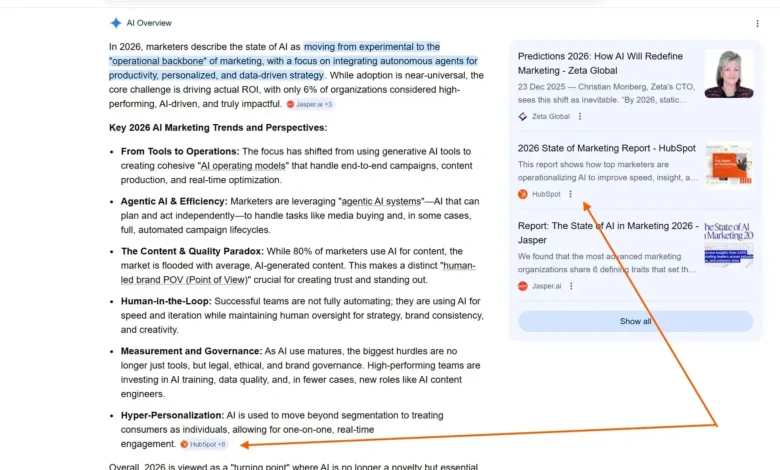
The landscape of online discovery has undergone a seismic shift as artificial intelligence fundamentally alters how consumers locate information. As of 2026, the traditional model of "ten blue links" is being rapidly superseded by AI-generated responses, which now dominate the top of the search journey. According to recent data from the HubSpot 2025 AI Trends for Marketers report, nearly 31% of Gen Z consumers have defaulted to chatbots as their primary search engine. This transition is not merely a preference shift but a structural change in the digital economy. Google’s internal reports indicate that AI Mode has surpassed one billion monthly users, with query volume doubling every quarter since its inception. For brands, the implications are stark: if a company is not cited or mentioned within these generative responses, it effectively ceases to exist for a growing segment of the buying public.

A Brief Chronology of the Search Evolution
The transition from traditional keyword-based search to generative AI search began in earnest in 2023 with the initial public rollout of large language models (LLMs) integrated into search interfaces. By 2024, platforms such as ChatGPT, Perplexity, and Microsoft Copilot, alongside Google’s AI Overviews (AIO), began to prioritize direct, synthesized answers over lists of external websites. This forced a pivot in search engine optimization (SEO) toward what is now termed Generative Engine Optimization (GEO) or AI Engine Optimization (AEO). In 2025, the focus moved from merely ranking for keywords to securing "citations"—the equivalent of modern-day backlinks—within AI-generated summaries. By 2026, the industry moved from experimental observation to a requirement for persistent, automated monitoring of brand sentiment and visibility across multiple AI platforms.
Defining AI Visibility and Its Core Metrics
Unlike traditional SEO, which relies on click-through rates (CTR) and ranking positions, AI visibility is a qualitative and quantitative measure of how a brand is represented within a chatbot’s narrative. The fundamental metrics that define this new landscape include the Brand Mention Rate, which tracks how frequently a brand is identified by name in response to category-specific queries.

Beyond mere mentions, the Citation Rate serves as a higher-tier metric. A citation occurs when an AI provides a verifiable link to a company’s owned content. Because many AI responses synthesize information from multiple sources, securing a citation signifies that the brand is considered a primary, authoritative source of truth by the algorithm. Furthermore, Sentiment and Accuracy scores assess how the brand is described. A negative sentiment is not always detrimental if it is factually accurate—for instance, describing a product as "premium-priced" may accurately filter out budget-conscious leads—but consistent negative or factually incorrect portrayals require immediate intervention. Finally, Share of Voice (SOV) provides a competitive context, measuring a brand’s presence relative to competitors across an identical set of prompts.
The Limitations of Manual Tracking
Early attempts to track AI visibility were often performed manually, involving human operators inputting identical queries into ChatGPT, Claude, and Gemini. However, this method is fundamentally flawed for several reasons. First, it captures only a single, static moment in time and is subject to the personalization bias of the user’s search history. Second, the sheer volume of variables—thousands of possible query permutations—renders manual tracking unsustainable for any organization of scale.

The necessity for automated systems has become clear. Dedicated AEO tools now operate on a schedule, running standardized prompts across multiple engines simultaneously. These tools organize the data into dashboards that monitor trends rather than isolated snapshots. For instance, while free tools like the AI Search Grader offer a baseline, professional-grade platforms now provide ongoing monitoring of citations, allowing marketing teams to see if specific campaigns or content updates result in a tangible shift in AI-generated recommendations.
The Strategic Framework for Implementation
Establishing a repeatable system for AI visibility requires a five-step framework designed to transform raw data into actionable intelligence.

- Benchmarking: Before active management, brands must establish a starting point using automated grading tools to assess sentiment and presence quality.
- Structured Prompt Engineering: Marketing teams must develop a controlled list of prompts that mirror real-world buyer behavior, including "problem-solution" queries and comparative analysis. This list should be documented and reused consistently to ensure that changes in data represent actual shifts in visibility rather than variations in query phrasing.
- Platform Selection: Not all AI platforms hold equal weight for every industry. By analyzing existing referral traffic from internal analytics, firms can identify which AI engines (e.g., ChatGPT vs. Perplexity) drive the most qualified visitors and prioritize their budget accordingly.
- Cadence and Automation: Weekly reviews are recommended for standard monitoring, with daily checks reserved for high-stakes product launches or during crisis-response scenarios where brand sentiment needs immediate shielding.
- CRM Integration: This is the critical differentiator. When AI visibility metrics are routed directly into a Customer Relationship Management (CRM) system, they cease to be "vanity metrics" and become "revenue inputs." This allows businesses to track whether a mention in an AI response actually leads to a qualified lead, a deal, or a closed sale.
The Impact of Content Structure on AI Citations
To improve visibility, brands must understand that AI models do not "read" websites like human beings; they process semantic data. Strengthening entity consistency—ensuring that the company name, address, and core offerings are identical across all digital touchpoints—is the first step.
Furthermore, content must be structured for machine readability. This involves answering specific user questions directly within the text, providing concrete data points, and using clear headings. An AI is far more likely to cite a page that acts as a comprehensive answer to a specific problem than a page that relies on broad, keyword-stuffed copy. When inaccuracies appear—such as outdated pricing or incorrect feature lists—the fix must be systemic. Marketers should conduct "site:" searches to identify where the incorrect information originated on their own domains and update it to ensure the AI has a corrected source of truth to pull from.

Broader Implications for the Marketing Industry
The transition to AI-dominated search has profound implications for the future of digital marketing. The industry is currently moving away from the "what ranks" mindset and toward a "what gets cited" paradigm. This shift forces a tighter collaboration between marketing, product development, and customer success teams. If an AI consistently reports negative sentiment about a specific feature, that is no longer just a marketing problem; it is a signal that the product team needs to address a recurring customer pain point.
Industry observers note that the divide between brands that invest in AEO and those that ignore it is widening. Companies that neglect this shift risk losing the "discovery phase" of the buying cycle entirely. As AI models become more integrated into daily workflows, the brands that remain invisible in these environments will struggle to fill their sales pipelines. Conversely, those that successfully map their content to the logic of AI models stand to benefit from a new, highly efficient channel of customer acquisition.

The bottom line for businesses is that tracking AI visibility is no longer an optional component of an SEO strategy; it is a fundamental requirement for maintaining market relevance in 2026 and beyond. The brands that lead will be those that treat AI as a primary, measurable, and highly influential participant in the customer journey. By leveraging automated tracking, integrating data into their existing CRM infrastructure, and consistently auditing their digital footprint, marketers can ensure that their brand is not just present, but prioritized, in the next generation of search.