The report highlights a significant pivot in the paid social landscape, where the cost of driving traffic has seen a notable decline even as user engagement—measured by click-through rates (CTR)—has trended upward. For digital marketers, this combination of lower costs and higher interest represents a rare and favorable shift in an increasingly crowded marketplace.
The 2026 Advertising Landscape: A Shift in Dynamics
The performance data for 2026 suggests that Meta’s underlying machine learning and optimization algorithms are operating with greater efficiency than in previous cycles. By analyzing nearly 1,800 campaigns, the researchers were able to filter out minor fluctuations and pinpoint broader industry trends. The core findings indicate that Facebook traffic campaigns have successfully bridged the gap between affordability and efficacy.
Throughout 2026, the cost-per-click (CPC) for traffic campaigns experienced a downward trend in the vast majority of sectors. While the digital advertising industry has historically been characterized by rising costs as competition for attention increases, the current year stands as an outlier. Industry experts point to improved automated bidding strategies and better creative delivery as primary drivers for these performance gains.
Sector-Specific Trends in Traffic Campaigns
Not every industry experienced the same relief in advertising costs. The data reveals a distinct divergence between retail-heavy sectors and service-based industries. The Shopping, Collectibles, and Gifts sector saw a significant increase in traffic CPCs, rising by 73.53%. Similarly, the Sports and Recreation category faced a 43.90% increase. These hikes suggest that seasonal demand and specific competitive pressures in these verticals may be driving up the cost of bidding for prime ad slots.
Conversely, the sectors that benefited most from the cooling of ad prices were those focused on high-value, long-term investments. The Real Estate sector saw the most significant improvement, with traffic CPCs plummeting by 39.56%. This was closely followed by the Restaurants and Food industry, which saw a 37.50% reduction in costs, and the Industrial and Commercial sector, which recorded a 37.21% drop.
This drastic reduction in costs for these specific industries suggests that Facebook’s platform is becoming a more viable channel for top-of-funnel awareness campaigns. When the cost of a click drops by over a third, the return on ad spend (ROAS) potential for these businesses increases exponentially, allowing for larger reach without necessarily requiring an increase in budget.
Analyzing Lead Generation Performance
While traffic campaigns focus on volume and brand awareness, lead generation campaigns serve as the lifeblood for service-based businesses. The 2026 data for lead campaigns is equally illuminating. Unlike traffic campaigns, which saw widespread cost reductions, lead campaigns demonstrated a "stability-first" trajectory.
The cost-per-lead (CPL) remained largely flat throughout the year, suggesting that while the cost to initiate contact with a user has decreased, the final cost of acquiring a qualified lead has balanced out. This indicates that while it is now cheaper to reach a user and entice them to click, the conversion process—moving from a click to a lead—is maintaining a consistent cost structure.
In terms of cost-per-click (CPC) for lead-focused campaigns, the results were overwhelmingly positive. The Automotive (For Sale) sector led the charge with a 44.17% decrease in CPC, followed by Dentists and Dental Services at 41.72%, and Health and Fitness at 30.30%. These figures are particularly striking, as these industries often deal with high customer acquisition costs. A reduction in CPC here directly impacts the bottom line, potentially allowing these businesses to scale their lead generation efforts more aggressively.

Only two industries bucked the downward trend in lead campaign CPC: Education and Instruction, which saw a 4.24% increase, and Sports and Recreation, which saw a marginal increase of 0.93%. These minor upticks are largely considered negligible compared to the widespread efficiency gains seen elsewhere.
Understanding the Cost-Per-Lead (CPL) Reality Check
While CPC and CTR provide insight into the top and middle of the funnel, the cost-per-lead (CPL) is the ultimate metric for many advertisers. The 2026 data reveals that CPL remains highly dependent on industry vertical, reflecting the varying difficulty of capturing user data.
Industries with the lowest CPL generally offer services that are either low-friction or high-frequency. Conversely, industries with the highest CPL often require higher degrees of consumer trust, complex decision-making processes, or higher price points. The disparity in CPL serves as a reminder that while Meta’s platform is getting more efficient, the inherent nature of the product or service still dictates the cost of customer acquisition.
Strategic Implications for Paid Media Budgets
The findings carry significant weight for advertisers managing integrated marketing budgets. For years, the debate has centered on the trade-off between Google Ads—which captures high-intent search traffic—and Facebook Ads, which excels at discovery and audience targeting.
WordStream’s data notes that Google Ads CPC is currently more than double the average CPC found on Meta’s platforms. While Google remains the gold standard for users actively seeking a solution, the 14% decrease in traffic costs on Facebook, combined with a 13% improvement in CTR, makes a compelling case for shifting a larger portion of the budget toward paid social.

The ability to secure cheaper clicks while simultaneously improving engagement creates a virtuous cycle. Advertisers are not just reaching more people; they are reaching people who are more likely to interact with the content. This shift suggests that Meta’s optimization efforts—particularly those related to AI-driven campaign delivery—are successfully identifying the right audiences at the right time.
The Role of Meta’s Algorithmic Optimization
The broader context of these improvements lies in the evolution of Meta’s advertising technology. Throughout 2026, Meta has continued to iterate on its bidding and campaign optimization features. By refining how the system predicts user behavior and matches it with advertiser objectives, the platform has reduced wasted impressions.
The "big picture" takeaway is that advertisers no longer have to sacrifice performance for volume. In the past, cheaper clicks were often associated with "low-quality" traffic that failed to convert. The 2026 data contradicts this narrative, showing that improved efficiency has allowed for a "best of both worlds" scenario where costs are declining while performance metrics remain robust.
Looking Ahead: The Efficiency Mandate
As we look toward the remainder of the year and into 2027, the primary takeaway for advertisers is the importance of agility. The 2026 benchmark data underscores that the digital advertising landscape is not static. Sectors that were once prohibitively expensive are now seeing major efficiency gains, while others are becoming more competitive.
For marketing teams, this is a call to action to re-evaluate their current Facebook ad strategies. The data provides a solid foundation for benchmarking performance against industry peers. Advertisers should consider whether their current campaigns are aligning with these broader market trends. If a business is seeing costs rise while the industry average is falling, it may be time to revisit creative strategies, audience targeting, or campaign settings.
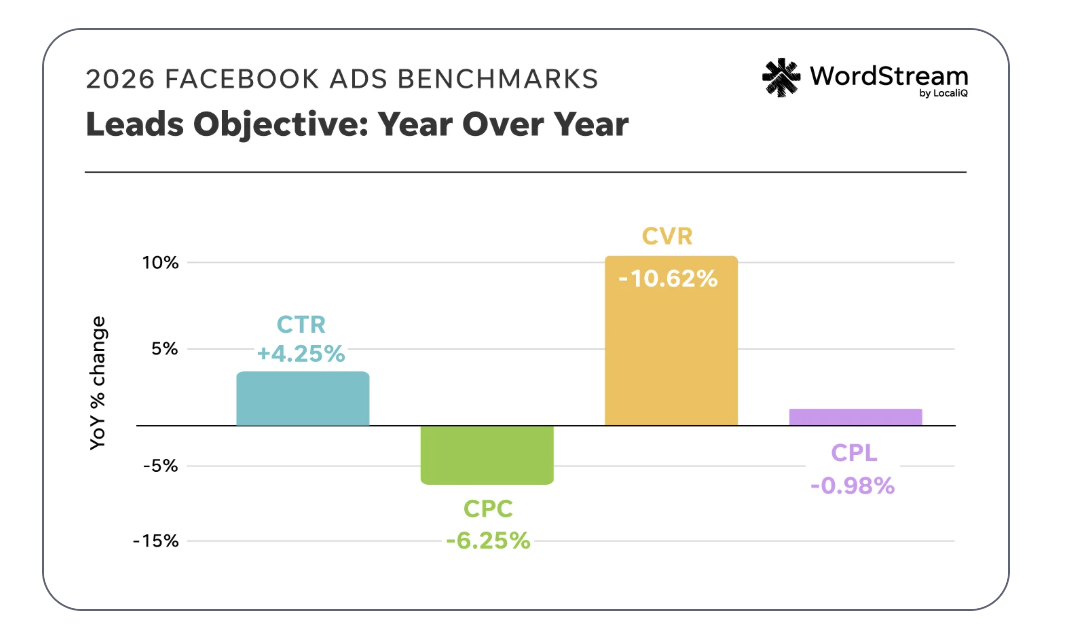
Ultimately, the 2026 Facebook ad benchmarks demonstrate that despite increasing regulation and a changing privacy landscape, the platform remains an exceptionally powerful and increasingly cost-effective tool for growth. By leveraging the current efficiencies in CPC and capitalizing on improved engagement, advertisers can stretch their budgets further and drive more meaningful results. The data confirms that in the current climate, efficiency is not just an aspiration—it is a measurable reality of the 2026 Facebook advertising ecosystem.