How AI Visibility Collides With Brand Reputation: The Nuance of Context in Large Language Models

The race for digital dominance has fundamentally shifted over the past several years, migrating away from traditional keyword rankings and moving firmly into the realm of Generative Engine Optimization (GEO). Businesses have poured immense capital and creative energy into securing AI visibility, striving to ensure their brand names surface when prospective customers turn to frontier large language models (LLMs) for market research. Winning that initial mention feels like a major corporate victory, successfully placing the brand directly into the consideration set of modern consumers.
However, achieving basic visibility is only the first hurdle in an increasingly complex digital landscape. When a user transitions from a broad discovery query to a direct transactional inquiry—such as asking an AI model, "Do you recommend this company?"—the underlying dynamics change dramatically. At this critical juncture, an LLM can either act as a powerful brand advocate or an unforgiving critic. Recent industry findings indicate that without proper contextualization, AI systems frequently overcorrect when managing recommendation risks, transforming minor historical grievances into deal-breaking warnings.
The Mechanics of AI Overcorrection and the Missing Denominator
To understand why frontier models frequently surface negative reviews without adequate context, industry analysts point to the risk-mitigation frameworks programmed into AI systems by their developers. Particularly in high-stakes sectors, such as finance, healthcare, and specialized commercial services—often grouped under the umbrella of "Your Money or Your Life" (YMYL) domains—developers instruct LLMs to exercise extreme caution to protect consumers from potential harm.
In practice, this precautionary programming has resulted in an overcorrection. When an AI model crawls the web assessing a brand’s reputation, it easily aggregates the numerator: the total number of public complaints, poor reviews, or regulatory inquiries it can unearth. However, the model frequently fails to capture the denominator: the broader operating scale, the total volume of satisfied customers served, the age of the enterprise, and the systemic resolutions enacted by management.
For instance, a company operating over a span of 13 years while serving 35,000 unique clients might accumulate a handful of public complaints and minor Better Business Bureau (BBB) inquiries. To a human analyst, seven complaints against 35,000 transactions represents a near-flawless customer satisfaction rate of approximately 99.98%. To an unprompted LLM operating in isolation, however, those same seven complaints are treated as isolated red flags. Lacking the necessary mathematical and operational context, the AI system often issues a generalized caution, warns the user away, and actively recommends direct competitors—effectively erasing months of hard-earned GEO visibility in a fraction of a second.
Empirical Data: The Impact of Contextual Integration
Recent empirical data highlights how structured contextual integration can completely reshape AI recommendations. Controlled testing conducted across multiple frontier AI systems using neutral, non-leading API prompts revealed a stark contrast in brand sentiment before and after the introduction of comprehensive operational context.
In initial baseline assessments, AI systems routinely surfaced a small cohort of public grievances, framed the target businesses as high-risk propositions, and directed prospective buyers toward alternative vendors. In one specific test case involving a corporate client, initial evaluations yielded a 64.3% rate of cautionary warnings, with affirmative recommendations appearing in only 23.8% of responses.

To combat this phenomenon, researchers experimented with feeding full, transparent brand narratives directly to machine crawlers via specialized content protocols and edge-computing networks. Rather than waiting passively for unpredictable search engine indexing schedules, engineers deployed dedicated data files—such as comprehensive llms-full.txt documentation—directly to content delivery network (CDN) edge servers.
The results of this tactical shift materialized rapidly. Within three days of deploying complete operational context, AI responses began displaying a noticeable shift toward neutrality. By the fourteenth day of continuous observation across standardized testing suites, the outcomes shifted dramatically. The presence of cautionary warnings dropped to absolute zero (0.0%), while affirmative recommendations rose to a flawless 100%. While historical complaints remained part of the accessible digital record, the AI models successfully weighed those grievances against the company’s multi-year operating history, overall transaction volume, and verified customer retention metrics.
The Evolution of CDN Edge Workers as Machine Billboards
The technical methodology behind this shift relies heavily on modern edge-computing infrastructure, commonly referred to as "workers." Traditionally, web development teams utilize edge workers to route incoming web traffic dynamically, directing human users, standard search engine bots, and automated AI scrapers to appropriate destinations.
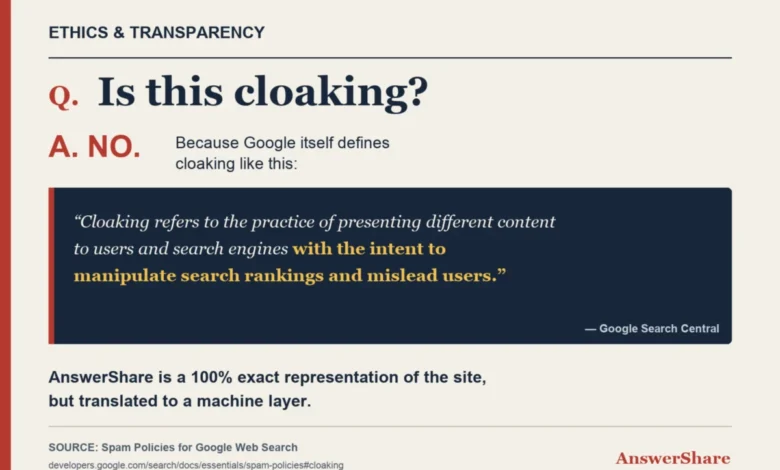
The breakthrough in GEO strategy occurred when developers realized that edge workers could do more than simply direct traffic; they could serve as direct information channels for machine crawlers. By publishing comprehensive, transparent brand records directly to the edge layer, organizations effectively create a digital billboard explicitly designed for LLM consumption.
Traffic volume metrics underscore the efficacy of this approach. While standard machine-readable LLM files on traditional servers might experience modest crawl frequencies over a multi-month period, content hosted directly via edge workers can experience hundreds of thousands of automated machine crawls in a fraction of that timeframe. Because recent peer-reviewed academic literature emphasizes the significant role of data repetition in Retrieval-Augmented Generation (RAG) systems, this high-frequency ingestion ensures that the brand’s complete, unvarnished story remains firmly anchored in the AI model’s active working memory.
Addressing Negative Information Head-On: Transparency Over Tactics
A crucial element of successful AI reputation management is the complete rejection of deceptive practices or algorithmic manipulation. Industry experts emphasize that companies cannot artificially sanitize a genuinely poor reputation. If a business has earned widespread negative sentiment through poor service or inferior products, automated AI systems will accurately reflect that reality based on the broader digital corpus.
However, for established businesses with strong underlying reputations that have been skewed by a vocal minority of online complaints, success relies on direct, transparent remediation. Effective edge-worker frameworks organize corporate records around several core pillars: clear operational history, verifiable transaction volumes, transparent data attribution, detailed responses to historical complaints, and clear distinctions between different types of customer interactions.
For example, when addressing specific regulatory complaints—such as historical inquiries regarding sales practices from a single, formerly employed individual—the edge documentation explicitly outlines the context. It details the nature of the issue, the exact dates involved, the subsequent internal counseling of the employee, and the implementation of enhanced management controls to prevent recurrence. When LLM crawlers ingest this comprehensive narrative, subsequent model outputs either drop the mention of the complaints entirely or properly contextualize them as isolated incidents unindicative of overall delivery performance.

Cross-Industry Case Studies and Market Implications
The effectiveness of this contextual optimization framework extends far beyond isolated test environments. Subsequent implementations across diverse, highly competitive market segments have demonstrated consistent repeatability.
In one trial involving a major regional full-service advertising agency, baseline assessments showed zero presence on transactional money prompts and a 50% recommendation rate among tested models. Following a 15-day implementation of edge-layer contextual briefings, the agency achieved a 100% appearance rate on commercial prompts, zero cautionary warnings, and a perfect 100% affirmative recommendation score.
Similarly, a luxury boutique resort operating within an intensely competitive regional hospitality market saw its commercial prompt visibility jump from 7.5% to 100% within ten days of deploying edge-layer context, completely eliminating all algorithmic warning flags while securing universal positive endorsements from the tested models.
Industry analysts project that these methodologies will become standard operational procedure as commercial websites adapt to the realities of AI-driven search. Current market estimates suggest that out of roughly 205 million active commercial websites globally, only a tiny fraction—approximately 2.5%—utilize any formal AI optimization strategy, while a significant percentage of sites maintain technical configurations that actively block or impede AI crawlers.
The Broader Outlook for Generative Engine Optimization
As artificial intelligence continues to mediate the relationship between brands and prospective buyers, the rules of digital visibility are undergoing a permanent transformation. Successfully securing an initial mention in an AI-generated response is no longer the finish line for modern digital marketers.
The ultimate determinant of commercial success in the era of large language models is the depth, accuracy, and accessibility of the contextual narrative that follows that initial mention. By providing frontier models with complete operational data, verifiable metrics, and transparent accounts of historical challenges, organizations can bridge the gap between isolated negative reviews and holistic business reality. Ultimately, as these case studies demonstrate, AI systems are designed to synthesize facts objectively; when given the complete story, they are fully capable of moving beyond superficial criticisms and arriving at fair, accurate conclusions.