Building an Open Source Secrets Infrastructure with OpenBao and CloudNativePG on Kubernetes

Managing infrastructure secrets within a Kubernetes environment requires a robust, self-healing backend that prioritizes operational transparency and avoids vendor lock-in. As organizations move away from proprietary, monolithic secret management solutions, the combination of OpenBao—the community-driven fork of HashiCorp Vault—and CloudNativePG (CNPG) offers a compelling, entirely open-source alternative. By leveraging these two CNCF-hosted technologies, enterprises can establish a secure, high-availability architecture that relies on native Kubernetes Custom Resource Definitions (CRDs) rather than external cloud-provider dependencies.
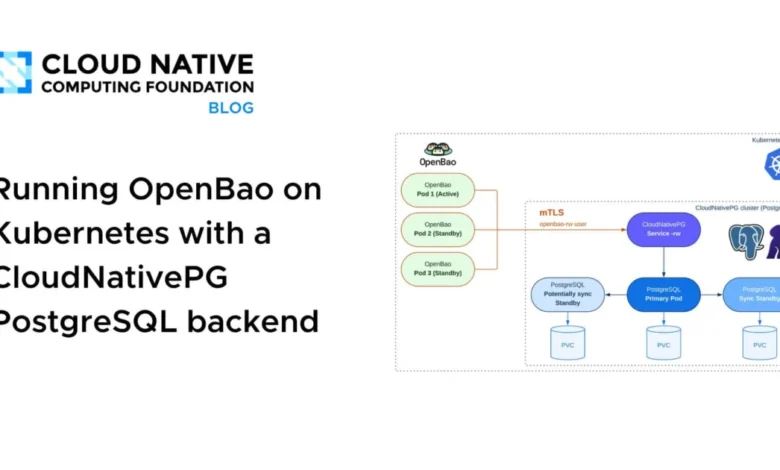
The architecture centers on using a PostgreSQL cluster as the primary storage backend for OpenBao. This approach transforms any standard Postgres deployment into an encrypted key-value store. When coupled with CloudNativePG, which automates the management, synchronous replication, and certificate authentication of Postgres instances, the result is a hardened, production-ready secrets engine.
The Evolution of Cloud-Native Secret Management
The necessity for this architecture stems from the increasing complexity of secret distribution in microservices. Traditionally, developers relied on cloud-managed services that often tied infrastructure to specific vendors. The emergence of OpenBao as a CNCF-governed project marks a significant shift toward democratizing secure access management.
OpenBao’s storage backend, specifically designed to interface with PostgreSQL, allows the engine to persist encrypted data while ensuring that the underlying database layer remains abstracted from the secret management logic. CloudNativePG, currently under evaluation for incubation by the CNCF Technical Oversight Committee, provides the necessary automation to ensure that the database layer itself is resilient. By implementing certificate-based authentication enforced via explicit pg_hba rules, the stack eliminates the security risks associated with static, long-lived passwords.
Chronology and Implementation Strategy
Deploying this stack requires a precise, phased approach to ensure that security postures—such as TLS enforcement and role-based access control—are configured before the secrets engine goes live.
- Environmental Provisioning: Using tools like the
cnpg-playground, administrators can establish a conformant Kubernetes cluster. The environment requires a three-instance CNPG cluster, which acts as the foundational persistence layer. This setup utilizes workload isolation, ensuring that database instances are isolated from application workloads through Kubernetes taints and tolerations. - Database Role Orchestration: Through the CNPG
DatabaseRoleobject, administrators can define distinct roles for schema management and runtime access. The "role-openbao" handles initial Data Definition Language (DDL) operations, while "role-openbao-rw" is restricted to Data Manipulation Language (DML) tasks. Both roles are mandated to authenticate via TLS client certificates, effectively removing the possibility of password-based brute force attacks. - Schema Initialization: Because CNPG does not yet natively manage granular table-level grants, a one-time Kubernetes Job is utilized to create the necessary tables (
openbao_kv_storeandopenbao_ha_locks) and apply specific permissions. This ensures that the runtime role only possesses the minimum necessary privileges, adhering to the principle of least privilege. - OpenBao Integration: The final step involves configuring the OpenBao Helm chart to point to the Postgres cluster. By disabling local data storage in OpenBao, the system ensures that all state is externalized to the highly available CNPG cluster.
Data Durability and Operational Integrity
A critical component of this architecture is the handling of synchronous replication. In a standard CNPG configuration, setting synchronous: method: any, number: 1 ensures that at least one standby node acknowledges a write before it is considered successful. This provides an RPO (Recovery Point Objective) of zero, which is essential for a secrets engine where even minor data loss could lead to service-wide credential invalidation.

Furthermore, the integration of TLS certificate management is automated through the operator. Certificates for the DatabaseRole are managed within Kubernetes secrets, with a 90-day validity period and automatic renewal. This lifecycle management is vital, as it reduces the administrative burden of rotating credentials manually—a task that is notoriously error-prone in large-scale deployments.
Analysis of Security Implications
The shift toward passwordless, certificate-authenticated communication between the secret engine and its storage backend represents a major security upgrade for Kubernetes-native infrastructure. By utilizing pg_hba.conf to explicitly reject non-TLS connections, the infrastructure becomes significantly more resistant to man-in-the-middle attacks and credential harvesting.
However, the architecture does introduce operational nuances. For instance, the OpenBao storage backend currently reads its TLS material only upon initialization. Consequently, when CNPG rotates client certificates, a rolling restart of the OpenBao pods is required to ensure the updated certificates are loaded into the connection pool. While this is a minor operational overhead, it is a necessary trade-off for the heightened security posture provided by short-lived, automated certificate rotation.
Broader Impact on the CNCF Ecosystem
The collaboration between OpenBao and CloudNativePG serves as a model for how CNCF projects can be combined to replace proprietary solutions. By relying on native CRDs, teams gain the ability to manage their entire infrastructure via GitOps workflows. This consistency simplifies disaster recovery planning, as the entire secrets engine—data, configuration, and security policies—can be recreated from code in the event of a total cluster failure.
Furthermore, as CloudNativePG moves closer to full Incubation status, the industry is likely to see an increase in adoption for these types of "composable" stacks. By decoupling the secrets engine from the underlying storage and using Kubernetes as the common interface, organizations gain the flexibility to migrate between different infrastructure providers without needing to re-engineer their core security frameworks.
Conclusion and Future Outlook
The integration of OpenBao and CloudNativePG offers a robust, enterprise-grade solution for secret management that aligns with modern cloud-native principles. Through synchronous replication, strict TLS enforcement, and the utilization of declarative Kubernetes resources, this stack provides a foundation that is not only secure but also highly resilient to failure.
As the community continues to refine these projects, future enhancements—such as more robust automated certificate reloading in storage backends and native support for complex table-level grants—will likely further reduce the operational friction associated with these deployments. For organizations looking to reclaim control over their infrastructure and eliminate the hidden costs of vendor lock-in, the OpenBao-CNPG combination provides a clear, proven path forward. Stakeholders interested in implementing this stack are encouraged to engage with the CNCF community through official channels, where ongoing discussions regarding roadmap features and best practices remain open to public contribution and review.