Digg is back from the dead again as the once-iconic news aggregator pivots to an AI-driven curation model.

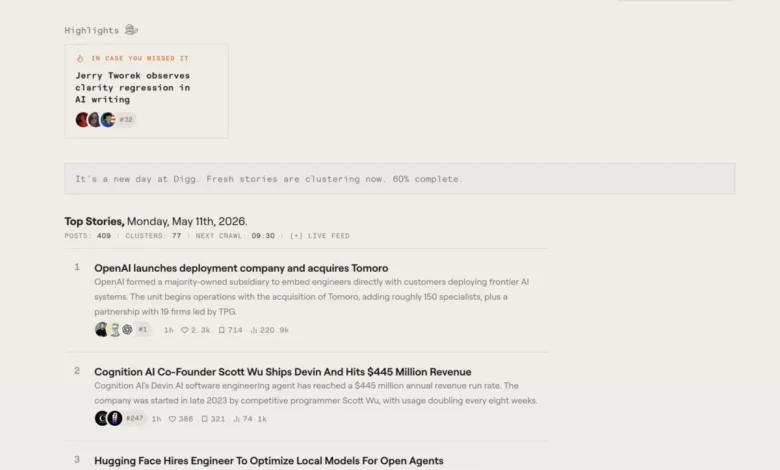
The internet’s original link-sharing titan has undergone yet another metamorphosis. After a turbulent 2026 that saw the platform launch a Reddit-style community forum, suffer through a significant round of layoffs, and eventually shutter its mobile application in March, Digg has resurfaced with a radically different identity. Kevin Rose, the platform’s founder and current partner at True Ventures, confirmed on Friday that the site has abandoned its brief attempt at competing with Reddit, opting instead to return to its roots as a sophisticated news aggregator—this time powered by artificial intelligence.
A Timeline of the Recent Pivot
The road to this latest iteration has been marked by rapid experimentation and necessary retrenchment. The saga began in earnest in mid-2025, when Digg sought to recapture its former glory by transforming into a community-centric forum. The objective was to challenge the dominance of Reddit by providing a more streamlined, curated environment for discussion.
However, the reality of managing a high-traffic community proved more difficult than anticipated. Throughout the latter half of 2025, the platform struggled to distinguish its value proposition from established incumbents. By January 2026, the company made a public push for user growth, but the initiative was plagued by systemic issues. Internal reports suggested that the site was overwhelmed by bot traffic, which undermined the quality of discourse and diluted the user experience.
The tipping point arrived in March 2026. Facing stagnant growth and the technical burdens of moderation, leadership made the difficult decision to lay off staff and suspend the app’s operations. The hiatus was brief; by April, Kevin Rose had returned to the company full-time, spearheading a "back-to-the-drawing-board" strategy that culminated in last week’s soft launch of the new Digg.
The New Architecture: AI-Driven Curation
The current iteration of Digg represents a departure from traditional human-moderated content systems. Rather than relying on a community of users to "dig" or "bury" stories, the platform now utilizes real-time ingestion of data from X (formerly Twitter). The site currently focuses exclusively on the artificial intelligence sector, a choice that reflects the current concentration of high-value, fast-moving discourse on the platform.
The interface is stark and data-heavy, prioritizing four distinct headline categories: the most-viewed stories, trending discussions, fastest-climbing narratives, and a retrospective "In case you missed it" section. Beyond these headlines, users are presented with a ranked list of the day’s top stories, supplemented by granular engagement metrics including views, comments, likes, and saves.

Crucially, these metrics are not derived from Digg’s internal ecosystem. Instead, the platform uses sentiment analysis and clustering algorithms to evaluate the pulse of AI-related discourse on X. By tracking how key industry figures—such as OpenAI CEO Sam Altman—interact with content, the system identifies "signal" amid the digital "noise." If an influential voice engages with a specific topic, the platform’s algorithms detect the subsequent ripple effect, elevating the associated news to the top of the feed.
Data-Centric Transparency
The new Digg is positioned as an essential tool for "data nerds" and industry observers who need to cut through the volatility of social media. The site provides a leaderboard of the 1,000 most influential individuals in AI, alongside rankings for corporations and politicians currently shaping AI policy.
This approach attempts to solve a fundamental problem in the modern information age: the difficulty of identifying what actually matters in an environment defined by rapid-fire updates. By visualizing the impact of X-based engagement through charts and graphs, the platform aims to provide a quantitative perspective on qualitative discussions.
Industry Reactions and Strategic Challenges
While the tech community has expressed curiosity regarding the pivot, analysts remain divided on the long-term viability of the model. The primary challenge lies in the site’s reliance on third-party platforms. By tethering its discovery engine to X, Digg is essentially operating as a secondary layer of the social media giant’s infrastructure.
"The utility is clear for someone who doesn’t have the time to manually track breaking AI news," says a digital media strategist familiar with the project. "But the ‘so what’ factor is still being tested. Why go to Digg when you can look at an algorithmic ‘For You’ feed or an RSS reader?"
Moreover, the platform currently lacks an integrated discussion layer. Users can consume the curated content, but they cannot engage in meaningful debate on the site itself. For a brand that built its legacy on user participation, this lack of interactivity is a stark contrast to its previous iterations.
Furthermore, the focus on AI may be a double-edged sword. While AI is currently the most active vertical on X, other sectors have seen a migration of traffic toward platforms like Meta’s Threads or decentralized networks. If Digg intends to scale, it must prove that its sentiment analysis and clustering technology can successfully bridge the gap between different social media ecosystems, many of which are becoming increasingly fragmented.

The Broader Impact on Digital Publishing
Despite the hurdles, Digg’s survival and subsequent pivot carry implications for the broader publishing industry. In an era where Google’s "AI Overviews" and changing search algorithms have significantly reduced organic traffic to traditional websites, publishers are in desperate need of new discovery engines.
Google’s recent shift toward AI-generated summaries has created a "zero-click" environment, where users obtain the information they need without ever visiting the source. This has decimated the advertising-supported revenue models of countless independent news outlets. If Digg succeeds in becoming a high-traffic referral source, it could serve as a vital lifeline for publishers who have been marginalized by the search giant’s dominance.
By focusing on the most influential voices and providing a curated "top 1,000" list of industry leaders, Digg is essentially creating a premium discovery layer. If this model manages to drive significant traffic to original reporting, it may set a new standard for how news is aggregated in the post-search era.
The Road Ahead
The company has been transparent about the current state of the site, noting in emails to beta testers that the platform remains "buggy" and "raw." The current launch is designed primarily to gather feedback from a controlled user base rather than to serve as a full-scale public debut.
Kevin Rose’s return to the helm suggests a commitment to refining the product until it reaches a point of utility that justifies its existence in a crowded marketplace. Whether the platform can move beyond its status as an AI-specific curiosity and regain its position as a destination for the general public remains an open question.
For now, the project remains in a state of flux. The success of this third incarnation of Digg will ultimately depend on its ability to evolve from a simple tracker of viral tweets into a comprehensive, indispensable utility for modern knowledge management. As the company continues to iterate, the tech industry will be watching closely to see if this iteration finally provides the stability the brand has lacked for over a decade.
Related posts: