A sophisticated Chinese-speaking threat actor has initiated a widespread, multi-vector cyber espionage campaign targeting critical infrastructure, government agencies, and small-to-medium enterprises across 29 countries. Security researchers at GreyNoise, utilizing their Global Observation Grid (GOG) sensor network, have identified this adversary as having clear tactical links to the Red Heron group—a collective previously implicated in the exploitation of critical flaws within Gitea self-hosted Git services. The campaign, which has been under intense observation since early June 2026, represents a significant escalation in the use of automated vulnerability chaining to harvest sensitive PII and government-linked intelligence.
The operational footprint of this campaign is extensive. Threat intelligence data confirms that the adversary has successfully breached at least 49 distinct organizations. In a single, highly coordinated operation, the hackers compromised 996 ZyXEL GS1900 Smart Managed Switches, extracting device configurations, network topology maps, and hashed root-level credentials. Beyond networking hardware, the attackers have systematically targeted enterprise software platforms, including PAN-OS Global Protect, FlowiseAI, Nuclio, Proxmox, and Ubiquity systems, exploiting known vulnerabilities to secure persistent access.
Chronology of the Campaign and Exploitation Tactics
The activity observed by GreyNoise suggests a highly disciplined approach to reconnaissance and exploitation. The campaign’s timeline reveals a transition from opportunistic scanning to targeted surgical strikes.
In early June 2026, initial scanning activity originating from a consistent set of IP addresses began appearing on the GOG sensor network. By mid-July, the threat actor shifted focus to the "wp2shell" vulnerability set within the WordPress Core component, specifically CVE-2026-63030 and CVE-2026-60137. Publicly available exploits for these flaws appeared in mid-July, and within days, the adversary was seen actively weaponizing them to deploy webshells on high-value targets.
The operational cadence accelerated significantly in August. On August 17, the threat actor pivoted to the ZyXEL GS1900 Smart Managed Switches, utilizing the high-severity CVE-2026-7273 to exfiltrate data from nearly a thousand devices globally. This was followed by attempts to chain multiple Ubiquiti UniFi OS vulnerabilities (CVE-2026-34908, CVE-2026-34909, and CVE-2026-34910), a move that aligns with recent warnings issued by the Cybersecurity and Infrastructure Security Agency (CISA) regarding the active exploitation of these specific flaws.

Deep Dive: The Breach of Western Government Infrastructure
One of the most alarming aspects of this campaign is the successful infiltration of an unnamed Western government organization. This incident provides a masterclass in modern lateral movement and post-exploitation tradecraft.
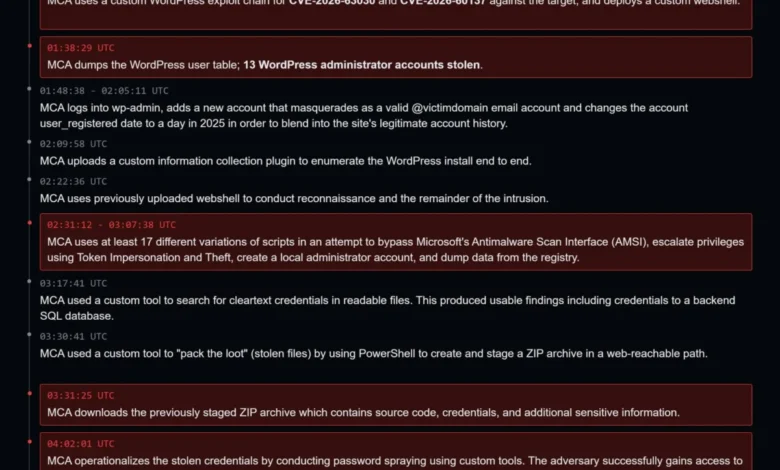
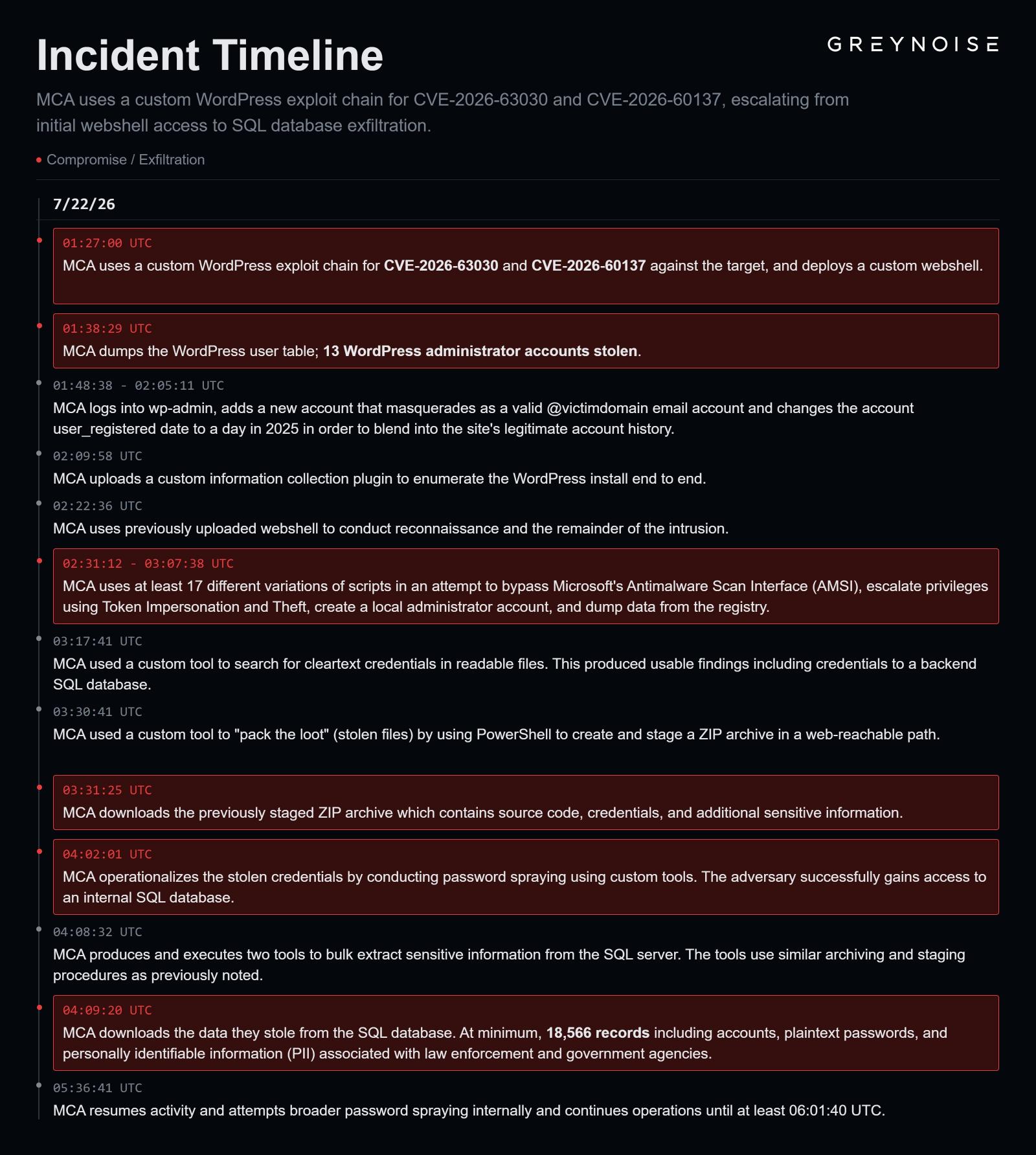
Upon establishing initial access via a custom wp2shell exploit, the threat actor initiated a 36-minute reconnaissance phase. During this window, the attackers meticulously probed the environment for security controls. Their methodology involved checking for the presence of Microsoft Defender and the Antimalware Scan Interface (AMSI), listing active services, identifying open listening ports, and enumerating local accounts.
The attackers demonstrated advanced capabilities in evasion, cycling through 17 distinct scripts designed to bypass AMSI protections. Their primary objective was the elevation of privileges through token impersonation and the extraction of registry data to facilitate further movement. Once the attackers successfully located credentials for a backend SQL database, they executed a targeted password-spraying attack, gaining unauthorized access to an internal SQL server. From this repository, they exfiltrated over 18,566 records, including plaintext passwords, internal account identifiers, and sensitive personally identifiable information (PII) related to government and law-enforcement personnel.
Red-on-Red: Global Scope and Regional Targets
The geopolitical implications of the campaign are further underscored by the discovery that the same threat actor successfully breached a Russian state organization located in occupied Ukraine. Security analysts have characterized this as a "red-on-red" compromise, where the actor’s objectives appear to transcend traditional state-aligned geopolitical alignments, focusing instead on pure data acquisition and intelligence gathering.
The breadth of the attack surface is vast. Researchers have cataloged the targeting of:
- Proxmox VE: Exploiting CVE-2023-54391.
- SENAITE LIMS: Targeting CVE-2026-54569.
- Linux Kernel: Utilizing the legacy "Dirty Pipe" vulnerability (CVE-2022-0847) for local privilege escalation.
- FlowiseAI: Leveraging CVE-2026-56271.
The fact that several of these vulnerabilities have not yet been added to the CISA Known Exploited Vulnerabilities (KEV) catalog highlights a dangerous gap between public security warnings and the reality of active threat actor behavior.
Strategic Implications for Defenders
The GreyNoise report emphasizes that this campaign is not a collection of isolated incidents but a cohesive, well-funded effort by an actor capable of adapting to various technological stacks. By chaining vulnerabilities—some of which are relatively obscure—the attacker has effectively bypassed standard perimeter defenses.
The use of "living-off-the-land" techniques, such as script-based AMSI bypasses and credential harvesting via password spraying, suggests that traditional signature-based detection mechanisms are insufficient. Organizations must adopt a more proactive posture, focusing on behavioral analytics and the hardening of backend database configurations.
Furthermore, the targeting of networking equipment like the ZyXEL switches and Ubiquiti routers serves as a reminder that the "edge" of the network remains a primary vector for initial access. Once a switch is compromised, the attacker gains a vantage point that is difficult to monitor, allowing for the interception of traffic and the persistence of command-and-control (C2) communication channels.
Official Responses and Remediation Guidance
While no single government entity has officially claimed responsibility for the attribution, the technical evidence provided by GreyNoise strongly points toward state-sponsored actors operating out of China. CISA continues to urge organizations to patch the identified Ubiquiti and WordPress vulnerabilities immediately.
"The persistence and speed with which these actors operate demonstrate that waiting for official patches is often too slow," says one industry analyst. "Defenders must treat the entire technology stack, from the switch firmware to the application layer, as a unified surface that requires constant monitoring for anomalies."
GreyNoise has released a comprehensive set of Indicators of Compromise (IoCs), including file hashes for backdoors and known C2 server IP addresses. Organizations are encouraged to ingest these IoCs into their Security Information and Event Management (SIEM) systems to retroactively scan for evidence of compromise dating back to June 2026.
.jpg)
Broader Impact on Cybersecurity Governance
The 2026 campaign serves as a sobering case study for cybersecurity governance. The ability of a single threat actor to manipulate such a diverse array of technologies—from legacy Linux kernel bugs to modern AI-driven infrastructure like FlowiseAI—highlights the growing complexity of the digital landscape.
As enterprises and government bodies continue to integrate AI, containerization (Proxmox), and decentralized Git services (Gitea) into their workflows, the attack surface expands exponentially. This campaign illustrates that hackers are not just looking for "low-hanging fruit"; they are performing deep-dive analysis on the software supply chain to find the most efficient route to sensitive government data.
The incident also raises questions regarding the efficacy of current vulnerability disclosure processes. With the attacker moving faster than the KEV catalog can update, security teams are often left in a reactive state. The transition from discovery to exploitation is now measured in days, or even hours, creating a high-stakes environment where validation and remediation must occur at machine speed.
Moving forward, the security community must prioritize the sharing of real-time telemetry, similar to the GOG network data, to enable faster identification of emerging threats. Until then, organizations must assume that their public-facing infrastructure is under constant, automated observation and that any delay in patching represents an open invitation to persistent, well-resourced adversaries.
Related posts: