CSIRO Deploys Serverless Beacon on AWS to Revolutionize Secure Genomic Data Sharing and Clinical Research

Australia’s national science agency, the Commonwealth Scientific and Industrial Research Organisation (CSIRO), has successfully engineered and deployed Serverless Beacon (sBeacon)—an advanced, highly scalable, and cost-effective serverless architecture designed to query genomic variant data securely on Amazon Web Services (AWS). Developed in close technical collaboration with the AWS Prototyping and Scaling Team, sBeacon addresses long-standing bottlenecks in international medical research, providing a production-ready framework that accelerates clinical discovery while enforcing rigorous data privacy standards.
The launch of sBeacon marks a significant milestone in bioinformatics, bridging the gap between massive genomic biobanks and the international clinical community. By leveraging a fully serverless framework, CSIRO has eliminated the heavy operational overhead traditionally associated with maintaining distributed genetic databases, offering a template that other global health institutions can rapidly adopt.
The Global Imperative for Standardized Genomic Interoperability
Modern genetic research relies heavily on the analysis of large patient cohorts to identify single nucleotide polymorphisms (SNPs) and structural variants linked to hereditary diseases, rare disorders, and complex conditions like oncology. However, genomic data is notoriously siloed across international hospitals, research institutes, and biobanks. Privacy regulations, institutional boundaries, and proprietary data formats have historically hindered collaborative research, preventing scientists from rapidly cross-referencing genetic variants on a global scale.
To combat this fragmentation, the Global Alliance for Genomics and Health (GA4GH)—an international policy-framing and technical standards-setting organization—developed the Beacon protocol. The Beacon protocol serves as an open, standardized API framework designed to facilitate secure, efficient genomic and phenotypic data discovery across international networks. Despite its widespread theoretical adoption, building a production-grade implementation capable of handling population-scale datasets while maintaining sub-second query speeds and strict zero-trust security has remained a major engineering challenge.
CSIRO’s sBeacon was conceptualized to solve this operational friction. By combining the GA4GH Beacon standard with native AWS serverless components—specifically Amazon Simple Storage Service (Amazon S3), AWS Lambda, Amazon DynamoDB, and Amazon Athena—the CSIRO team created an architecture that scales elastically from single-sample local studies to massive, multi-thousand-genome biobanks without requiring dedicated server infrastructure.
Architectural Anatomy: Decentralized Storage and Modular Compute
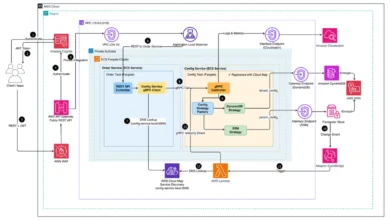
The sBeacon solution is deployed via Infrastructure as Code (IaC) utilizing Terraform, allowing institutions to spin up the entire development and production stack within their own secure AWS environments. The architecture is strategically partitioned into two core operational pillars: data onboarding and data querying.
Data Onboarding and Metadata Indexing
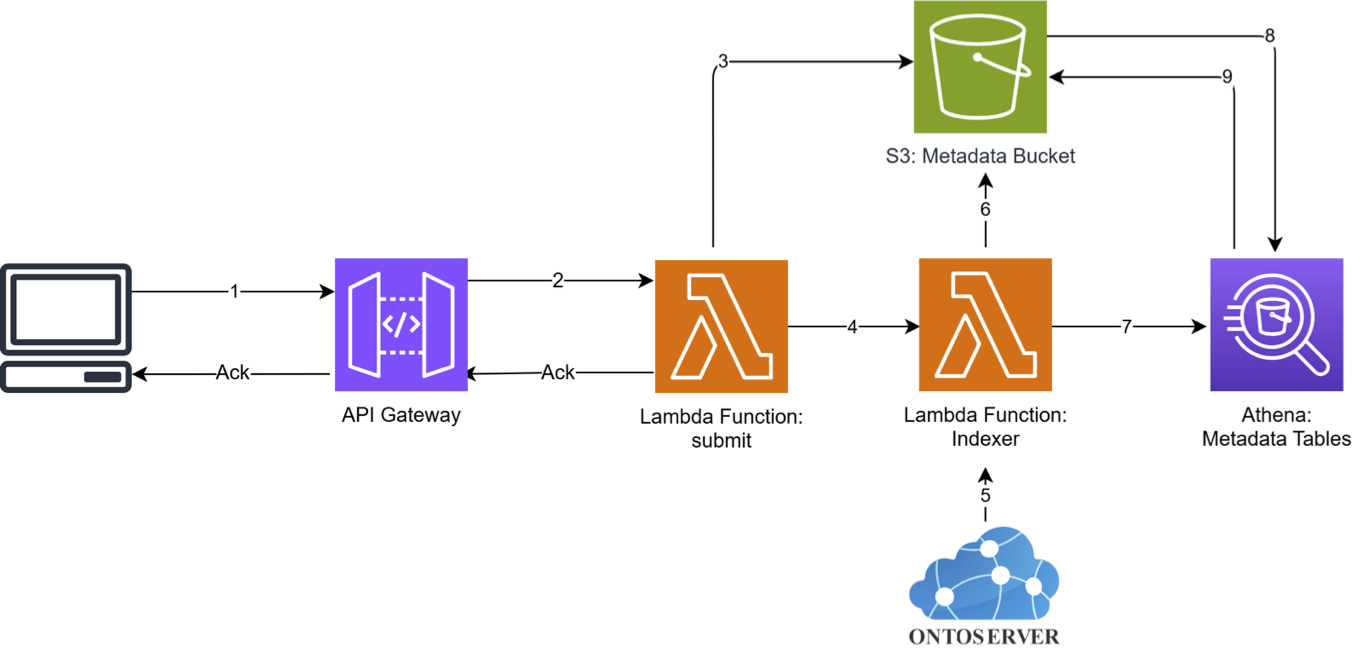
During the data onboarding phase, genomic datasets and their corresponding phenotypic metadata—such as disease status, geographic location, and age cohorts—are registered within the system. Crucially, raw genomic files, typically stored as Variant Call Format (VCF) files, are never copied or duplicated outside their original storage locations. Instead, sBeacon references these files via Amazon S3 URIs, establishing a decentralized storage model.
In contrast, non-sensitive phenotypic metadata is ingested into sBeacon’s internal storage mechanisms to build indexed tables via Amazon Athena and the CSIRO Ontoserver, which complies with the Ensembl OLS V4 ontology specification. This separation ensures that raw sequence data remains strictly under the ownership and control of the hosting institution, while the indexing layer enables rapid cross-referencing of medical traits.
Modular Data Querying via AWS Lambda
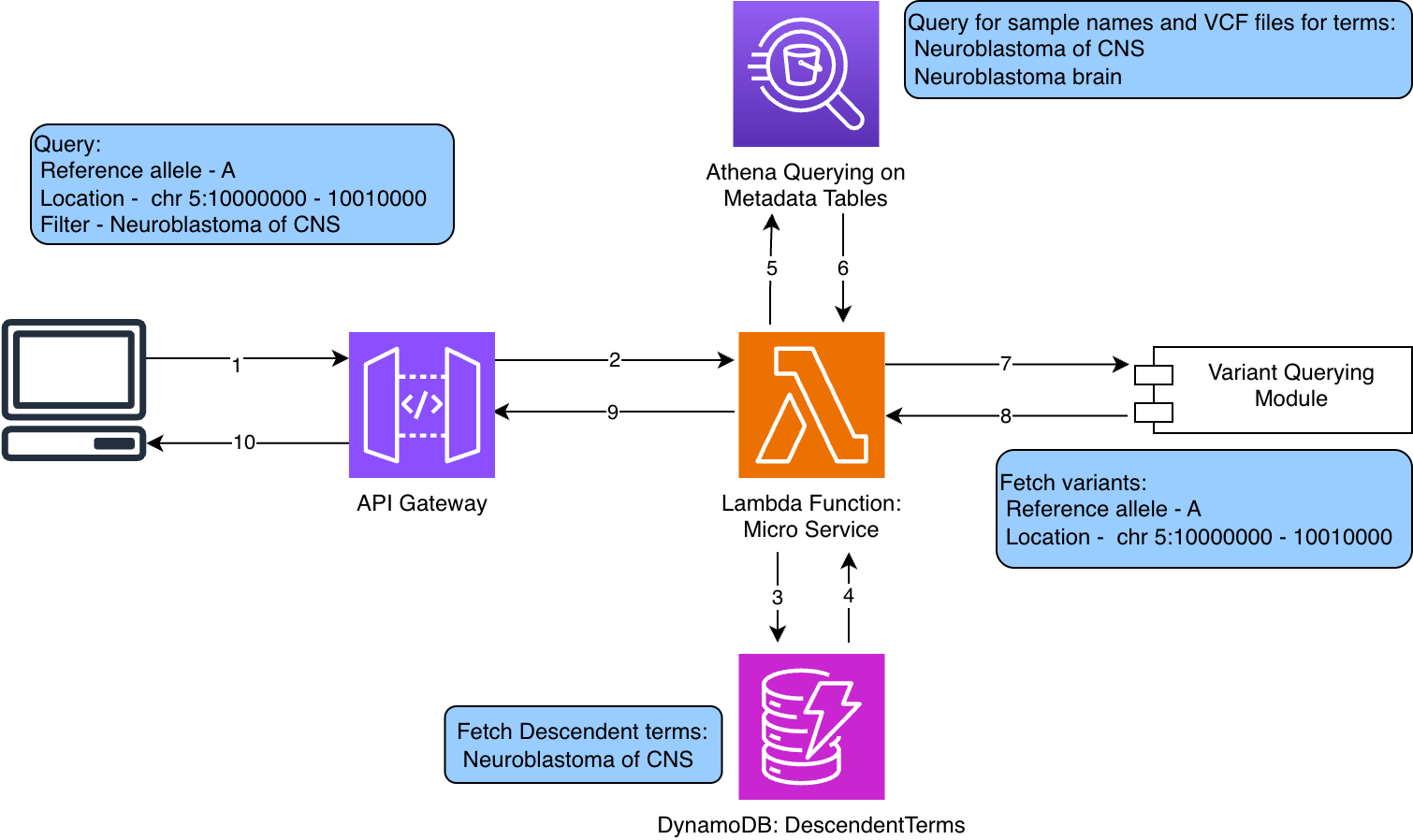
Querying within sBeacon is engineered modularly to accommodate diverse use cases, ranging from human genetic disease diagnostics to epidemiological pathogen tracking. When a query is initiated via the Amazon API Gateway, it passes through an authorization layer before hitting dedicated microservice Lambda functions.
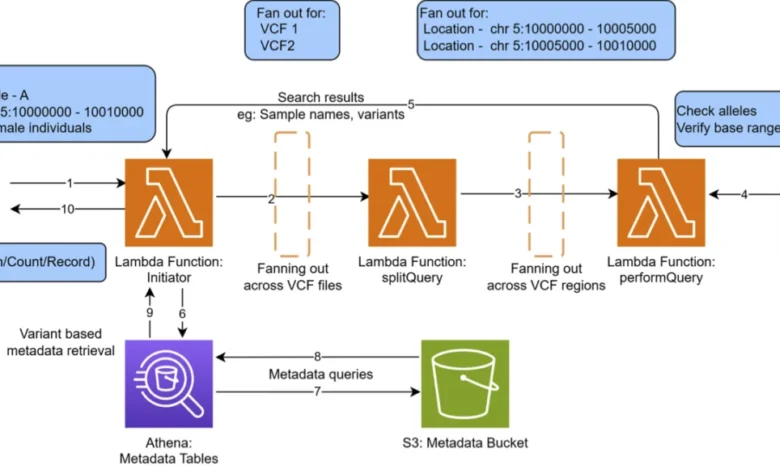
For genomic variant queries, sBeacon employs a specialized Variant Querying Module. An initiator Lambda function dynamically fans out split-query and perform-query operations across distributed VCF files stored in Amazon S3. Utilizing bcftools and htslib underlying libraries, the system issues precise HTTP byte-range requests (Range: bytes=X-Y) directly against the targeted VCF files. Consequently, only the specific tabix-indexed region of interest—typically around 1 kilobyte per query—is accessed. Raw genomic sequence bytes are never loaded into Lambda memory as returnable data; the system computes and returns only aggregate results, such as boolean existence, numeric allele counts, or filtered variant records.
Empirical Performance and Cost Analysis: The 1000 Genomes Case Study
To validate sBeacon’s scalability and operational economy, CSIRO researchers benchmarked the platform using chromosome 1 (chr1) of the internationally recognized 1000 Genomes Project dataset. Representing approximately 8% of the human genome, this test cohort encompassed multi-sample VCF files from 2,504 individuals, totaling roughly 1.1 gigabytes of compressed data stored in Amazon S3.
The empirical results underscored the exceptional efficiency of the serverless model:
- Ingestion Efficiency: Ingesting chromosome 1 data for all 2,504 individuals required a mere 18 seconds of processing time, incurring an ingestion cost of approximately USD 0.00052. Because sBeacon avoids duplicating heavy genomic files, ongoing storage overhead is remarkably low—costing roughly USD 0.03 per month for the dataset’s metadata and index structures.
- Query Latency: Query performance remained consistently near real-time regardless of the volume of variants returned. For example, querying across a genomic region spanning 10,000 base pairs to retrieve complex genotypes across the entire cohort of 2,504 individuals executed in an average of 1.52 seconds.
- Operational Cost: The compute cost for executing complex regional queries averaged approximately USD 0.00013 per query. Standard monthly operating costs—factoring in 1,000 queries, data storage, and metadata indexing—remain fractions of a cent, demonstrating that population-scale genomic discovery can be maintained at a negligible financial footprint.
Zero-Trust Security and Strict Privacy Enforcement
Given the sensitive nature of human genetic data, sBeacon was architected from the ground up to support a strict zero-trust security posture. Security responsibilities are distributed under the AWS Shared Responsibility Model, while application-level authorization is enforced meticulously inside the Lambda execution layers rather than relying solely on API gateway configurations.
Integration with Amazon Cognito manages user identity and access control through JSON Web Tokens (JWTs). The JWT carries explicit user group memberships as claims, which are evaluated by query Lambda functions to enforce granular data disclosure limits:
- Boolean Access Tier (
sbeacon-boolean-access-user-group): Restricts responses strictly to binary existence queries (exists: true/false). - Count Access Tier (
sbeacon-count-access-user-group): Limits output to aggregate allele and sample counts without revealing individual identifiers. - Record Access Tier (
sbeacon-record-access-user-group): Grants authorized clinicians access to full variant details and sample names. - Admin Tier (
sbeacon-admin-group): Manages dataset onboarding, user administration, and infrastructure governance.
Furthermore, because sBeacon utilizes a decentralized storage model where VCF files remain within the deploying institution’s secure Amazon S3 buckets, cross-institutional data sharing occurs without establishing risky cross-account trusts or centralizing vulnerable data lakes. Data owners retain absolute sovereignty over their genomic repositories.
Broader Implications and Future Outlook
The introduction of sBeacon represents a paradigm shift for translational genomics, offering a blueprint for how public sector science agencies and healthcare networks can leverage cloud-native serverless technologies to break down data silos. By drastically lowering the financial and technical barriers to running high-throughput genomic queries, sBeacon empowers hospitals, research universities, and biotechnology firms to participate in global federated research networks without compromising patient confidentiality or inflating IT expenditures.
As clinical genomics increasingly pivots toward personalized medicine and massive population-scale sequencing initiatives, architectures like sBeacon provide the necessary scalability, agility, and security required for the next generation of medical breakthroughs. Researchers and engineering teams interested in deploying the framework can access the complete source code and deployment documentation via the official CSIRO GitHub repository (aehrc/terraform-aws-serverless-beacon), paving the way for a more connected, collaborative, and secure global scientific community.