NVIDIA Unveils Generative AI Ecosystem for Global Media and Entertainment at IBC 2026


The International Broadcasting Convention (IBC), held in Amsterdam from September 11–14, 2026, has once again cemented its status as the primary global forum for the media and entertainment industry. This year’s gathering is particularly significant, drawing more than 44,000 attendees from over 170 countries to navigate a sprawling exhibition floor covering 14 halls and vast outdoor spaces. With more than 1,300 exhibitors showcasing cutting-edge advancements and over 600 industry speakers dissecting the future of content, the event serves as a bellwether for the rapid digitization of broadcast workflows. At the heart of this year’s narrative is a seismic shift toward software-defined production, underscored by a major expansion of NVIDIA’s AI for Media suite.
The Evolution of AI in Broadcast Workflows
For decades, broadcast environments were defined by rigid, purpose-built hardware. Today, the industry is transitioning toward flexible, AI-augmented software stacks. NVIDIA’s latest announcements at IBC 2026 reflect this pivot, offering a robust collection of GPU-accelerated software development kits (SDKs), NVIDIA NIM microservices, and specialized blueprints. These tools are designed to integrate seamlessly into live production, sports, news, and streaming environments, allowing media organizations to perform complex tasks—such as video authentication, motion analysis, and multilingual localization—without disrupting established broadcast pipelines.
The urgency for these tools is driven by the proliferation of synthetic media. As generative AI becomes more accessible, the ability to verify content integrity has moved from a technical luxury to an operational necessity. To address this, NVIDIA has advanced its Synthetic Video Detector (SVD) NIM microservice. First unveiled at SIGGRAPH earlier this year, the SVD has seen rapid performance improvements. Current data indicates a 99.3% accuracy rate for text-to-video detection and a 97.7% accuracy rate for image-to-video content. These statistics represent a critical milestone in digital forensics, providing editorial and integrity teams with a reliable layer of validation in an era of sophisticated deepfakes.
Strategic Industry Partnerships and Integration
The adoption of these technologies is not occurring in a vacuum; it is being driven by strategic partnerships with industry leaders. Dalet, for instance, is integrating the SVD into its cloud-hosted news verification workflows. By allowing editorial teams to review authenticity scores directly within the Dalet interface, the company is bridging the gap between high-level AI analysis and daily newsroom operations.
Similarly, TwelveLabs has announced the general availability of its "Compliance by TwelveLabs" application. This tool leverages SVD to provide frame-level authenticity signals, enabling broadcast teams to automatically screen content against regional compliance standards. This automated oversight is a transformative development for global broadcasters who must navigate disparate regulatory landscapes.
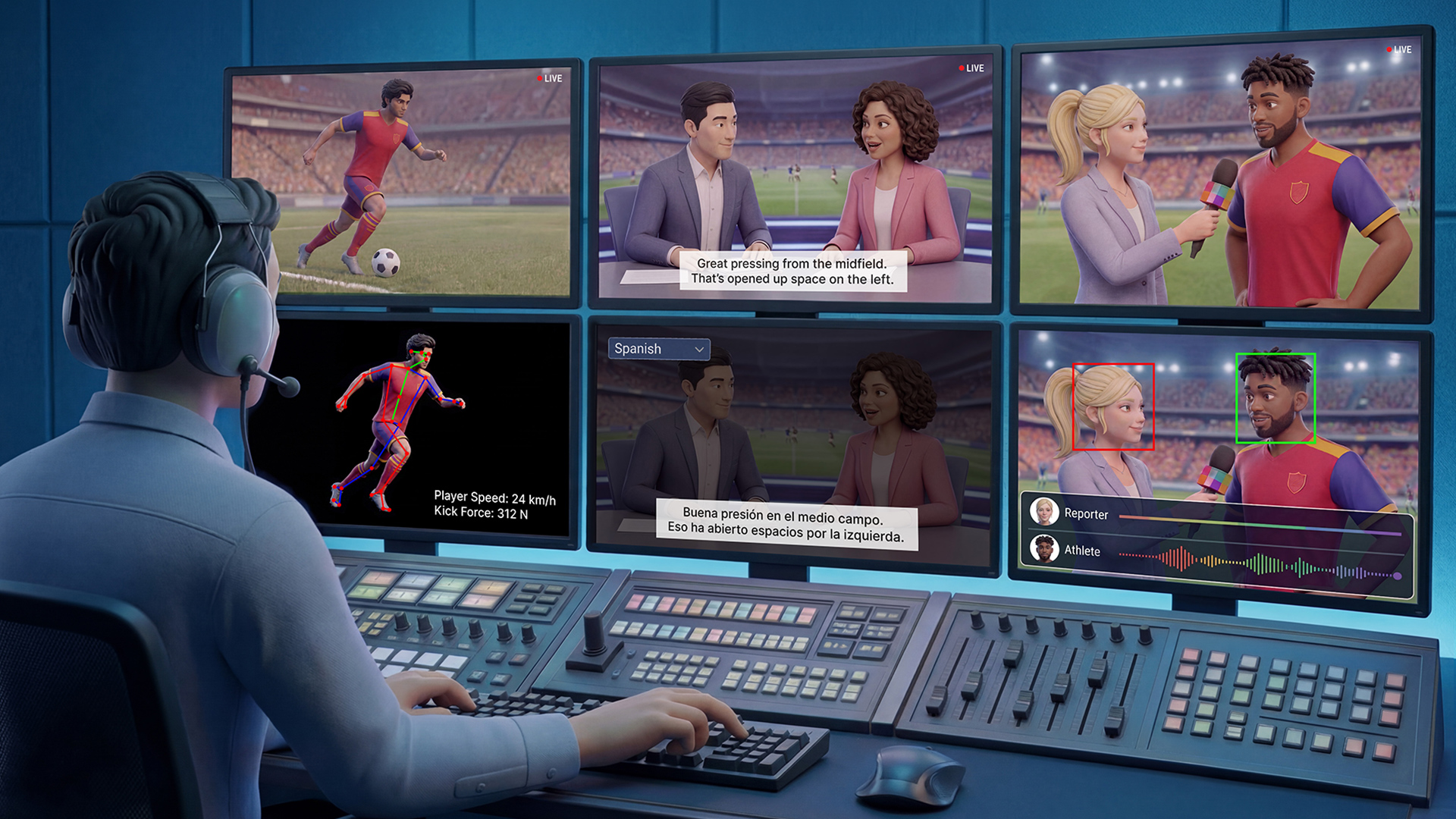
Furthermore, Wowza is scaling the distribution of SVD through its Video Intelligence Framework. By powering this solution with NVIDIA-accelerated infrastructure, Wowza enables broadcasters to perform real-time analysis of live video feeds—detecting objects, scenes, and potential AI tampering—across on-premises, edge, cloud, and air-gapped environments. This deployment model is essential for organizations that require high-security protocols for their broadcast architecture.
Advancing Motion Capture and Visual Fidelity
Beyond content integrity, NVIDIA is redefining how human motion is captured and processed. The NVIDIA 3D Body Pose technology allows for the estimation of joint locations and angles from standard single-camera video, eliminating the need for traditional, cumbersome marker-based systems. In the sports sector, this capability facilitates player tracking, biomechanics analysis, and enhanced replay experiences.
Vizrt has already begun utilizing this technology in live virtual-studio settings. By tracking body movement in real time, broadcasters can now drive sophisticated 3D lighting effects, including reflections and shadows, which react dynamically to a presenter’s gestures. In the animation sector, this motion data provides a foundation for digital doubles and character retargeting, significantly reducing the labor hours associated with high-end virtual production.
Visual fidelity is also seeing significant gains through NVIDIA’s Video Frame Generation (VFG) and Video Super Resolution (VSR) technologies. VFG, which uses generative AI to interpolate frames, can increase video frame rates by a factor of four, preserving temporal consistency for fluid slow-motion replays. Ross Video is currently integrating VFG into its Rio Replay platform, targeting 6x to 8x slow-motion generation for sports, which allows for cinematic clarity even when original footage is captured at lower frame rates. Simultaneously, VSR and TrueHDR offer broadcasters the ability to upscale content and convert standard-dynamic-range video to high-dynamic-range (HDR) in real time, effectively future-proofing legacy content libraries for modern streaming platforms.
Holoscan for Media and the Open Exchange Layer
A critical challenge in modern broadcasting is the "silo" problem, where different software tools struggle to communicate effectively. To solve this, NVIDIA has integrated the Media Exchange Layer (MXL) with its Holoscan for Media platform. Holoscan for Media serves as an open reference architecture for software-defined live production, and the addition of MXL provides a standardized, interoperable layer for exchanging live video, audio, and data.
This development enables independent software functions to share accelerated infrastructure, which is a major efficiency gain. Rather than building bespoke bridges between vendors, developers can create applications that operate within a unified, software-defined environment. This shift toward modularity allows media companies to evolve their capabilities independently, selecting the best-in-class tools for specific tasks without being locked into a single-vendor monolithic stack.
Multimodal AI and the Future of Sports Intelligence
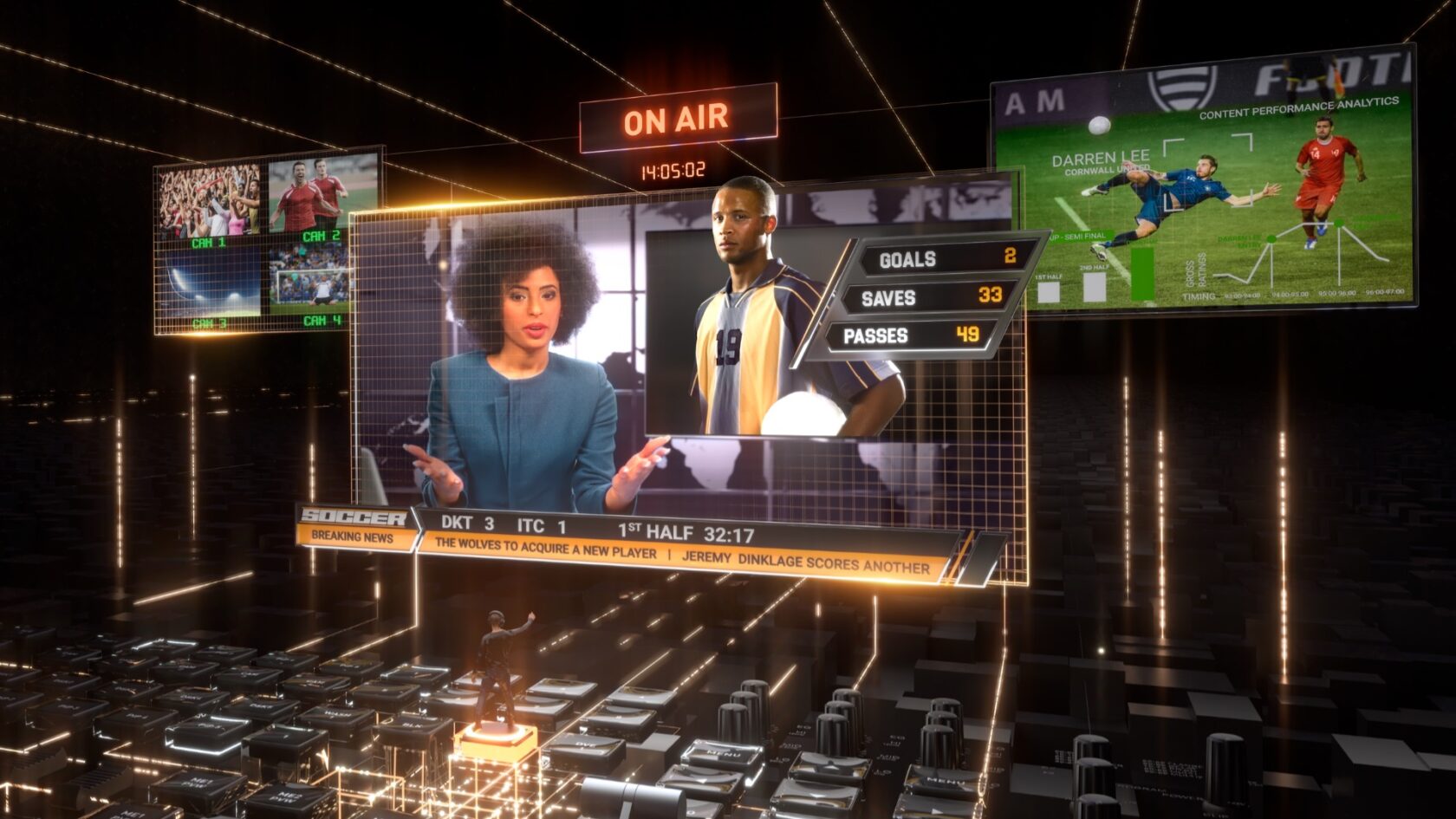
Perhaps the most ambitious component of the NVIDIA announcement is the introduction of "Sports Intelligence Playbooks." These playbooks provide a roadmap for sports organizations to transition from general-purpose AI to fine-tuned, domain-specific models. By utilizing proprietary footage and metadata, leagues can train models that "understand" the unique rules, strategies, and nuances of their specific sport.
Early testing of this domain specialization has yielded impressive results. When models were fine-tuned for specific sports contexts, multiple-choice accuracy on unseen footage jumped from 53% to 94%. This demonstrates that the future of AI in sports lies in proprietary, "expert" models that act as intelligent agents. Machina Sports, for example, is integrating these playbooks to enable rights holders to turn their vast archives of media into actionable, private intelligence. Coupled with the NVIDIA AI-Q Blueprint, these models can move beyond passive analysis into active decision-making, such as automating highlight generation or assisting in real-time officiating.
Global Localization at Scale
Finally, the challenge of global distribution is being addressed through advanced content localization tools. Reaching international audiences requires more than just subtitling; it involves perfect lip-syncing, localized graphics, and authentic voice dubbing. By bringing these technologies into the Holoscan for Media toolkit, NVIDIA is enabling a unified, real-time localization workflow.
The improved NVIDIA LipSync NIM microservice is particularly noteworthy for its ability to preserve facial textures and handle occlusions, ensuring that dubbing appears natural even when a speaker is partially turned away from the camera. Collaborations with companies like NDI, AI-Media, and CAMB.AI demonstrate a growing ecosystem of partners dedicated to making global broadcasting economically viable. By generating multiple language versions from a single media stream, broadcasters can drastically reduce the bandwidth and production complexity associated with international distribution.
Broader Implications and Industry Outlook
The collective impact of these announcements at IBC 2026 suggests that the media industry has reached a tipping point. The convergence of generative AI, high-performance accelerated computing, and open-standard exchange layers is effectively lowering the barrier to entry for high-quality production while raising the bar for content integrity.
Analysts at the conference noted that the transition to software-defined production is no longer a "future-looking" trend but a current operational necessity. Media companies that embrace this infrastructure are positioned to gain a significant competitive edge by reducing operational costs and increasing the agility of their content teams. As these technologies continue to mature, the broadcast industry will likely see a further shift toward automated, data-driven workflows, ultimately transforming how audiences engage with live events and digital media on a global scale.