The landscape of enterprise software procurement has undergone a fundamental transformation as the "Age of Artificial Intelligence" matures, leading market analysts and industry leaders to signal a retreat from the traditional multi-year contract model. For over a decade, the three-year enterprise agreement was considered the gold standard for Software-as-a-Service (SaaS) companies seeking to establish predictable revenue and high valuation multiples. However, recent data suggests that forcing these long-term commitments in the current technological climate may be counterproductive, potentially damaging customer relationships and slowing down the sales cycle.
The Great Shift: Analyzing the 2023-2026 Procurement Data
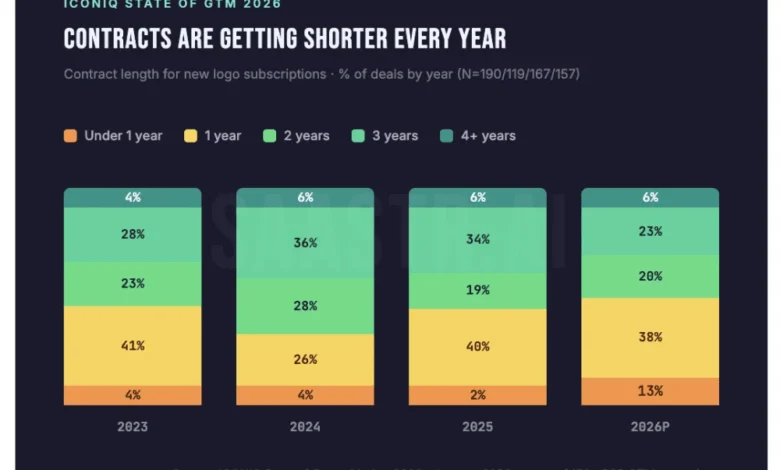
Recent data from ICONIQ Capital highlights a significant pivot in buyer behavior across the B2B and AI sectors. According to the 2026 reporting period, the prevalence of three-year contracts for new customer acquisitions (new logos) has seen a steady decline. In 2023, approximately 28% of new enterprise contracts were signed for a three-year duration. By 2026, that figure has dropped to 23%.
In contrast, the market has seen a sharp increase in sub-one-year commitments. Contracts with durations of less than 12 months, which accounted for only 4% of the market in 2023, have more than tripled to 13% in 2026. This shift is not merely a negotiating tactic employed by procurement departments to lower prices; rather, it represents a rational response to the volatility and rapid evolution of the AI technology stack.
Industry analysts suggest that this trend reflects a "wait and see" approach by Chief Information Officers (CIOs) and Chief Financial Officers (CFOs). In an era where a software category can be disrupted or rendered obsolete within 18 months, committing to a 36-month or 60-month lifecycle is increasingly viewed as an unacceptable institutional risk.
The AI Obsolescence Cycle and Compressed Innovation
The primary driver behind the shortening of contract lengths is the unprecedented pace of the AI replacement cycle. Historically, enterprise software categories—such as Customer Relationship Management (CRM) or Enterprise Resource Planning (ERP)—remained stable for five to ten years. A company could sign a multi-year deal with a leader like Salesforce or SAP with reasonable confidence that the software would remain relevant throughout the term.
In the Age of AI, the innovation curve has compressed. Large Language Models (LLMs), specialized agentic workflows, and infrastructure layers are seeing generational shifts every 12 to 18 months. A vendor that leads the market today may be surpassed by a more efficient, less expensive, or more integrated competitor by the second year of a three-year contract.
Buyers are increasingly wary of "vendor lock-in" during a period of high architectural flux. If a company locks into a three-year agreement for an AI-powered customer service platform today, they risk being tethered to legacy technology while their competitors adopt more advanced, "next-gen" autonomous agents that emerge 18 months later. Consequently, the demand for shorter, more flexible contracts is a strategic move to maintain organizational agility.
Net Revenue Retention as the New North Star
For SaaS and AI vendors, the focus is shifting away from initial contract length and toward Net Revenue Retention (NRR). High-performing companies in the current market, such as Datadog, Figma, Databricks, and Snowflake, demonstrate that long-term stability is achieved through expansion and results rather than rigid legal commitments.
Top-quartile companies currently maintain NRR rates between 110% and 123%. These organizations have moved away from "closing" a three-year deal based on a sales pitch or a slide deck. Instead, they focus on a "land and expand" strategy where the initial contract may be short—six to twelve months—but the subsequent value delivered leads the customer to voluntarily expand their usage and eventually commit to longer terms once the ROI is proven.
For a Series B startup or an established enterprise, an NRR of 120% serves as a buffer against the risks of short-term contracts. If the product is essential and delivers measurable value, the renewal becomes a formality. In this environment, the quality of the renewal and the growth of the account are more accurate indicators of company health than the duration of the initial "new logo" sign-on.
The Hidden Costs of Forced Multi-Year Agreements
Sales organizations that continue to push for multi-year contracts often rely on heavy discounting to incentivize the commitment. However, market experts warn that this strategy often backfires in the AI era.
- Sales Friction: Attempting to force a three-year deal on a buyer who is uncertain about the technological landscape slows down the sales process. What could have been a 60-day sales cycle for an annual agreement turns into a six-month negotiation involving legal, procurement, and executive leadership, often resulting in a "no-decision" outcome.
- Customer Resentment: When buyers feel pressured into long-term commitments for unproven AI solutions, it creates "resentful customers." If the software fails to keep pace with the market by month 18, the customer becomes a detractor. This leads to high churn at the end of the term and damages the vendor’s reputation in a tight-knit market.
- Valuation Misalignment: While multi-year deals provide a "backlog" of contracted revenue, sophisticated investors in 2026 are looking closer at usage and engagement metrics. Contracted revenue from a customer who has stopped using the product is seen as "low-quality" revenue that is unlikely to renew, regardless of the initial contract length.
The Rise of Forward Deployed Engineers and Post-Sales Investment
To adapt to the demand for shorter contracts, leading AI firms are reallocating resources from traditional sales "hunters" to post-sales technical execution. The emergence of Forward Deployed Engineers (FDEs) and robust deployment teams has become a critical competitive advantage.
The objective in the 2026 market is to reach "Time to Value" (TTV) within 60 to 90 days. In the past, enterprise software implementations could take six months to a year. In the current climate, if a customer does not see undeniable ROI within the first quarter of their contract, the likelihood of renewal—let alone expansion—drops precipitously.
By investing heavily in the deployment phase, vendors make the renewal "obvious." When a customer sees a 30% increase in productivity or a 20% reduction in operational costs within the first 90 days, the conversation naturally shifts from "should we renew?" to "how do we scale this?" This organic transition into longer-term commitments is more sustainable and leads to higher lifetime value (LTV).
Implications for the Broader Tech Ecosystem
The trend toward shorter contracts is forcing a maturation of the SaaS business model. It is moving the industry away from the "growth at all costs" mentality of the 2010s toward a "value-based" economy.
For venture capitalists, this shift requires a new set of metrics for evaluating startups. Traditional Total Contract Value (TCV) is becoming less relevant than Monthly Recurring Revenue (MRR) growth and usage-based consumption patterns. Startups that can demonstrate high retention on month-to-month or annual contracts are viewed as having more "product-market fit" than those who hide behind the protection of multi-year legal barriers.
Furthermore, this shift is influencing product development. Engineering teams are now under pressure to release features more frequently to ensure the product remains competitive throughout the year. The "annual release" cycle is dead; it has been replaced by continuous deployment and weekly updates, ensuring that the software the customer uses in month 11 is significantly more capable than the version they bought in month one.
Conclusion: Navigating the 2026 Procurement Landscape
The message for B2B and AI founders is clear: stop fighting the market’s demand for flexibility. In 2026, pushing for a three-year contract at the start of a relationship is often a sign of a weak value proposition or a lack of confidence in the product’s longevity.
The most successful companies are those that embrace shorter initial terms, focus on rapid deployment, and earn their multi-year commitments through consistent performance. By optimizing for NRR and renewal quality rather than upfront contract length, vendors can build more resilient businesses that are capable of navigating the rapid shifts of the AI era. The goal is no longer to "lock the customer in," but to become so indispensable that the customer never wants to leave.