The Great Consolidation: Why America’s Smallest Trucking Fleets Are Vanishing Without Leaving the Highway

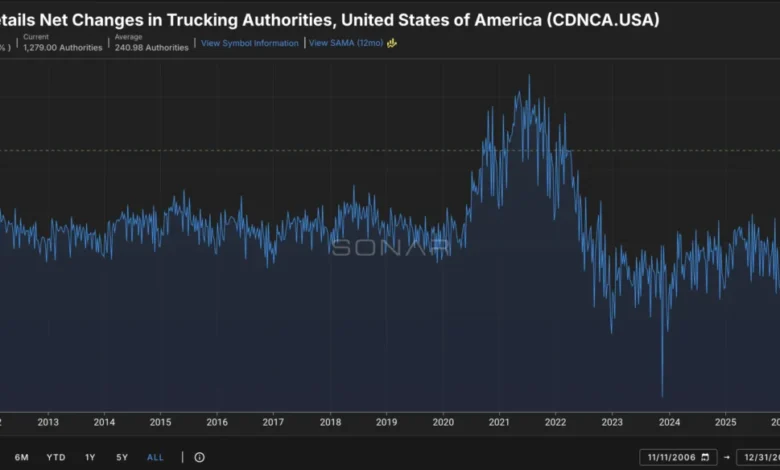
For over three and a half years, the foundational tier of the American commercial trucking sector has undergone a quiet, systemic contraction. Industry metrics show that the population of tractors operated by micro-carriers—fleets managing between one and six trucks—has slid dramatically from its 2023 peak of approximately 398,000 units down to roughly 362,000. While casual observers might attribute this downward trend to widespread business failures and total market exits, a closer examination of federal data reveals a more nuanced reality. The vast majority of these commercial vehicles are not being permanently parked or scrapped; instead, they are changing hands, migrating away from independent operating authorities and integrating into the stable structures of mid-sized and large-scale regional fleets.
This ongoing restructuring represents a fundamental shift in how small-business entrepreneurship functions within modern supply chains. Understanding this transformation requires examining the dual narratives driving the owner-operator exodus: the compounding mathematical pressures squeezing independent margins, and the structural mechanics of how equipment and drivers are absorbed into larger corporate enterprises.
Scale and Scope: The Broadest Base of the Market
Despite the steady erosion of numbers, the micro-carrier tier remains the demographic giant of the United States logistics landscape. According to official data from the Federal Motor Carrier Safety Administration (FMCSA) company census file, more than 1.8 million active carrier registrations fall into the one-to-six-truck classification. This broad aggregate encompasses private corporate fleets and intrastate operators alongside for-hire interstate freight haulers, representing the vast majority of all registered motor carriers in the country.
Rather than a niche or fringe sector thinning out at the margins, this contraction affects the foundational bedrock of American transportation. Furthermore, this downward slide has occurred steadily regardless of monthly freight volume fluctuations, indicating that structural economic pressures—rather than transient seasonal downturns—are driving the migration.
The Mathematical Squeeze: Record Costs Outpace Rates
The reasons behind the departure of independent owner-operators are firmly rooted in economics rather than mystery. Operating expenses for commercial carriers escalated rapidly through 2025 and into late 2026, driven by unprecedented cost burdens across every major ledger item.
According to benchmark research published by the American Transportation Research Institute (ATRI), the average marginal cost of operating a commercial truck reached an all-time high of $2.336 per mile. Within that cost structure, driver compensation remained the single heaviest line item at roughly 82 cents per mile, closely followed by fuel expenditures at approximately 48 cents per mile.
However, the financial landscape shifted dramatically when fuel expenses surged to historic levels. Throughout the autumn of 2026, the U.S. Department of Energy’s national on-highway diesel benchmark shattered previous records, climbing steadily until it reached $6.127 per gallon by the week of November 9. Given that a standard working tractor averages roughly six to seven miles per gallon, diesel fuel costs alone translated to nearly $1.00 per mile—nearly double the fuel expense burden recorded just twelve months prior. This spike was exacerbated by global energy dynamics, as Brent crude oil prices breached the $100-per-barrel threshold while international refining capacity tightened significantly.
Compounding these fuel challenges, commercial auto liability and physical damage insurance premiums continued their relentless climb. ATRI data indicates that insurance costs averaged roughly 10.6 cents per mile, representing a year-over-year increase of nearly 4% and resting far above historical averages. Independent operators managing one or two trucks bore the brunt of these premium hikes, lacking the bargaining power or corporate capital reserves required to self-insure or negotiate volume discounts. When combined with surging expenses for highway tolls, routine maintenance, and replacement parts, the smallest carriers faced an insurmountable structural disadvantage: a total absence of scale across which to spread fixed overhead costs.
Surcharges and the Spot Market Trap
A critical differentiator between large, contract-bound carriers and small, spot-dependent owner-operators lies in the mechanics of fuel recovery. Mid-sized and large-scale fleets heavily reliant on dedicated contract freight typically benefit from automatic fuel surcharge mechanisms. These programmatic rate adjustments float dynamically in tandem with the Department of Energy’s weekly diesel average, effectively insulating larger operations from sudden commodity shocks.

Conversely, independent owner-operators frequently rely on the spot market, sourcing loads day-to-day via digital load boards and brokerages. Spot freight is almost universally quoted as an "all-in" flat rate, meaning the agreed-upon price already incorporates whatever market rate the broker is willing to pay at that moment. When diesel prices spike by over a dollar per gallon, the spot-market carrier possesses no mechanism to independently adjust a surcharge line item. They absorb the entirety of the fuel price increase out of pocket while operating under freight rates that fail to keep pace with operational realities.
Paradoxically, this margin compression is occurring during a period of relatively firm freight pricing. Unlike the severe rate corrections witnessed in previous post-boom cycles, spot van and reefer rates through late 2026 remained stronger than any comparable period since 2021. Meanwhile, macroeconomic freight volumes, as tracked by the SONAR Truckload Volume Index (STVI.USA), held steady near historical averages rather than experiencing explosive growth.
Therefore, the core crisis facing independent operators is not falling freight revenue, but rather an unsustainable cost-to-rate velocity. When expenses outpace income generation, carriers without fuel surcharges or institutional scale face a rapid depletion of their cash reserves.
The Mechanics of Equipment Migration
The most revealing aspect of the current industry contraction is traced through federal fleet-size distributions and equipment leasing data. A granular analysis of the FMCSA census highlights a distinct structural correlation between fleet size and asset leasing:
- One-to-six-truck carriers: Operate almost entirely on owned equipment, with leased tractors accounting for a mere 6.9% of their total fleet.
- Seven-to-19-truck fleets: See the leased share of tractors jump significantly to 18.2%.
- 20-to-100-truck mid-sized fleets: Rely on leased equipment for nearly one-third (31.6%) of their total active tractors.
- 101-to-999-truck fleets: Push lease dependency past the 40% threshold.
This upward curve illustrates the primary pathway of industry consolidation. When an independent owner-operator surrenders their federal operating authority due to financial pressures, they frequently choose not to leave the industry entirely. Instead, they transition into a lease-on arrangement with an established mid-sized or large carrier, bringing their existing commercial vehicle with them or leasing equipment directly from specialized commercial lessors such as Penske or Ryder.
Within the 20-to-100 truck segment alone, federal census filings record more than 217,000 term-leased tractors operating alongside approximately 466,000 company-owned power units. This transition provides a rational economic outlet for operators seeking relief from administrative burdens, regulatory compliance costs, and soaring insurance premiums.
The Efficiency Sweet Spot of Mid-Sized Fleets
The 20-to-100 truck demographic occupies a unique structural advantage within contemporary supply chains. Although this tier represents fewer than 2% of all registered active motor carriers (comprising roughly 44,500 businesses), they collectively operate an estimated 1.75 million power units.
Industry analysts identify this segment as the operational efficiency sweet spot. These mid-sized carriers possess enough scale to negotiate volume fuel discounts, implement formal corporate fuel-surcharge agreements with shippers, and distribute maintenance and insurance expenses across a sizable asset base. Simultaneously, they retain the regional agility and operational flexibility required to adapt quickly to changing localized market demands. This structural cushion explains why mid-sized fleets continue to absorb surplus equipment and drivers while smaller independents are forced to dissolve their individual authorities.
Industry Implications and Future Outlook
The steady migration of equipment and personnel away from micro-carriers and into larger, more durable operating structures carries profound implications for shippers, freight brokers, and industry regulators. As commercial capacity increasingly consolidates within resilient mid-sized and large-scale fleets capable of weathering sustained high fuel costs and flat freight volumes, the overall market supply chain becomes structurally stickier.
For individual transportation professionals currently evaluating their business models, the current economic climate signals the end of casual, undercapitalized independent operations. Surviving as a micro-carrier now demands rigorous cost-accounting discipline down to the penny, direct contractual relationships with local shippers to bypass volatile spot markets, and a strict adherence to corporate management principles. For thousands of owner-operators, the choice is no longer whether to remain in the transportation sector, but whether the heavy burdens of independent ownership continue to outweigh the stability of operating under another company’s authority.