Unmasking the Architect of Qilin: How Digital Footprints Led to a St. Petersburg Resident

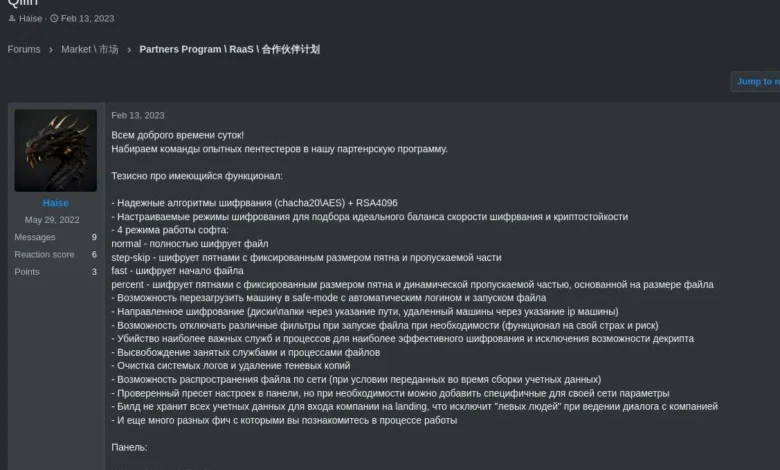
The cybercrime landscape is currently dominated by the Qilin ransomware group, an organization that has rapidly ascended to the top of the threat hierarchy, claiming at least 365 victim organizations within the last three months. While the group’s operations appear sophisticated and global, a meticulous investigation into the operational security habits of its administrator, known as “Haise,” has stripped away the veil of anonymity. Evidence aggregated by cybersecurity intelligence firms, including NCC Group, Intel 471, and Flashpoint, points directly to a 36-year-old individual named Aleksey Mikhailovich Yakovtsev, a resident of St. Petersburg, Russia. This discovery underscores a recurring reality in the world of high-stakes cybercrime: even the most industrious digital criminals often fall victim to the “long tail” of their own early-career mistakes.
The Rise of Qilin: A Ransomware-as-a-Service Powerhouse
Since its inception in September 2022, Qilin has redefined the efficiency of the Ransomware-as-a-Service (RaaS) model. Operating with a business-like structure, the group recruits affiliates to perform the “dirty work” of breaching corporate networks, deploying encryption payloads, and exfiltrating sensitive data. In exchange for their services, affiliates are incentivized with a generous revenue-sharing model, typically keeping 80 percent of the extortion proceeds.
Qilin distinguishes itself from other Russian-based ransomware syndicates by its willingness to collaborate with English-speaking threat actors. This cross-pollination of talent has allowed Qilin to form alliances with notorious groups such as Scattered Spider and RansomHub, significantly expanding its reach and operational capacity. By employing a “double extortion” strategy—whereby victims are coerced into paying both for the decryption of their systems and for the non-disclosure of stolen data—Qilin has successfully maximized its leverage over a wide array of sectors, including healthcare, finance, and critical infrastructure.
The Anatomy of an Operational Security Failure
The persona “Haise” was carefully cultivated to mask the true identity behind Qilin’s infrastructure. However, the path to unmasking this individual began years before the group was formed. In the underground economy, threat actors frequently rotate their aliases to maintain security, attempting to decouple their present illicit activities from their past transgressions. Yet, this strategy often fails when a criminal is forced to reference older, compromised identities to gain entry into elite, invitation-only forums.

In June 2022, when Haise applied for membership to RAMP—a notoriously guarded Russian cybercrime forum that served as a hub for ransomware operators—the administrative vetting process required a disclosure of history. Internal messages recovered from the forum, which was seized by the FBI in January 2026, reveal that the forum’s administrators vetted Haise by associating the handle with a Telegram username: “Alexbigboss44.”
This single link proved to be the thread that unraveled the entire tapestry. Intelligence researchers discovered that Alexbigboss44 was not a new creation but a moniker tied to an older, prolific cybercriminal known as “Rjun.” Records indicate that Rjun was active on platforms such as Exploit and XSS as early as 2020. During that period, the user was deeply entrenched in the illicit trade of corporate access, traffic logs, and the exploitation of Google Ads accounts to facilitate large-scale advertising fraud and gambling schemes.
Chronology of an Identity Trace
The trail of digital evidence left by the individual behind these handles reveals a clear developmental arc:
- 2013–2014: Early digital footprints emerge in Russian travel agency data breaches, showing flights between St. Petersburg and Murmansk associated with Aleksey Yakovtsev.
- 2018–2019: The individual begins his journey in the cyber-underground as a novice arbitrageur, focusing on credit card fraud and lower-level financial crimes.
- 2020: The identity “Rjun” is established on major Russian forums, utilizing the email address [email protected] and the Telegram handle Alexbigboss44.
- 2022: The transition to RaaS occurs. The user applies for membership to the RAMP forum as “Haise,” maintaining ties to the previous Alexbigboss44 identity.
- 2025: A massive breach of the Russian state services platform, Gosuslugi, exposes millions of records, including those linking the [email protected] address to Aleksey Mikhailovich Yakovtsev.
- 2026: FBI seizure of RAMP and subsequent analysis by firms like IntelHawk and Flashpoint solidify the link between the Qilin administrator and the St. Petersburg resident.
The Role of Data Breaches in Attribution
The de-anonymization of the Qilin administrator was made possible largely by the “collateral damage” of other cyberattacks. When the official Russian state services portal, Gosuslugi, was compromised in late 2025, it exposed the personal data of over 20 million citizens. This breach served as a crucial repository for threat hunters, allowing them to map the email address [email protected] to Yakovtsev.
Further verification came through a convergence of technical indicators. Telegram ID 118329521, which had been used by Haise to manage the Qilin affiliate program, was linked to a phone number (+79602347275). While the number was registered to Yakovtsev’s biological sister, forensic analysis revealed that the suspect had habitually used her contact information for forum registrations. This practice, likely intended to provide a layer of obfuscation, instead created a permanent, cross-referenced identifier that allowed researchers to bridge the gap between his online persona and his physical life.

Implications and Broader Impact
The identification of Yakovtsev carries significant implications for the international effort to curb ransomware. By publicly exposing the identity of a major RaaS administrator, security researchers and law enforcement demonstrate that the “anonymity” promised by the dark web is often an illusion.
The fact that Yakovtsev, a university-educated individual with a master’s degree in computing and information systems, chose to pivot from legitimate technical work to orchestrating global ransomware attacks reflects the economic allure of the RaaS model within Russia. However, his failure to fully scrub his digital past serves as a cautionary tale for other operators. The reliance on old email addresses, persistent phone numbers, and a failure to account for the impact of third-party data breaches—such as the Gosuslugi incident—highlights the inherent vulnerability of even the most “professional” criminal groups.
While attempts to reach Yakovtsev for comment have remained unsuccessful, the public nature of these findings places him in a precarious position. For organizations targeted by Qilin, the identification of an administrator provides a concrete lead for law enforcement cooperation and potential future indictments. As threat intelligence platforms continue to evolve—leveraging AI-driven stylometry and historical pattern matching—the era of the “untouchable” ransomware kingpin is steadily drawing to a close. The case of Haise stands as a testament to the fact that in the interconnected digital age, the history one leaves behind is just as vital to their undoing as the actions they perform in the present.
Related posts: