OpenAI Launches Business Hub and Verified Profiles to Transform ChatGPT into a Premier Consumer Discovery Engine

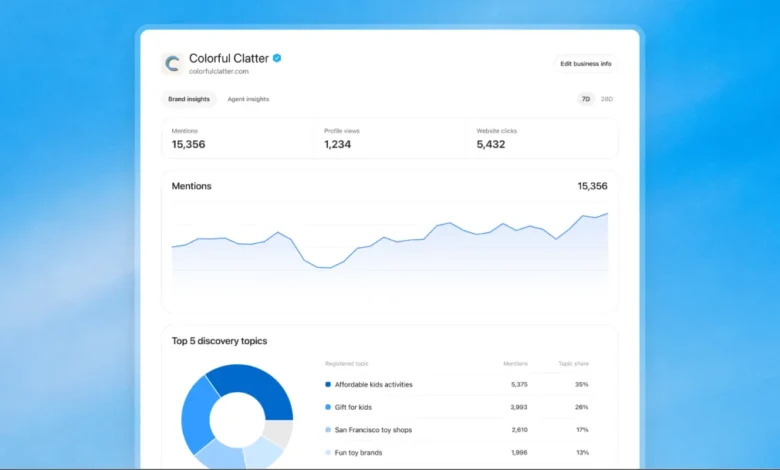
In a strategic pivot aimed at redefining how users interact with brands, OpenAI has officially unveiled a new Business Hub, a suite of tools designed to formalize the presence of enterprises within the ChatGPT ecosystem. This launch, currently in its beta phase, marks a significant departure from the company’s previous, less successful attempts to position its flagship AI as a direct retail competitor to platforms like Amazon. By enabling companies to verify their identities, manage product information, and deploy specialized AI agents, OpenAI is positioning ChatGPT as a discovery layer—a move that places the artificial intelligence firm in direct competition with traditional search engines like Google.
The Business Hub serves as a centralized control panel for organizations, mirroring the functionality of the Google Business Profile service. Enterprises can now curate official information regarding their products and services, ensuring that when a user asks a query about a brand, the AI retrieves verified, up-to-date data rather than relying on potentially outdated or hallucinations-prone training sets.
A Strategic Evolution in Consumer Discovery
The shift toward becoming a discovery engine represents an acknowledgment by OpenAI that its users are increasingly utilizing the platform not just for creative writing or code generation, but for high-intent research. According to recent market analysis, over 40% of internet users now begin their product research on AI-driven platforms, moving away from traditional link-heavy search engine result pages.
"As people turn to AI to discover products, compare options, and make decisions, ChatGPT has become the platform for people and businesses to connect through AI," the company stated in a press release on Tuesday. "Today’s announcement is an early step in bringing businesses more deeply into ChatGPT."
The integration of specialized business agents is perhaps the most ambitious aspect of this rollout. These agents are designed to act as digital concierges, capable of answering nuanced questions about a company’s catalog, store hours, or service policies. By providing a structured way for brands to feed their proprietary data into an AI agent, OpenAI is essentially democratizing the creation of customer service bots, removing the technical barriers that have historically kept small and medium-sized enterprises from adopting advanced conversational AI.
Navigating the Lessons of the Past
To understand the weight of this announcement, one must look at the timeline of OpenAI’s commercial experiments. In early 2025, the company aggressively pursued a strategy to turn ChatGPT into a shopping mall. This included the development of a "checkout cart" feature, which allowed users to purchase products directly within the interface, with OpenAI collecting a commission on every transaction.
The strategy was ambitious, aimed at capturing a slice of the multi-trillion-dollar e-commerce market. However, the project encountered significant friction. Consumer trust in AI-facilitated transactions remained low, and logistical challenges—such as inventory management, shipping, and returns—proved far more complex than the company’s initial software-centric approach anticipated. By March 2026, OpenAI officially shuttered the e-commerce experiment, acknowledging that the infrastructure was not ready to support direct retail.
The current Business Hub represents a more measured, infrastructure-first approach. Rather than trying to be the merchant of record, OpenAI is choosing to be the mediator of information. This aligns more closely with the business model of search engines, which derive value by connecting users with the information they need to complete transactions elsewhere.

Analytics and the Data-Driven Future
A crucial component of the new Business Hub is the introduction of limited business insights, a feature that echoes the utility of Google Analytics. In an era where third-party cookies are increasingly deprecated, businesses are desperate for first-party data that reveals how customers are actually interacting with their brands.
OpenAI’s new dashboard provides metrics such as profile views, business mentions, and click-through rates to external websites. This data is invaluable for marketing teams seeking to quantify the return on investment for their presence on the platform. While the company has kept these metrics relatively lean, the potential for expansion is clear. If businesses can prove that their presence on ChatGPT is driving measurable conversions—even if those conversions ultimately happen on the brand’s own website—the platform will quickly become an indispensable advertising channel.
The Verification Process and Security Concerns
As with any platform that allows companies to define their own identities, the potential for bad actors to impersonate legitimate brands is a significant concern. OpenAI has promised a rigorous verification process to maintain the integrity of the platform, though details remain sparse.
Benji Shomair, OpenAI’s VP of Monetization, addressed these concerns during a press briefing. "There are multiple verification methods that we use for different types of businesses in different markets," Shomair explained. While the specifics of these methods—which likely include business registration checks, domain authentication, and perhaps third-party identity verification—remain undisclosed, the intent is clear: to ensure that when a user interacts with a "verified" business agent, they are receiving information from an authentic source.
The Competitive Landscape: Challenging the Search Hegemony
The broader implication of this launch is the escalation of the conflict between AI providers and search giants. For decades, Google has maintained a near-monopoly on the "discovery" phase of the consumer journey. By providing a high-quality, verified, and interactive interface for brand discovery, OpenAI is threatening to siphon off a portion of the traffic that would otherwise go to Google.
Industry analysts note that if ChatGPT becomes the primary interface for product research, the traditional SEO (Search Engine Optimization) industry will need to undergo a radical transformation. Organizations will no longer just be optimizing for keyword density or backlink profiles; they will be optimizing for "AI-readiness," ensuring their product data is structured correctly for OpenAI’s models to ingest and accurately represent.
Future Implications and Scalability
The success of the Business Hub will likely depend on adoption rates among small-to-medium businesses (SMBs). If the onboarding process is seamless and the traffic driven to their sites is high-quality, the Hub could quickly become the standard for digital business presence. However, if the interface remains clunky or if businesses feel that OpenAI is extracting too much value without providing adequate reach, they may remain hesitant to invest time in the platform.
Moreover, the ethical implications of AI-driven commerce must be addressed. As OpenAI begins to favor businesses that use its tools, questions regarding "algorithmic bias" in product recommendations will likely emerge. Will the platform prioritize verified partners in its responses? How will it handle competing claims between brands? These are questions that regulators in the U.S. and the EU are already watching closely.
As the beta progresses, the tech community will be observing closely to see if this pivot to a "discovery engine" model provides the sustainable revenue stream that OpenAI needs to support its massive compute costs. By providing businesses with a professional, controlled environment to showcase their offerings, OpenAI is not just building a new feature—it is attempting to rewrite the rules of the digital marketplace. Whether this approach will prove more resilient than its previous e-commerce endeavors remains the central question for the company as it enters the next chapter of its commercial evolution.