Major Third-Party Security Breach Compromises 178 High-Traffic Websites via Optimizely Supply Chain Attack

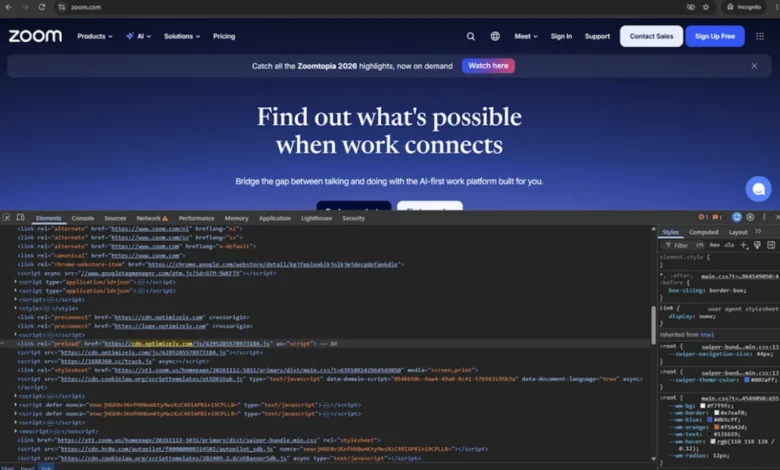
In a stark reminder of the fragile nature of modern web infrastructure, at least 178 high-profile web destinations were compromised over a 24-hour period beginning November 16, 2026. The incident, which originated from a security vulnerability within the platform of Optimizely—a leading provider of A/B testing and digital experience software—enabled attackers to silently inject malicious JavaScript into some of the most visited sites on the internet. Among the affected entities were major media outlets such as the BBC and CNN, as well as critical service providers like Equifax, Ledger, and Zoom. This supply chain attack underscores the systemic risks inherent in the contemporary web’s reliance on third-party scripts, which often operate with unrestricted privileges on user devices.
The Anatomy of the Breach
The breach was first identified and documented by the security research firm Report URI. According to their findings, attackers leveraged a vulnerability in Optimizely’s experimentation framework to inject malicious payloads directly into the JavaScript files that Optimizely delivers to its clients’ websites. Because Optimizely’s code is designed to execute as soon as a page loads—often appearing at the very top of the document object model (DOM) to ensure A/B testing accuracy—the malicious payload was executed automatically the moment a user landed on an affected page.
Scott Helme, a researcher at Report URI, reported that the malicious payload was not static; it was rebuilt or rotated at least 26 times throughout the day. This dynamic behavior suggests a highly sophisticated operation aimed at evading signature-based detection. The multi-purpose malware kit deployed through this vector was capable of exfiltrating sensitive data, including browser cookies, payment card information, and screenshots. Furthermore, the malware was programmed to intercept cryptocurrency transactions by silently swapping legitimate wallet addresses with those controlled by the attackers, a technique known as "cryptojacking" or "address replacement."
In addition to broad data theft, the attackers deployed custom exploit kits, identified by security researchers as "DarkSword" and "Coruna." These kits are designed to target vulnerabilities in older versions of Apple’s iOS and iPadOS. By chaining together multiple zero-click exploits, these tools could theoretically seize complete control over outdated mobile devices without requiring any interaction from the user, effectively turning a simple visit to a news site into a full-scale device compromise.
A Chronology of the Incident
The window of exposure began on November 16, 2026, when the unauthorized injection first occurred. Throughout that day, the Optimizely platform became a conduit for malicious activity.
- November 16: The vulnerability was exploited. Malicious JavaScript files were served to 178 distinct organizational domains. Report URI observed the payload rotating throughout the day to avoid detection.
- November 17: Following internal investigation and external reports, Optimizely began the remediation process.
- November 18: Optimizely released a formal security incident report, confirming the scope of the event and detailing the defensive measures taken.
The rapid nature of the attack highlights the "snowball effect" of supply chain compromises. A single breach at a service provider, which acts as a foundational dependency for hundreds of other websites, creates a multiplicative effect that is difficult for downstream victims to detect or block in real-time.
Data-Driven Analysis of the Vulnerability
The incident exposes a significant gap in the adoption of defensive web standards. The most effective tool for mitigating this type of attack is the Content Security Policy (CSP). A CSP allows website administrators to create an "allowlist" of trusted domains that are permitted to execute code or load resources. If a website had a strictly configured CSP, it would have rejected any attempt to load malicious scripts from unauthorized sources, even if the primary vendor (Optimizely) was compromised.
However, data from Report URI paints a concerning picture of web security hygiene. Of the 178 impacted websites:

- 68 websites had no CSP at all, leaving them entirely vulnerable to unauthorized third-party injections.
- 50 websites had a CSP that was configured so loosely that it allowed the malicious payload to bypass security controls.
- Only 24 websites (approximately 15 percent) possessed a sufficiently robust CSP to effectively block the attack.
This aligns with wider internet trends. According to analysis from crawler.ninja, which scans the top one million websites daily, only about 10 percent of the internet’s busiest sites currently employ effective CSPs. The prevalence of "permissive" CSPs is largely driven by the complexities of modern web development, where marketing and analytics teams frequently add new third-party tools that require rapid deployment, often at the expense of rigorous security oversight.
Official Response and Remediation
Optimizely addressed the incident in a series of statements, confirming that an unauthorized party exploited a specific vulnerability within their "Web Experimentation" product. "We acted swiftly to contain the incident and have fully remediated the identified vulnerability," the company stated.
The remediation steps undertaken by Optimizely included:
- Path Blocking: Access to the vulnerable server path was immediately restricted.
- Code Sanitization: All malicious scripts injected into customer projects were purged.
- Access Revocation: All active sessions were terminated, and authentication tokens were revoked, forcing a global password and security reset for affected user accounts.
- Enhanced Infrastructure Security: Additional protections were implemented via Cloudflare to prevent the delivery of unauthorized code in the future.
While the company has stated that the incident is resolved, they have engaged third-party cybersecurity experts to conduct a comprehensive forensic investigation to determine the full extent of the data access.
The Broader Implications for Web Security
The Optimizely breach serves as a case study for the risks of "third-party dependency" in the modern web ecosystem. Zach Edwards, a researcher at Infoblox and co-founder of the ad-tracking service DecryptAds, emphasizes that the issue is exacerbated by the way businesses prioritize user data collection.
"To make the product work as expected, this code is set up to fire immediately on-page load, and not restrict rendering behind a consent dialog box," Edwards explained. "This means that this supply chain attack didn’t require any clicking or consent to trigger—most of the impacted clients would immediately serve up the payload as soon as someone loaded the page."
The reliance on JavaScript as the primary engine for interactivity has created an environment where the browser is no longer a sandbox, but a sprawling, interconnected network of third-party code. When a vendor like Optimizely—which is often integrated into the very heart of a website’s functionality—is compromised, the trust boundary between the website operator and the end-user is shattered.
Security experts suggest that the "Wild West" era of web scripts must come to an end. As Scott Helme noted, "Organizations are running all this code, but they don’t know what it’s doing." The rise of AI-assisted malware generation further complicates this, as attackers can now produce sophisticated, evasive code in seconds, significantly lowering the barrier to entry for large-scale supply chain attacks.
For the average internet user, the incident provides a practical warning about the value of defensive tools. While traditional antivirus software remains a staple of personal computing, the modern threat landscape has shifted toward the browser. Ad-blockers and script-blocking extensions, such as NoScript, have effectively become the "new firewall," capable of preventing malicious payloads from executing by simply refusing to load unverified scripts. However, the onus remains on the enterprise level to implement structural defenses like CSPs, which represent the only scalable solution to the ongoing crisis of trust in the third-party JavaScript supply chain.